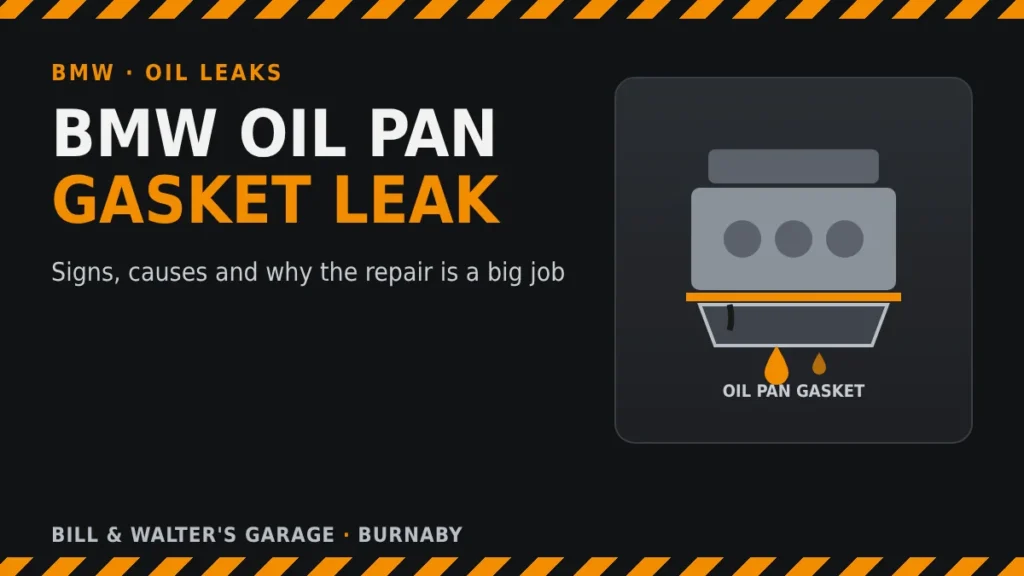
A BMW oil pan gasket leak usually shows up as a slow, oily film along the bottom seam of the engine, drips on the undertray or the garage floor, and a gradual drop on the oil level reading. The leak itself is rarely an emergency, but the repair often is a big job, because on many BMWs the front axle carrier (subframe) has to be lowered just to get the pan off. The first step is making sure the oil really comes from the pan and not from a gasket higher up.
Quick answer
- Most common sign: oil wetting the bottom seam of the engine where the pan meets the block, often found only when the undertray comes off.
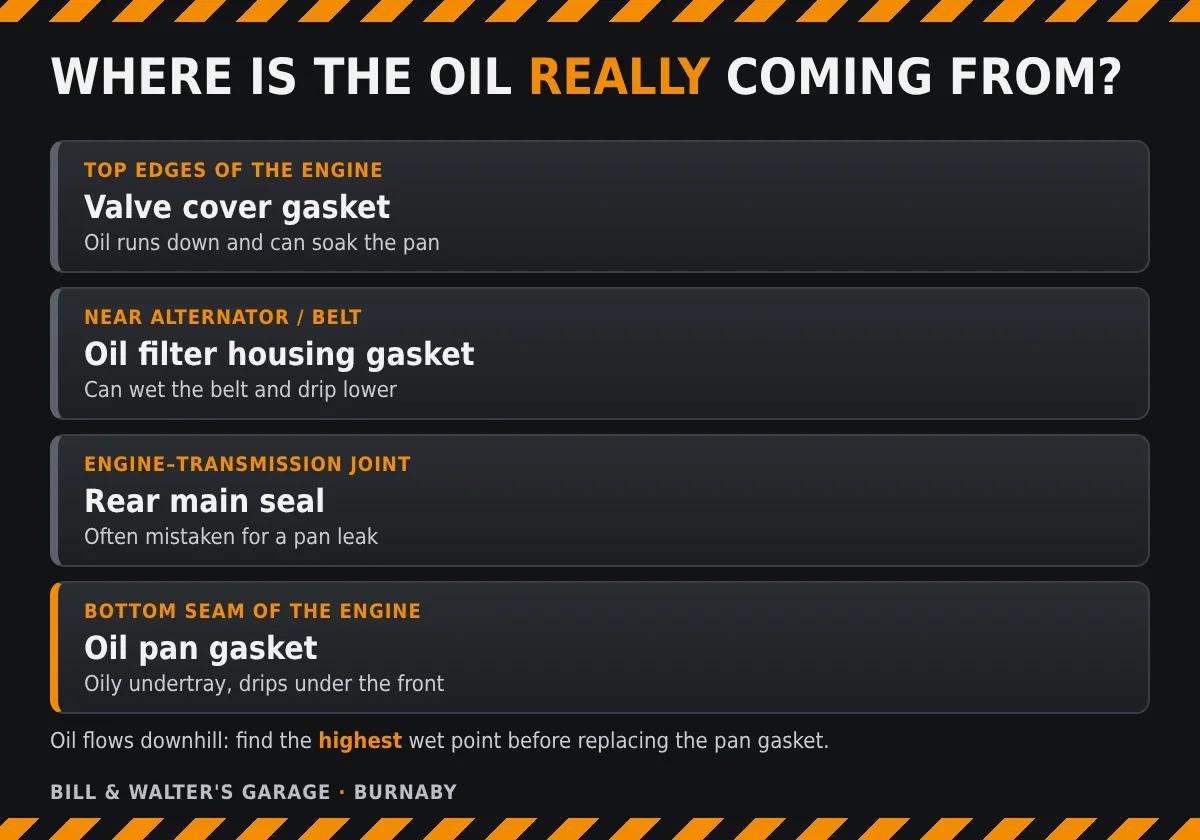
- Check higher first: oil runs downhill, so a leaking valve cover or oil filter housing gasket can soak the pan and look like a pan leak.
- Why it costs more than it looks: on many models the front subframe or axle carrier must be lowered, and BMW’s procedure calls for new aluminum pan bolts every time.
- When to act fast: oil dripping on the exhaust (burning smell or smoke), a falling oil level, or an oil warning on the dash.
- Good news: a slow seep can often be monitored for a while, as long as the oil level is kept full and nothing is dripping on hot parts.
BMW oil pan gasket leak symptoms
The oil pan (sump) bolts to the bottom of the engine block. The gasket between them seals the engine’s oil supply, so when it starts to fail the signs are usually low and slow:
- Oil on the bottom seam of the engine. BMW Insights, writing about the N20 four-cylinder, notes that oil along the lower seam points toward the oil pan gasket.
- An oily undertray or subframe. The same source says these leaks are easy to miss until the plastic underbody shield is removed, because the oil collects there first.
- Spots on the driveway. Small, dark brown or black drops under the front half of the car, usually toward the centre.
- Oil level dropping between changes. If the car is not burning oil, a falling level on the electronic oil reading suggests it is leaving somewhere. (If there is no sign of a leak, our article on oil consumption in BMW-built MINI engines explains the other possibility.)
- Burning-oil smell or light smoke after a drive. This happens when oil reaches the exhaust; BMW Insights lists it as a sign that oil is getting onto hot parts.
Some owners see none of these. On one 5series.net thread, an E60 530xi owner saw no spots on the floor and a normal oil level, yet the shop found the pan gasket leaking during a service. That is common: a seep can wet the pan for a long time before it ever drips.
Common causes, ranked
1. Leaks from higher up that only look like a pan leak
This is the first thing a good technician rules out. BMW Insights points out that oil runs downward, so the wet spot is not always the source. On the N20, wetness near the alternator or serpentine belt often points to the oil filter housing gasket, and oil at the top edges of the engine to the valve cover gasket. Both can drain down the block and coat the pan. The usual method is to clean the engine, drive it, and look again; when the source is still unclear, UV dye added to the oil makes the leak glow under a UV lamp.
2. The oil pan gasket itself
Gaskets harden with years of heat cycles. BMW Insights describes the pan gasket as a slower but very common leak source on higher-mileage N20 engines, and owners of six-cylinder cars such as the N52 325i describe the same thing on forums like Bimmerpost and 5series.net. Age and mileage matter more than any single model year.
3. The rear main seal
The rear main seal sits where the crankshaft exits the back of the engine. On a g42.bimmerpost.com thread, one experienced owner warned that a rear main seal leak is commonly confused with an oil pan gasket leak, and suggested checking the bellhousing area to tell them apart. Oil at the joint between engine and transmission points to the rear main seal rather than the pan.
4. Oil pan bolts, sensor and drain plug
On many BMW engines the pan bolts are aluminum. Parts suppliers describe them as stretch bolts, and BMW’s repair procedure says they must be replaced every time they are released. The drain plug washer and the oil level sensor seal on the bottom of the pan can also seep and should be checked before blaming the gasket.
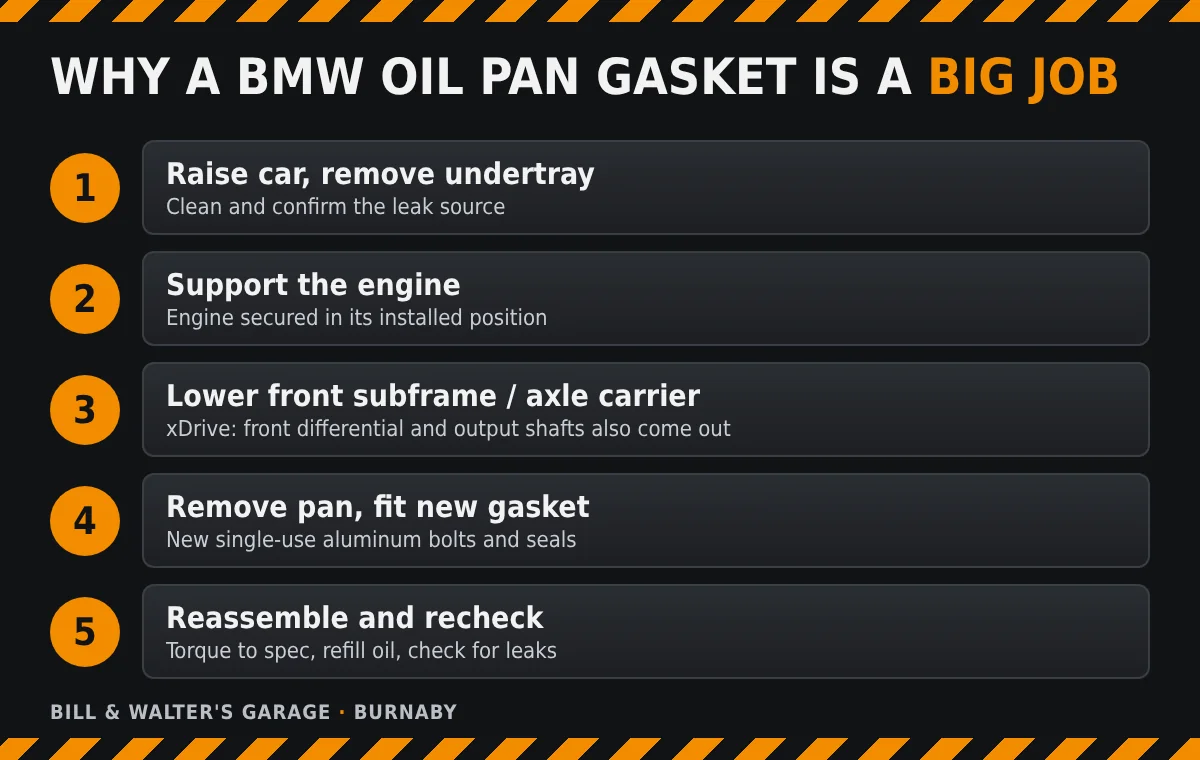
Why the oil pan gasket is a big job on a BMW
On an older car with a simple engine, a pan gasket might be a short job. On many modern BMWs it is not, because the pan sits above the front axle carrier and the parts attached to it.
- AWD models (xDrive / xi): A published BMW procedure for the E90 335xi with the N54 engine lists lowering the front axle, removing both front output shafts and the front differential, and moving the power steering pump aside before the pan can come out. The engine has to be supported in position while this is done.
- Rear-wheel-drive 3 Series: A detailed DIY thread on E90Post for an E90 describes supporting the engine, removing the engine mount nuts and dropping the front subframe before the pan bolts can be removed.
- One-time bolts: BMW’s procedure states that aluminum bolts must be replaced every time they are loosened. Parts sellers such as BimmerWorld sell one-time-use aluminum stretch bolts for the N51, N52 and N54 oil pan, and note that the crankcase and pan screws on the N54 and N55 are single use.
- All seals replaced: The same procedure says to replace all seals on reassembly, and on automatic-transmission cars the transmission cooler lines on the pan also have to be released.
Because the job involves lowering suspension and drivetrain parts, a proper repair finishes with a check that everything is torqued correctly. Since so much labour goes into reaching the pan, it also makes sense to deal with any other leak found while the car is apart.
What BMW owners report
Owner forums are full of oil pan threads, and a few patterns come up again and again:
- On Bimmerpost, a 2006 325i (N52) owner who had already replaced the valve cover, oil filter housing and Valvetronic gaskets still had a leak low on the engine and asked whether the pan was worth doing. Another member summed up older BMWs this way: “pretty much every seam in the engine is guaranteed to leak.”
- On 5series.net, an E60 530xi owner was told by a shop that the pan gasket was leaking even though there were no spots on the floor. Replies were split: some owners said a slow seep with a steady oil level can be watched, and one 535xi (N54) owner said their independent shop recommended doing the valve cover at the same time.
- In the E90Post subframe-drop DIY, the author stresses that the pan bolts are single use and should never be reused, and other posters describe finding oil-soaked pans and broken oil level sensor studs once the pan came down.
The common thread: owners who confirmed the source first, and fixed nearby leaks during the same job, were the happiest with the result.
What happens if you ignore it
A light seep with a stable oil level is not an emergency. Problems start when the leak grows or spreads:
- Fire and smoke risk: oil reaching the exhaust can produce smoke and a burning smell. Hot exhaust and dripping oil are never a good combination.
- Rubber damage: BMW Insights notes that oil on rubber mounts and the serpentine belt can degrade them and shorten belt life.
- Low oil level: if the level drops far enough, the engine is starved of lubrication.
- Bigger bill later: a leak left for years tends to spread to other parts, and a car that also needs a valve cover or filter housing gasket will cost more if those jobs are done separately.
We are not quoting prices here because every car is different. Ask for a written estimate that lists exactly which gaskets and bolts are included.
What you can check yourself vs. what needs a shop
Safe checks you can do at home:
- Check the oil level on the iDrive or dashboard display regularly and note how fast it drops.
- Place a piece of cardboard under the front of the car overnight and look at where any drops land.
- Look for a burning smell after a drive, especially when the car is parked.
- Note any oil warning on the dash and stop driving if the red oil pressure warning appears.
Leave the rest to a shop. Diagnosing the source usually means raising the car, removing the undertray, cleaning the engine and sometimes using UV dye. Do not crawl under a car supported only by a jack, and do not loosen subframe or engine mount bolts at home without proper support equipment.
Lower Mainland driving and oil leaks
Our wet winters mean an oily undertray can hide under road grime, so a leak often goes unnoticed until a service. Burnaby and New Westminster hills and stop-and-go traffic on Highway 1 also keep engines heat-cycling, which ages rubber gaskets. If your BMW sits outside, a quick look at the parking spot after a dry night is the easiest way to catch a drip early.
How Bill & Walter’s diagnoses a BMW oil leak
Bill & Walter’s Garage has been family-owned since 1956 and specialises in European vehicles, including BMW repair in Burnaby. Every visit starts with a safety inspection. For an oil leak, our technicians raise the car, remove the undertray, and trace the oil to its highest wet point before recommending any work, so you are not paying for a pan gasket when the real problem is a valve cover or filter housing gasket. If the pan is the culprit, we use new single-use bolts and seals as the procedure requires and tell you about any other leaks we find while the car is apart.
As an independent shop, we have no franchise or manufacturer sales pressure. You get a clear explanation and the choice of whether to fix it now or monitor it. A free courtesy car is available while your vehicle is in the shop, and regular customers in the Brentwood area can use our free pickup and delivery. If you are also seeing oil consumption or a warning light that needs diagnosis, mention it when you book.
Call (604) 298-3031 or book online. We are at 4406 Dawson St, Burnaby, open Monday to Friday 7:00 AM–5:30 PM and Saturday 7:30 AM–4:00 PM. Looking at a used BMW? Our pre-purchase inspection includes a look underneath for leaks like this one.
Frequently asked questions
How do I know if my BMW oil pan gasket is leaking?
Look for oil along the bottom seam where the pan meets the engine block, an oily undertray, or drops under the front of the car. Because oil runs downhill, a shop should confirm the source by cleaning the area and checking higher gaskets first.
Can I drive my BMW with an oil pan gasket leak?
A slow seep with a stable oil level can usually be monitored for a while. Get it checked soon if the oil level drops, you see drips on the ground, or you smell burning oil, because oil on the exhaust and a low oil level are both risks.
Why is BMW oil pan gasket replacement so expensive?
On many BMWs the front subframe or axle carrier must be lowered to reach the pan, and on xDrive models BMW’s procedure also involves removing the front differential and output shafts. The aluminum pan bolts are single use and must be replaced.
Is it an oil pan leak or a rear main seal leak?
Oil at the joint between the engine and transmission (the bellhousing area) usually points to the rear main seal. Oil along the length of the pan seam points to the pan gasket. A clean-and-recheck or UV dye test confirms it.
Can I reuse BMW oil pan bolts?
No. BMW’s procedure states that aluminum bolts must be replaced every time they are loosened, and parts suppliers sell them as one-time-use stretch bolts.
Should I fix other leaks at the same time?
Often yes. If the valve cover or oil filter housing gasket is also leaking, fixing it in the same visit means the pan stays clean and you can tell whether the repair worked.
Sources
- BMW Insights: BMW N20 Oil Leak Spots
- BMW E90 335xi (N54) oil pan service and repair procedure
- BimmerWorld: Oil pan bolt kit (N51/N52/N54)
- BimmerWorld: Genuine BMW aluminum screw set (N54/N55)
- E90Post: DIY E90 oil pan gasket and subframe drop
- Bimmerpost: Oil leaks, worth it to fix?
- 5series.net: Oil pan gasket is leaking oil
Oil leaks can have more than one cause, and oil often runs from a higher gasket down to the pan. This article is general information; a hands-on inspection is the only way to confirm the source on your car.