If your car battery dies overnight when the weather turns cold and wet, there are usually two things going on at once: the cold has cut how much power the battery can deliver in the morning, and something is either draining it while the car sits or not recharging it fully while you drive. An ageing battery, short trips, a parasitic draw from a module or accessory, or water getting into the electrical system are the usual suspects. A proper battery and charging test, followed by a draw test, finds which one it is.
Quick answer
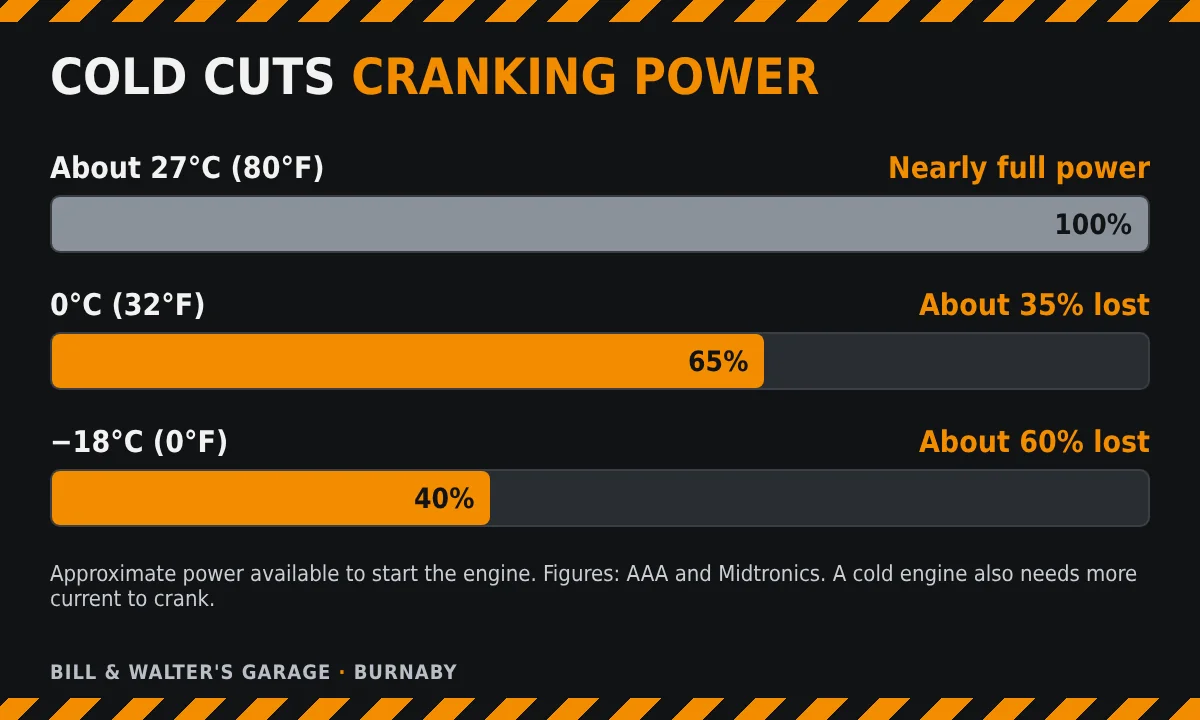
- Cold does not drain a battery by itself, but it reduces how much power the battery can give. AAA says a battery loses about 35% of its cranking power at 0°C.
- Age matters: CAA puts typical battery life at three to five years. AAA suggests testing from year three and every year after that.
- Short trips do not give the alternator time to recharge what the starter used.
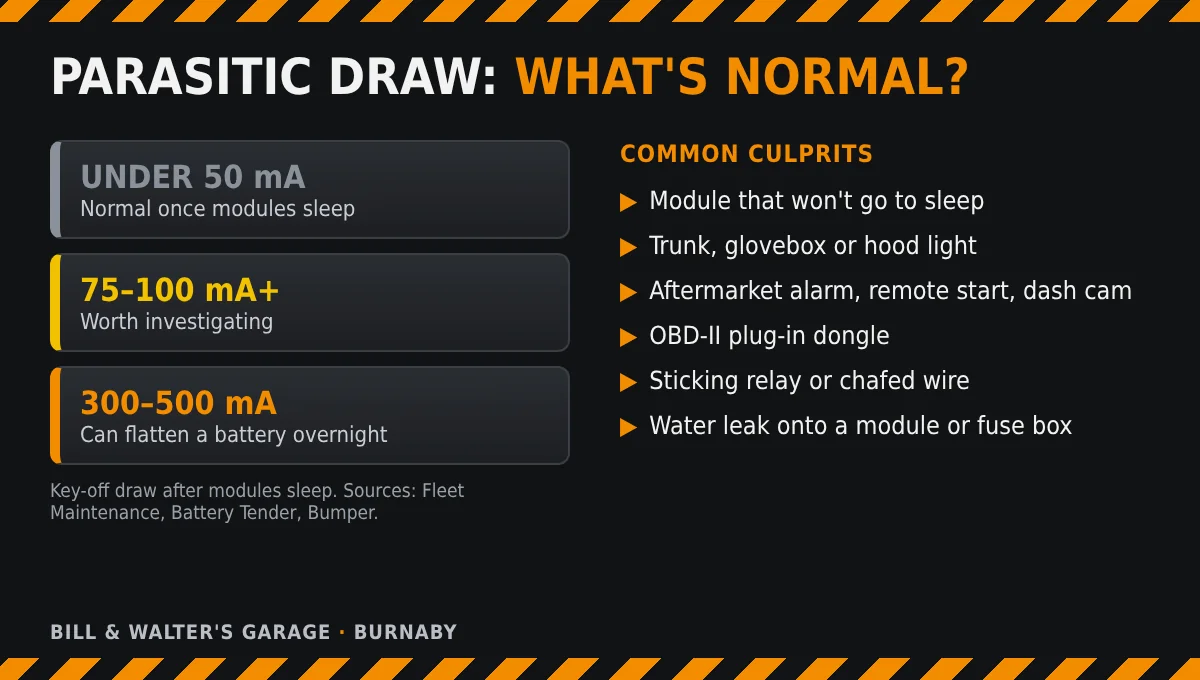
- Parasitic draw: once the car’s modules go to sleep, the draw should be under about 50 milliamps. Several hundred milliamps can flatten a battery overnight.
- Wet weather clue: if the battery dies after heavy rain, look for water leaking onto a module or into a fuse box.
Symptoms: what you notice before the battery dies
A battery rarely fails without warning. CAA South Central Ontario lists four signs that a battery may need replacing:
- The engine cranks slowly, especially on cold mornings.
- Grinding, clicking or buzzing when you turn the key or press start.
- The vehicle has stalled or failed to start before.
- Headlights dim at idle but brighten when you rev the engine.
CAA Niagara adds a few more: dim or yellowish headlights, a battery warning light, electrical accessories acting up, a swollen or cracked battery case, a rotten-egg (sulphur) smell, and a battery that is more than three years old. If the car starts fine after a drive but is dead after sitting for a day or two, that pattern points toward a parasitic draw rather than a simple weak battery.
Why does my car battery die overnight? Common causes, ranked
1. An old or weak battery meeting cold temperatures
Battery tester maker Midtronics explains that cold weather does not drain a battery overnight on its own. Instead, it slows the chemical reactions inside and raises internal resistance, so the battery can supply less current. AAA’s figures, given to reporters by AAA Mid-Atlantic, are that a battery loses about 35% of its cranking power at 0°C and about 60% at −18°C. At the same time, CAA Niagara notes that a cold engine needs roughly twice the current to start. A battery that was borderline in September may simply not have enough left in November.
2. Short trips and a battery that never fully recharges
CAA Niagara points out that quick trips prevent the battery from fully charging and shorten its life. In winter you are also running the heater fan, rear defroster, heated seats, wipers and headlights, all of which use power the alternator would otherwise put back into the battery. A car that only does short hops around Burnaby can slowly run its battery down over several weeks.
3. A parasitic draw: something stays awake after you lock the car
Every modern car draws a small current with the key off to keep the clock, radio presets and security system alive. Gerald Tabas of Power Probe, writing in Fleet Maintenance magazine, says the draw should be under 50 milliamps once the modules have gone to sleep, and that the car should sit 30 minutes to an hour before measuring. Bumper.ca adds that 300–500 mA is enough to drain a battery overnight. Common culprits they list include:
- A control module that does not go to sleep (body control, infotainment or telematics).
- A trunk, glovebox or under-hood light that stays on, often because of a faulty switch. Battery Tender notes interior lights typically draw one to three amps.
- Aftermarket accessories wired to constant power: alarms, remote starters, dash cams, amplifiers or OBD-II plug-in devices.
- A relay that sticks on, or a chafed wire.
- Phone chargers or other devices left plugged into a 12-volt socket that stays live.
- Less commonly, a leaking diode inside the alternator.
4. Water leaks into electrical parts (the wet-weather cause)
This one is easy to miss. Several owners describe batteries dying, or electrical faults appearing, only after heavy rain. In the cases we found, water from a windshield, sunroof, light seal or cowl leak dripped onto a module under the dashboard or in the trunk, which then stayed awake or shorted and drained the battery. Wet carpets, a musty smell or fogged windows are clues.
5. Corroded terminals or a charging system fault
Corrosion on the battery terminals adds resistance, so less charge gets in and less power gets out. CAA Niagara lists terminal corrosion as a common battery problem. A weak alternator can also leave the battery undercharged, especially with winter electrical loads.
What owners report
- On Vancouver-area forum REVscene, a 2010 Lancer owner whose battery died after two days, but only in freezing weather, measured a significant draw with the car off and traced it to an aftermarket horn relay that kept clicking. Disabling the horn stopped the drain.
- A BC owner on Ford-Trucks.com found the batteries in his F350 dead after a hard rain, with the heater fan running with the key off. The cause was a windshield leak dripping onto the main electronic module under the dash.
- On the Audi Owners Club forum, an A6 owner’s battery kept draining overnight after a footwell leak soaked a comfort control module and corroded its plugs. The owner noted the drain began once the water damage got bad.
- On an Early Retirement forum thread, one poster found an OBD-II dongle drawing 45 mA. On its own that is small, but combined with cold mornings it was enough to stop the van starting. Unplugging it solved the problem.
- Not every case is easy. A 2000 Jetta owner on Straight Dope had a car that was completely dead after a weekend, yet a shop kept it for over a week and could not find the fault. Intermittent draws are some of the hardest problems to trace.
What happens if you ignore it
- Getting stranded on a cold, dark morning, or in a parking lot after work.
- A shorter battery life: CAA Niagara notes that a battery that is never fully recharged wears out sooner.
- Freezing risk: Midtronics notes a fully charged battery will not freeze until about −60°C, but a discharged one can freeze at around −7°C.
- Hidden water damage: if a leak is the cause, it will keep corroding connectors and modules until it is fixed.
What you can check yourself vs. what needs a shop
Simple checks you can do safely:
- Note the battery’s age from your service records or receipt.
- Look at the terminals for white or green crust and check that the clamps are tight (do this with the engine off).
- Make sure the trunk, glovebox and interior lights go out, and that nothing is left plugged into a 12-volt socket.
- Unplug aftermarket devices such as OBD-II dongles and dash cams overnight and see whether the problem stops.
- After heavy rain, check for wet carpets, water in the spare-tire well, or a damp smell.
Leave the rest to a shop. A parasitic draw test involves connecting a meter in series with the battery and waiting for the modules to sleep, then pulling fuses one at a time to find the circuit responsible. On many European cars, a new battery also needs to be registered with the car’s computer, as our Audi and VW battery drain article explains.
The Lower Mainland angle: wet more than cold
Burnaby rarely sees the −18°C mornings that make batteries fail across the Prairies, but AAA’s figure of about 35% lost cranking power at 0°C means a frosty morning is still enough to expose a weak battery. Our bigger problem is moisture. Months of rain test every windshield seal, sunroof drain and door membrane, and a slow leak onto a module or fuse box can create a drain that only appears in wet weather. Short trips in stop-and-go traffic, with the defroster, wipers and lights all on, add to the strain. CAA Niagara recommends having the battery tested at least twice a year; before the rainy season is a good time for one of those tests.
How Bill & Walter’s diagnoses a battery that keeps dying
Bill & Walter’s Garage has looked after Burnaby drivers since 1956. Every visit starts with a safety inspection, and for a battery problem we test the battery, the starter and the charging system first. If those pass, we perform a parasitic draw test after letting the modules sleep, then isolate the circuit responsible. When the problem only appears in wet weather, we look for the water path too, because replacing a battery will not fix a leak.
We specialise in European vehicles (BMW, Mercedes-Benz, Audi, VW), where battery registration and module sleep behaviour need the right tools, and we service all other makes too. If the battery is the problem, our battery replacement service covers testing and installation, and our diagnose and test service handles the harder-to-find electrical drains. As an independent shop, there is no franchise or manufacturer sales pressure. A free courtesy car is available while your car is with us, and regular customers in the Brentwood area get free pickup and delivery.
Call (604) 298-3031 or book online. We are at 4406 Dawson St, Burnaby, open Monday to Friday 7:00 AM–5:30 PM and Saturday 7:30 AM–4:00 PM. Getting the car ready for winter? Ask about a safety check at the same visit.
Frequently asked questions
Why does my car battery die overnight in cold weather?
Cold reduces how much power a battery can deliver, so a weak or partly discharged battery that coped in summer may not crank the engine on a cold morning. If it dies after sitting even when the battery is fairly new, a parasitic draw is the next thing to test.
How much parasitic draw is normal?
Once the car’s modules have gone to sleep, a draw under about 50 milliamps is generally considered normal. Several hundred milliamps can flatten a battery overnight.
Can rain cause my car battery to die?
Rain does not drain a battery directly, but water leaking onto a control module, fuse box or connector can keep a circuit awake or cause a short that drains it. If the problem follows heavy rain, look for a water leak.
How long should a car battery last?
CAA puts typical battery life at three to five years. AAA suggests having it tested at three years old and every year after that.
Will driving the car recharge a dead battery?
A longer drive helps, but short trips with the heater, lights and defroster on may not fully recharge it. A battery that has been run completely flat should be tested before you rely on it again.
Do I need to register a new battery on my car?
Many European cars, including BMW, Audi and VW models, need a new battery registered with the car’s computer so the charging system treats it correctly. Your shop can do this when the battery is installed.
Sources
- WTOP: Extreme cold takes a toll on cars (AAA Mid-Atlantic)
- Midtronics: Does cold drain batteries overnight?
- CAA Niagara: Will your car battery survive winter?
- CAA Niagara: How to make your car battery last longer
- CAA South Central Ontario: Four warning signs to replace your car battery
- Fleet Maintenance: Vehicle won’t start after sitting
- Bumper: Parasitic battery drain
- Battery Tender: Parasitic battery drain
- REVscene: Parasitic battery drain
- Ford-Trucks.com: Dead batteries
- Audi Owners Club: Footwell leak and battery drain
- Early Retirement forum: Car battery in cold weather
- Straight Dope: Identifying parasitic drain
A battery that keeps dying can have more than one cause, and several can happen at once. This article is general information; a hands-on battery, charging and draw test is the only way to confirm the cause on your car.