MINI Cooper carbon build-up happens when deposits collect on the back of the intake valves in the N14 turbo engine, reducing airflow and causing misfires and rough running. MINI’s own service bulletin links it to short trips, low engine loads and poor fuel quality, and the factory fix is to diagnose first, then clean the valves with walnut-shell blasting only if the carbon is bad enough.
Key takeaways
- MINI bulletin SI M12 02 10 covers Cooper S models (R55, R56, R57, and later R58 and R59) with the N14 engine that misfire or run rough.
- The bulletin lists several possible causes. Carbon on the intake valves is one. Clogged injector tips, ignition parts and mechanical faults are others.
- Higher-mileage cars driven mostly in stop-and-go city traffic are the ones the bulletin says are most likely to build heavy carbon.
- The factory repair grades the carbon first. Heavy deposits get walnut-shell blasting. Lighter deposits get an in-rail injection cleaning.
- A misfire on a MINI is not automatically carbon. Coils, plugs and other faults have to be ruled out first.
Which MINIs get carbon build-up?
The problem is tied to the N14, the 1.6 L turbocharged direct-injection engine in the second-generation Cooper S. MINI service bulletin SI M12 02 10, “Cooper S with N14: Diagnosis for Misfire Faults”, first covered the R55 (Clubman), R56 (hatch) and R57 (convertible). Later revisions from December 2012 and September 2013 added the R58 (Coupe) and R59 (Roadster) with the same engine.
UK MINI specialist Lohen describes the N14 as the engine in the 2007–2010 Cooper S and in John Cooper Works models up to 2012. If you aren’t sure which engine your MINI has, the engine code is on the vehicle’s build data, and any shop can confirm it from the VIN.
Symptoms of MINI Cooper carbon build-up
According to the bulletin, the driver usually notices one or both of these:
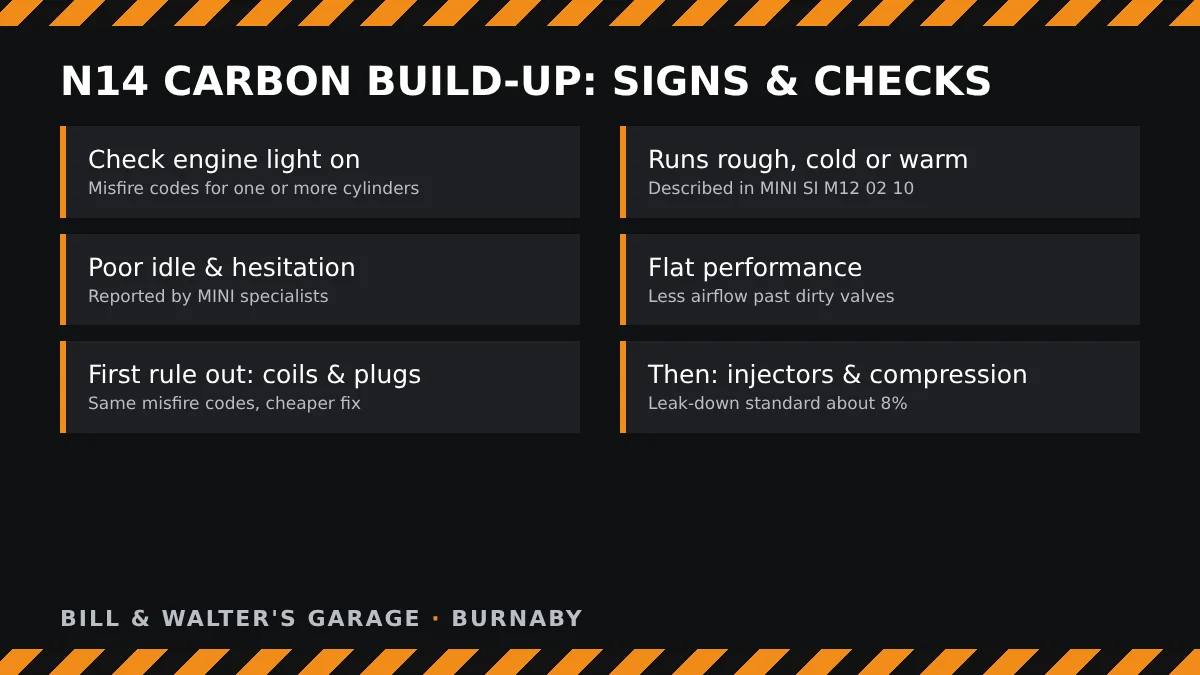
- Check engine light on, with misfire fault codes stored for one or more cylinders (MINI’s own codes 2771–277F, sometimes with the multiple-cylinder codes 2781–2783).
- The engine runs rough, either cold or warm.
- Less often, misfire codes are stored even though the check engine light is off.
Specialists add symptoms that drivers describe in their own words. Lohen lists poor idle, weak acceleration and a drop in performance. A Canadian BMW shop writing about walnut blasting also mentions hesitation. It adds that a rough idle or misfire alone doesn’t prove the valves need cleaning, and that’s the most important point in this article.
What causes it: ranked from most to least common
1. Short trips and low engine loads
MINI’s bulletin names “poor fuel quality in combination with unfavorable driving behavior (low loads and short driving distances)” as a cause of misfires on the N14. That kind of use can clog the injector tips or leave “excessive carbon deposits on the intake valves/ports”, which restricts airflow into the cylinders. The 2012 and 2013 revisions add that higher-mileage cars, usually above 35,000 miles (about 56,000 km), driven mostly in city stop-and-go conditions may build excessive carbon on the intake valves.
2. Direct injection itself
Older port-injected engines spray fuel at the back of the intake valves, which helps keep them clean. A direct-injection engine sprays fuel straight into the cylinder instead. AustralianCar.Reviews says this is why the N14 is prone to carbon on the back of the intake valves. Lohen also points to hot, oil-laden vapour from the crankcase ventilation system mixing with the intake air. MINI’s bulletin doesn’t name either mechanism directly, but it does have technicians check crankcase pressure and the turbocharger oil feed pipe during diagnosis.
3. Other faults that look like carbon
The bulletin is clear that misfires on the N14 have “multiple causes related to electrical and mechanical engine components”. Ignition coils, worn spark plugs, clogged injectors and low compression can all cause the same misfire codes. The bulletin also tells technicians to check timing chain stretch when a related camshaft fault code is stored, so a rough-running N14 can have more than one thing going on.
What owners report
Owner stories show why diagnosis comes first. In a Classic Motorsports forum thread, an R56 Cooper S owner with misfires on three cylinders had the intake removed and cleaned, and the misfire stayed. Swapping coils showed “the code followed the coil”, and a new coil fixed that misfire. Later problems in the same car turned out to be a loose intake connector and a sensor fault. In the same thread, another member says the 2007 Cooper S he traded in had severe carbon deposits by the time he let it go.
Automotive YouTuber Eric the Car Guy documented cleaning the valves on his own 2007 MINI Cooper S. With the intake manifold off, he found the valves “caked up with performance robbing carbon deposits”, and cleaned them with a walnut blaster and picks. Between them, the two stories cover both sides: heavy carbon is real on these engines, but it isn’t the answer to every misfire.
How the factory repair works
Under SI M12 02 10, a MINI technician follows a test plan rather than going straight to cleaning. In outline:
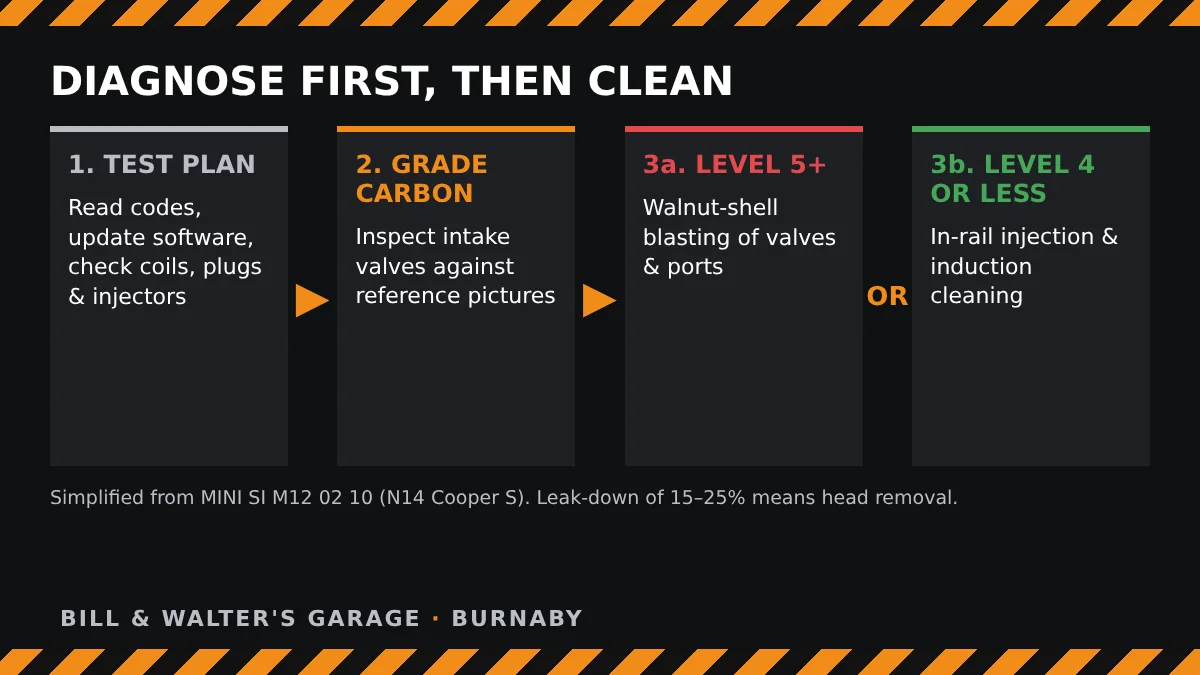
- Run the misfire test plan and check engine software, updating it if it’s below a specified level.
- Inspect the intake valves and compare the deposits with reference pictures that grade the carbon by level.
- Heavy carbon (level 5 or worse): clean the intake valves and ports with the BMW Group Carbon Blaster, which blasts crushed walnut shells. MINI’s tool bulletin SI M04 03 11 specifies 0.45–0.80 mm walnut shells, which are soft enough not to damage the metal.
- Lighter carbon (level 4 or less): do an in-rail injection cleaning with a fuel injection and induction cleaner instead.
- Check compression and leak-down. The bulletin gives a leak-down standard of about 8%. A result of 15–25% means the cylinder head has to come off and the valves lapped, which is a much bigger job.
For prevention, the bulletin recommends a bottle of MINI’s fuel system cleaner every 3,000 miles (about 4,800 km) at refuelling. It also suggests dealers offer a yearly in-rail cleaning, at the owner’s cost, for N14 cars that don’t yet have symptoms.
What happens if you ignore it
Carbon doesn’t go away on its own. As deposits grow, airflow drops, misfires get more frequent and the engine feels flat. In the worst case the bulletin describes, carbon and poor sealing lead to high leak-down figures and a cylinder-head removal instead of a cleaning. A rough-running engine that stumbles when you pull into traffic is also a safety concern, not just a nuisance.
What you can check yourself vs. what needs a shop
Safe for owners:
- Note when the roughness happens: cold start, warm idle, or under load.
- Note whether the check engine light is steady or flashing, and tell the shop. Either way, book a diagnosis rather than waiting it out.
- Keep your oil topped up and changed on time. N14 engines are also known for oil use (see our article on MINI Cooper oil consumption).
- Mix in some longer highway drives if most of your driving is short hops.
Leave to a shop: reading MINI-specific fault codes, coil and injector tests, compression and leak-down testing, and the intake removal and walnut blasting itself. As Foreign Automotive explains, the job involves getting access to the ports, isolating the area being cleaned and removing all the blasting media afterwards, which takes the right tools and care.
Why Lower Mainland driving matters
The bulletin’s risk factors read like a description of driving around Burnaby and Vancouver: short trips, low loads and lots of stop-and-go. A MINI that mostly runs errands along Hastings or crawls through rush hour on Highway 1 rarely gets the long, steady drives that help keep an engine healthy. Cold, damp mornings in our long rainy season add more cold starts too. None of this means your MINI will need cleaning, but it’s worth knowing if your car fits the pattern.
How Bill & Walter’s diagnoses a rough-running MINI
Every visit to Bill & Walter’s starts with a safety inspection. We’re a family-owned independent shop in Burnaby, here since 1956, and European cars are our specialty. For a MINI that misfires, our diagnose & test service checks the simple things first: fault codes, coils, spark plugs and injectors. Then we look at the intake valves only if the evidence points there. You get a clear explanation of what we found before any work begins, with no franchise or manufacturer sales pressure.
Learn more about our MINI repair in Burnaby, call (604) 298-3031, or book online. We’re at 4406 Dawson St, open Monday to Friday 7:00 AM–5:30 PM and Saturday 7:30 AM–4:00 PM, and a free courtesy car is available while your MINI is with us.
FAQ
What causes carbon build-up in a MINI Cooper?
MINI bulletin SI M12 02 10 links it to poor fuel quality combined with low engine loads and short trips. On the direct-injection N14 engine, fuel doesn’t wash over the intake valves, so deposits can build up there, especially on higher-mileage cars driven mostly in stop-and-go traffic.
Which MINI engines are affected?
The bulletin covers the N14 engine in R55, R56, R57, R58 and R59 Cooper S models. Specialists describe the N14 as the engine in the 2007–2010 Cooper S and in John Cooper Works models up to 2012.
What are the symptoms of carbon build-up on a MINI?
A check engine light with misfire codes, and the engine running rough cold or warm. Owners and specialists also mention poor idle, hesitation and a loss of performance.
How is MINI carbon build-up fixed?
The factory procedure grades the carbon first. Heavy deposits are cleaned off the intake valves and ports with walnut-shell blasting, and lighter deposits get an in-rail injection cleaning. Coils, plugs and injectors are checked first because they cause the same misfire codes.
Can a fuel additive prevent carbon build-up?
MINI’s bulletin recommends its fuel system cleaner every 3,000 miles (about 4,800 km) and suggests a yearly in-rail cleaning for N14 cars without symptoms. Additives can’t remove heavy carbon that’s already on the valves.
Is every MINI misfire caused by carbon?
No. The bulletin lists multiple electrical and mechanical causes, and owners have chased carbon only to find a failed ignition coil. Proper diagnosis comes first.
Sources
- MINI SI M12 02 10, Cooper S with N14: Diagnosis for Misfire Faults (June 2011), via NHTSA
- MINI SI M12 02 10 (July 2011 revision), via NHTSA
- MINI SI M12 02 10 (December 2012 revision), via NHTSA
- MINI SI M12 02 10 (September 2013 revision), via NHTSA
- MINI SI M04 03 11, BMW Group Carbon Blaster
- Lohen, De-coke servicing for Gen 2 R56 MINI
- AustralianCar.Reviews, MINI R58 Coupe recalls and faults
- Foreign Automotive, BMW walnut blasting explained
- Classic Motorsports forum, R56 MINI mystery CEL
- Eric the Car Guy, Direct Injection Intake Valve Cleaning
Disclaimer: misfires and rough running can have more than one cause. This article is general information, and a hands-on inspection is the only way to confirm a diagnosis on your vehicle.