Car maintenance in Burnaby should account for more than mileage alone. Frequent rain, damp conditions, short urban trips, hills, potholes, and stop-and-go traffic can place additional stress on brakes, tires, batteries, suspension components, fluids, and electrical connections.
Following the maintenance schedule in your owner’s manual remains the starting point. However, drivers who make mostly short trips, spend long periods in traffic, carry heavy loads, or frequently drive on steep and uneven roads may need inspections sooner than drivers operating under lighter conditions.
This guide explains how Burnaby driving affects your vehicle, which maintenance items deserve attention, and when to schedule service at a local auto repair shop.
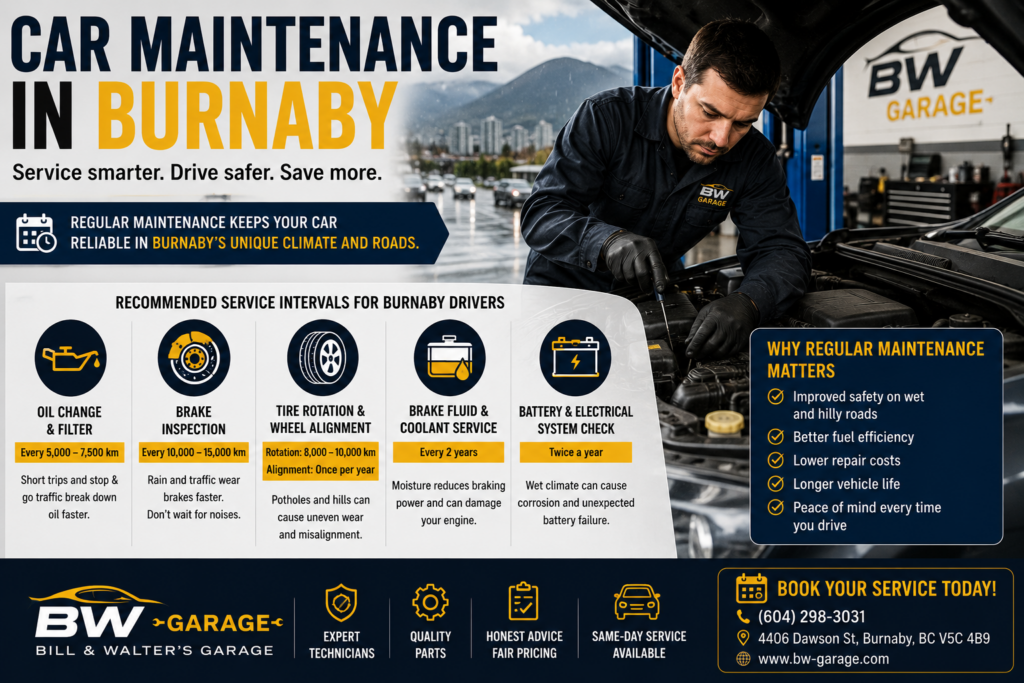
How Burnaby Driving Conditions Affect Your Car
Burnaby generally experiences wet winters, substantial rainfall, changing temperatures, dense traffic, and varied elevation. These conditions do not automatically damage a properly maintained vehicle, but they can reveal existing weaknesses and accelerate certain types of wear.
Rain, Moisture, and Corrosion
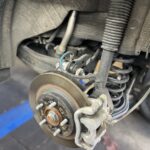
Moisture can contribute to surface rust on brake rotors, corrosion around electrical connections, and deterioration of exposed suspension and exhaust components.
A small amount of rotor surface rust after the vehicle has been parked in wet weather is common and may clear after several normal stops. Persistent grinding, vibration, uneven braking, or visible corrosion requires inspection.
Stop-and-Go Traffic
Repeated acceleration and braking generate more heat and friction than steady highway driving. Drivers commuting through busy areas such as Metrotown, Brentwood, Lougheed, and major Burnaby corridors may experience faster brake wear than drivers who primarily travel long highway distances.
Hills and Steep Roads
Frequent downhill braking can increase brake temperature and accelerate wear, especially when drivers ride the brake pedal continuously.
Steep roads also place additional demand on the engine, transmission, cooling system, tires, and suspension.
Short Urban Trips
Repeated short trips may prevent the engine, oil, exhaust system, and battery from reaching ideal operating conditions.
This can contribute to:
- Moisture remaining in the engine and exhaust system
- Faster battery discharge
- Increased cold-start wear
- Oil contamination
- Reduced fuel efficiency
Potholes and Uneven Roads
Impacts from potholes and curbs can damage tires, bend wheels, disturb alignment angles, and accelerate suspension wear.
If the vehicle starts pulling, the steering wheel sits off-centre, or the tires begin wearing unevenly, schedule a professional wheel alignment inspection.
Recommended Car Maintenance Schedule for Burnaby Drivers
The intervals below are general inspection guidelines—not replacements for the manufacturer’s schedule. Your vehicle’s age, mileage, engine, oil specification, warranty requirements, and driving pattern may require different intervals.
Engine Oil and Filter
Follow the oil-change interval shown in your owner’s manual or vehicle maintenance system.
Many modern vehicles allow longer intervals under normal operating conditions, while frequent short trips, extended idling, towing, severe traffic, or repeated cold starts may justify earlier service.
During an oil change, technicians should also inspect:
- Fluid levels
- Visible leaks
- Belts and hoses
- Tires
- Battery condition
- Brake condition
- Dashboard warnings
Bill & Walter’s Garage provides oil and filter service and allows customers to combine an oil change with tire rotation or brake checks.
Learn more about oil-change and filter services in Burnaby.
Brake Inspection
Have the brakes inspected during regular maintenance and immediately when symptoms appear.
Burnaby traffic, hills, and wet conditions can make early brake inspection particularly valuable. Watch for:
- Squeaking or grinding
- Vibration during braking
- A soft or spongy pedal
- Pulling while stopping
- A brake or ABS warning light
- A burning smell
- Longer stopping distances
British Columbia regulations require vehicles operated on public roads to have effective brakes, adequately maintained brake linings, and properly secured brake hoses and tubing.
Read more about brake repair and inspection in Burnaby.
Tire Rotation and Tire Inspection
Use the tire manufacturer’s and vehicle manufacturer’s recommendations as the primary interval.
A practical approach is to inspect the tires during each routine service and rotate them when recommended—often around the same time as an oil change, depending on the vehicle and tire type.
Check for:
- Uneven tread wear
- Low pressure
- Sidewall cracking or bulges
- Embedded objects
- Vibration
- Abnormal road noise
- Reduced wet-weather traction
Uneven wear may indicate incorrect pressure, delayed rotation, damaged suspension, or poor wheel alignment.
Wheel Alignment
Wheel alignment does not always need to be performed on a fixed annual schedule. It should be checked when there is evidence of a problem or after an event likely to disturb alignment.
Book an alignment inspection if:
- The car pulls left or right
- The steering wheel is off-centre
- Tire wear is uneven
- The vehicle has hit a significant pothole or curb
- Suspension or steering repairs were completed
- New tires are being installed
- Handling feels unstable
A proper alignment can improve steering stability and help prevent premature tire wear.
Battery and Charging System
Battery condition should be checked before winter and whenever starting performance changes.
Watch for:
- Slow cranking
- Clicking during startup
- Dim lights
- Repeated jump-starts
- Electrical resets
- Corroded terminals
- A battery or charging-system warning light
Short trips can be particularly difficult for a weakening battery because the charging system may not have enough time to restore the energy used during startup.
A proper assessment should test the battery, alternator, starter, cables, and charging voltage rather than replacing the battery based on symptoms alone.
Brake Fluid
Brake-fluid replacement should follow the manufacturer’s interval and the actual condition of the fluid.
Brake fluid is hygroscopic, meaning it absorbs moisture over time. Excess moisture can reduce boiling performance and contribute to internal corrosion.
The technician should evaluate:
- Fluid level
- Colour and contamination
- Moisture content when testing is available
- Signs of leakage
- Manufacturer replacement interval
Avoid stating that every vehicle requires a brake-fluid flush exactly every two years. Some manufacturers specify a time interval, while others recommend inspection and replacement based on condition or model-specific schedules.
Coolant
Coolant should also be serviced according to the manufacturer’s specifications.
Different vehicles use different coolant chemistries and replacement intervals. Mixing incompatible coolant types or using a generic interval can create problems.
Have the cooling system inspected for:
- Correct coolant level
- Visible leaks
- Hose deterioration
- Radiator condition
- Water-pump leakage
- Cooling-fan operation
- Correct freeze protection
- Signs of overheating
Belts and Hoses
Inspect belts and hoses during routine maintenance and before long trips.
Warning signs include:
- Cracks
- Glazing
- Fraying
- Swelling
- Coolant residue
- Squealing
- Soft or brittle hoses
- Visible leaks
A failed belt or cooling hose can cause charging problems, loss of power steering on some vehicles, overheating, or a roadside breakdown.
Review BW Garage’s belts and hoses services.
Suspension and Steering
Burnaby’s hills, potholes, curbs, and uneven roads can expose worn suspension and steering components.
Schedule an inspection if you notice:
- Clunking over bumps
- Excessive bouncing
- Loose steering
- Uneven tire wear
- Poor cornering stability
- Vehicle pulling
- Fluid leaking from shocks or struts
Suspension problems can affect tire life, steering control, alignment, and braking stability.
Exhaust System
Moisture, short trips, road salt, and age can contribute to exhaust corrosion.
Watch for:
- Louder exhaust noise
- Rattling
- Exhaust smell inside the cabin
- Reduced fuel economy
- Visible rust or holes
- A check-engine light
- Unusual vibration
An exhaust leak can create a safety risk, especially when fumes enter the passenger compartment.
Vehicle Diagnostics
Dashboard warning lights should be diagnosed rather than ignored or cleared without testing.
Modern diagnostic work may include:
- Scanning diagnostic trouble codes
- Reviewing live data
- Testing batteries and charging systems
- Inspecting sensors and wiring
- Performing road tests
- Confirming whether a component has actually failed
Bill & Walter’s Garage provides diagnostic testing using modern equipment for check-engine lights, electrical faults, and other vehicle problems.
Learn more about vehicle diagnostics in Burnaby.
Warning Signs Your Car Needs Service Sooner
Do not wait for the next scheduled maintenance interval if you notice:
- Grinding, squeaking, or clunking
- Steering pull
- A soft brake pedal
- A burning smell
- Dashboard warning lights
- Fluid leaks
- Longer stopping distances
- Steering or brake vibration
- Slow engine cranking
- Overheating
- Sudden fuel-economy changes
- Uneven tire wear
- Smoke or unusual exhaust smell
A maintenance schedule is only a baseline. New symptoms should be inspected promptly.
Why Local Auto Repair Experience Matters
A Burnaby repair shop regularly sees vehicles exposed to local rain, traffic, hills, short commutes, and road conditions.
That local experience can help technicians recognize patterns such as:
- Rotor rust and brake wear
- Alignment damage after pothole impacts
- Corroded electrical terminals
- Moisture-related exhaust wear
- Battery problems caused by short trips
- Tire wear from urban driving
- Suspension wear from rough roads
The shop should still follow manufacturer service information and diagnostic evidence rather than making assumptions based only on location.
Should You Always Choose OEM Parts?
OEM parts can offer predictable fit and manufacturer-level specifications, but they are not automatically the best choice for every repair.
Depending on the vehicle and component, a reputable OEM-quality or premium aftermarket part may provide suitable performance, warranty coverage, and value.
Ask the shop to explain:
- The brand and quality level
- Why the part is recommended
- Warranty differences
- Whether the part meets required specifications
- Whether a lower-cost alternative changes durability or performance
Avoid claiming that OEM parts always provide a longer lifespan. Part quality varies, and some high-quality aftermarket manufacturers supply components that meet or exceed original specifications.
Why Choose Bill & Walter’s Garage for Car Maintenance in Burnaby?
Bill & Walter’s Garage has served Burnaby since 1956 and provides routine maintenance, diagnostics, brakes, batteries, wheel alignment, suspension, oil changes, safety checks, and other repair services for domestic, import, and European vehicles.
The shop states that it offers:
- Certified technicians
- Modern diagnostic equipment
- High-quality parts
- Written estimates
- Routine and complex repairs
- Service for multiple vehicle makes
- Saturday opening hours
Current business information published on the main website is:
Bill & Walter’s Garage
4406 Dawson St, Burnaby, BC V5C 4B9
(604) 298-3031
Monday–Saturday: 8:00 AM–5:00 PM
Frequently Asked Questions
How often should I service my car in Burnaby?
Follow the manufacturer’s maintenance schedule and have the vehicle inspected sooner when you drive mainly in heavy traffic, make frequent short trips, travel on hills, or notice warning signs.
Should I change my oil every 5,000 kilometres?
Not necessarily. The correct interval depends on the vehicle, oil specification, engine design, maintenance monitor, and operating conditions. Follow the owner’s manual unless a qualified technician recommends a shorter interval for documented severe use.
How often should brakes be inspected?
Inspect the brakes during routine service, before long trips or winter driving, and immediately when noise, vibration, warning lights, pulling, burning smells, or pedal changes appear.
Does Burnaby rain damage brakes?
Rain can contribute to temporary rotor surface rust and corrosion over time, but normal rainfall should not make a properly maintained brake system unsafe. Persistent noise, vibration, or poor stopping performance requires inspection.
How often should wheel alignment be checked?
Check alignment when the vehicle pulls, tires wear unevenly, the steering wheel is off-centre, suspension work is performed, or the vehicle hits a significant pothole or curb.
Should the battery be checked before winter?
Yes. Cold weather can expose a weak battery, and short urban trips may not fully recharge it. A battery and charging-system test can reduce the risk of a no-start condition.
Is a local mechanic better than a dealership?
The best choice depends on technical capability, experience, equipment, parts access, warranty, pricing, and communication. A qualified independent garage can handle many routine and complex repairs, while some manufacturer-specific programming or warranty work may require a dealership.
Book Car Maintenance in Burnaby
Regular maintenance helps protect your vehicle, reduce unexpected breakdowns, and identify developing problems before they become expensive.
Bill & Walter’s Garage provides oil changes, brake inspections, wheel alignment, battery testing, suspension work, vehicle diagnostics, and general automotive maintenance.
Contact Bill & Walter’s Garage to request an appointment.