If your parking brake is not working, the cause is usually a stretched, corroded or frozen cable on a lever-type brake, or a motor, sensor or module fault on an electronic parking brake (EPB). The warning signs are a brake light or EPB message that won’t go out, a brake that won’t release or drags, or a car that creeps when parked on a slope. Because a parking brake that won’t hold or won’t let go is a safety problem, it’s worth getting checked quickly.
Key takeaways
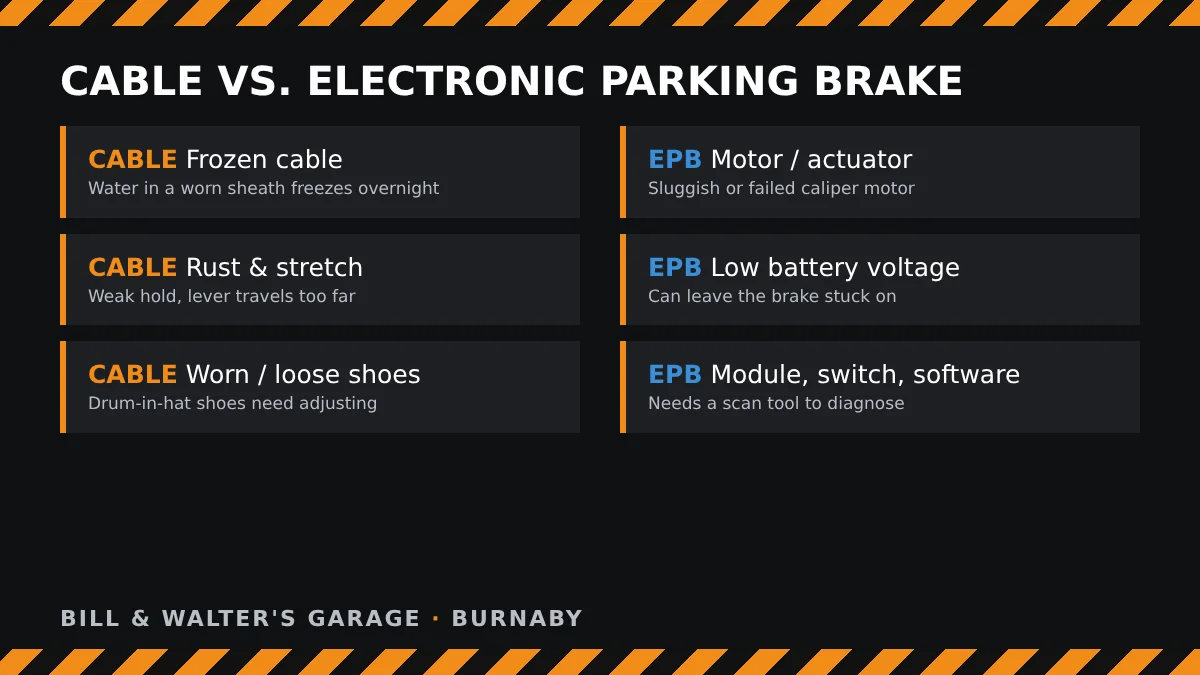
- There are two main types: cable (lever or pedal) parking brakes and electronic parking brakes with small motors on the rear calipers.
- Cable systems usually fail from corrosion, stretching or water freezing inside the cable sheath. That makes our wet, near-freezing winters a common trigger.
- EPB faults include a sluggish or failed motor, a sticking caliper, low battery voltage, switch faults and missing data from other modules.
- Rear brake pad work on an EPB car needs a service (maintenance) mode. Getting it wrong can set fault codes and damage the unit.
- Several parking brake recalls have been issued in Canada, so it’s worth checking your VIN.
How your parking brake works
Cable parking brakes. A lever or foot pedal pulls a steel cable that runs back to the rear wheels. On many cars with rear disc brakes, the cable operates small brake shoes inside a drum built into the centre of the rear rotor, a “drum-in-hat” design that YourMechanic describes as a lever that expands the shoes against the drum. On others, the cable works a mechanism built into the rear caliper.
Electronic parking brakes (EPB). Most newer cars use a switch instead of a lever. According to Vehicle Service Pros, the common design has two switch-activated motors that apply and release the rear calipers, each driving the caliper piston through a screw mechanism. Most manufacturers control the EPB through the ABS module. Some older EPB systems used a single central motor that pulled ordinary cables. Tomorrow’s Technician notes that on Volkswagens the EPB module talks to the rest of the car over the CAN network, and many systems add an Auto Hold feature.
Symptoms of a parking brake not working properly
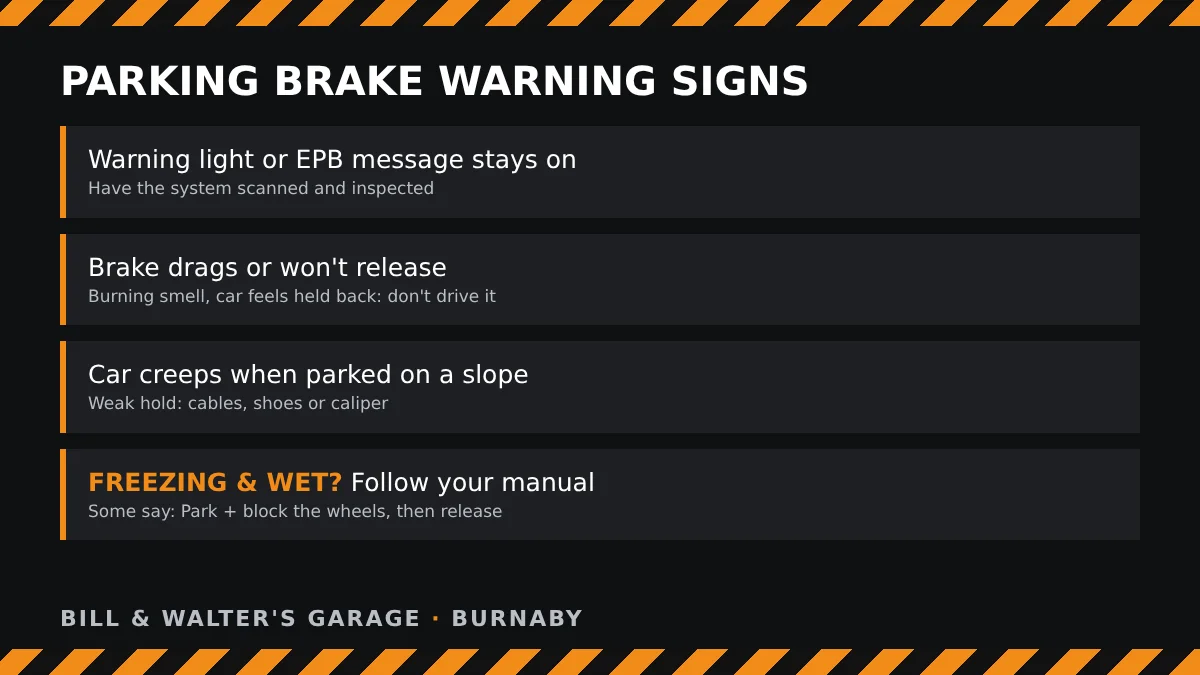
- Warning light or message stays on. Kia’s owner’s manual, for example, says the EPB warning light should go out about three seconds after you switch on. If it stays on, comes on while driving or doesn’t light at all, the EPB may be faulty.
- The brake won’t release, or feels sluggish and drags as you drive. You may notice a burning smell from the rear wheels or the car feeling held back.
- The brake won’t hold. The car creeps or rolls when parked on a slope.
- The lever travels too far. YourMechanic says a lever should stop firmly about halfway through its travel. One that comes up very high, or a pedal that goes to the floor, suggests stretched cables or worn, out-of-adjustment shoes.
- The brake won’t apply at all when you pull the lever or press the switch.
Note that some sounds are normal. Kia’s manual says a short click or motor sound when the EPB applies or releases is not a fault.
Common causes, ranked
1. Corroded or frozen cables
This is the classic problem on lever-type brakes. Phoenix Systems explains that when the end seals on a cable wear out, road spray gets inside the sheath, collects at low points and freezes. It adds that a cable that freezes is usually corroded along its length. Firestone lists freezing, rust and corrosion as leading reasons a parking brake gets stuck, along with pulling the lever too hard and leaving the brake applied during long storage.
2. Stretched cables or worn, out-of-adjustment shoes
Over time cables stretch and the small parking brake shoes wear. The result is a long lever travel and a weak hold. Adjustment matters in both directions: YourMechanic warns that shoes set too tight create heat, which can warp the drums and cause brake fade.
3. Seized rear caliper mechanism
Where the parking brake works through the rear caliper, a split rubber boot lets water in and the mechanism can rust and stick. Transport Canada recall 2017-312 covers exactly this on some 2014–2015 Mazda3 and Mazda6 and 2016–2017 Mazda3 models: a failed boot could let the parking brake shaft corrode and stick, reducing holding force so a parked car could roll, or causing the brakes to drag.
4. Electronic parking brake faults
Vehicle Service Pros lists a sluggish actuator motor, a sticking caliper, and ice, mud or debris reaching the motor as common EPB problems. A dead battery can leave an EPB stuck on, and a wrong gear-position signal can keep it applied. Tomorrow’s Technician adds missing speed, gear or brake-pedal data on the network, a failed O-ring letting water reach the motor gears, and faulty pedal, door or EPB switches. If your battery is weak, see our article on why a car battery dies overnight, because low voltage affects modules like the EPB.
5. Software faults covered by recalls
Transport Canada recall 2014-380 covers some 2013–2015 Cadillac XTS and 2014–2015 Chevrolet Impala models. The EPB might not fully release, so the rear brakes could drag and overheat, and the indicator might not light when the brake was on. The fix was a software update, and a follow-up recall, 2015-059, covered 2014 Impalas.
What owners report
- A Mazda owner on Mazdas247 found the rear brakes stayed on after parking, twice in wet weather as the temperature dropped below freezing, and suspected water freezing in the cable. The reply was simple: “get new P-brake cables.”
- A Nissan Maxima owner on Maxima.org had the left rear seize after a couple of hours parked in the cold, and again overnight. Another member blamed a cable damaged by lift pads, which let water in to rust and freeze.
- A Saab 9-5 owner on Saabnet had the main cable replaced but not the short cable to the lever, and the freezing came back with the first hard cold. It’s a reminder that every section of the cable needs checking.
- A 2016 Honda Civic owner on CivicX saw an “electric parking brake problem” message with brake warning lights on, and the car wouldn’t go into reverse. It usually cleared after a restart, which is typical of intermittent electronic faults that still need a proper scan.
What happens if you ignore it
A parking brake that doesn’t hold means the transmission’s park pawl (or your memory to leave it in gear) is all that stops the car from rolling on a hill. A brake that doesn’t fully release is just as serious. YourMechanic warns that dragging shoes can cause brake fade “and possibly even a fire”, and the GM recall above describes rear brakes overheating with heat, smoke and sparks. Driving on a dragging brake also wears out rear pads, shoes, rotors and drums much faster, turning a cable or adjustment job into a bigger brake repair.
What you can do yourself vs. what needs a shop
Safe owner steps:
- Follow your owner’s manual for an EPB warning. Kia’s manual says to press the switch, then pull it up, and repeat once. If the light stays on, have the system inspected. If the EPB won’t release at all, Kia recommends a flatbed tow truck.
- Don’t drive with the brake stuck on. Firestone advises calling roadside assistance or a tow if it won’t release.
- On freezing, wet nights, follow your manual. Kia’s and Hyundai’s manuals warn that the parking brake can freeze on when the brakes are wet or there’s snow and ice near the rear brakes. Their advice is to apply it only while you shift into Park, block the rear wheels, then release it.
- Test the hold on a gentle slope in a safe place, and notice how far the lever travels.
- Check for recalls using your VIN in Transport Canada’s recall database or with your dealer.
Leave to a shop: freeing seized cables, adjusting shoes, replacing cables, calipers or EPB motors, and any rear brake work on an EPB car. Vehicle Service Pros explains that replacing rear pads on these cars needs the EPB put into “service mode”, usually with a scan tool, and the parking brake only works again after the system correctly exits that mode. Tomorrow’s Technician warns that unapproved methods set fault codes and can damage the unit.
Why parking brakes struggle in the Lower Mainland
Our winters are the worst of both worlds for parking brake cables: months of rain and road spray to get water into the sheaths, and enough nights hovering around 0°C to freeze it there. Burnaby’s hills add another factor. Parking on a slope near Burnaby Mountain or in North Burnaby puts real weight on the parking brake, so a weak hold matters more here than on flat ground. A quick check during a fall brake inspection can catch a sticky cable or caliper before the first cold snap.
How Bill & Walter’s diagnoses parking brake problems
Every visit to Bill & Walter’s starts with a safety inspection, and brakes are at the top of that list. For a parking brake that isn’t working, we check the cables, shoes and rear caliper mechanisms for corrosion, wear and adjustment. On EPB cars we read the fault codes, check battery voltage and test the actuators with the right scan tools, using the proper service mode for any rear brake work. We explain what we find before any work starts, and our full brake jobs come with a 24-month / 40,000 km warranty. For more on keeping your brakes healthy, see our complete guide to brake maintenance.
We’re a family-owned independent shop at 4406 Dawson St in Burnaby, here since 1956. We specialise in European cars and service all makes. Call (604) 298-3031 or book online. We’re open Monday to Friday 7:00 AM–5:30 PM and Saturday 7:30 AM–4:00 PM, with a free courtesy car while your vehicle is with us.
FAQ
Why is my parking brake not working?
On lever or pedal brakes, the usual causes are stretched, corroded or frozen cables and worn or out-of-adjustment shoes. On electronic parking brakes, common causes are a failing motor, a sticking caliper, low battery voltage, switch faults or a module or software problem.
Can a parking brake freeze?
Yes. Water that gets inside a worn cable sheath can freeze and lock the brake on. Kia and Hyundai manuals warn the parking brake can freeze when the brakes are wet or there’s ice near the rear brakes, and suggest parking in Park with the wheels blocked instead when freezing is a risk.
Is it safe to drive with the parking brake warning light on?
Have it checked soon. The light can mean the brake is partly applied or the system has a fault. Driving with a dragging brake can overheat the rear brakes, and if the brake won’t release, manufacturers recommend a tow rather than driving.
Why does my electronic parking brake need a scan tool for brake pads?
The rear calipers have motors that hold the pistons. The EPB has to be put into service or maintenance mode to retract them safely, and correctly taken out of that mode afterwards. Doing it the wrong way can set fault codes and damage the unit.
Can a weak battery cause electronic parking brake problems?
Yes. The EPB relies on electrical power and network data. A dead battery can leave an EPB stuck on, and low voltage can trigger warning messages.
Are there recalls for parking brake problems?
Some. Transport Canada recalls have covered certain Cadillac XTS and Chevrolet Impala electronic parking brakes and some Mazda3 and Mazda6 rear calipers. Check your VIN in Transport Canada’s recall database or with your dealer.
Sources
- Vehicle Service Pros, Pushbutton parking: electronic parking brake operation and diagnosis
- Tomorrow’s Technician, VW electric parking brake service
- Firestone Complete Auto Care, Why parking brakes get stuck
- Phoenix Systems, How do I free a frozen parking brake cable?
- YourMechanic, How to adjust a parking brake shoe
- YourMechanic, Symptoms of a bad or failing parking brake release cable
- Kia owner’s manual, EPB malfunction
- Kia owner’s manual, winter driving and frozen parking brake
- Hyundai owner’s manual, parking brake
- Transport Canada Recall 2014-380, General Motors
- Transport Canada Recall 2015-059, General Motors
- Transport Canada Recall 2017-312, Mazda
- Mazdas247, Parking brake cable freezing up
- Maxima.org, Parking brake seized
- Saabnet, Parking brake cable frozen again
- CivicX, Electric parking brake problem
Disclaimer: parking brake symptoms can have more than one cause. This article is general information, and a hands-on inspection is the only way to confirm a diagnosis on your vehicle.