Audi battery drain usually means something keeps the car’s electronics awake after you lock it, or the battery can no longer hold enough charge to cover the normal small draw. Modern Audis and Volkswagens are full of control modules, so a single module that won’t go to sleep can flatten a healthy battery in a few days. The fix is to measure the draw, find the circuit and repair the cause, not just keep buying batteries.
Quick answer: key takeaways
- A parked Audi or VW still draws a little power. After it fully sleeps, PicoAuto suggests expecting no more than about 80 mA.
- It can take 30 minutes to 2 hours for a modern car to fully go to sleep, so a quick meter check right after locking can mislead.
- Common culprits: a module that won’t sleep, aftermarket accessories, a door or alarm fault, and a replacement battery that wasn’t coded or is the wrong type.
- Cold weather cuts battery strength (about 35% at 0 °C, according to BCAA), and short trips don’t recharge it.
- Some 2024–2025 ID.4 and Q4 e-tron models have a recall for a part that charges the 12-volt battery. Check your VIN.
Symptoms of battery drain in an Audi or VW
A parasitic drain rarely announces itself. Most owners notice one or more of these:
- The car starts fine after a short stop but is slow to crank, or completely dead, after sitting two or three days.
- A new battery helps for a while, then the problem returns.
- Odd warning lights or messages on start-up (start-stop unavailable, electrical faults, comfort features switched off) after the car has sat.
- Clicking, a dim dash, or locks and windows that respond slowly.
- The clock, radio presets or window auto-up settings reset.
Before blaming Audi battery drain, remember that those same symptoms can come from a worn-out battery or a charging fault, which is why measuring beats guessing. If you’re not sure whether it’s the battery, the alternator or the starter, our guide to why your car won’t start walks through the differences.
Why Audi battery drain is so common on modern European cars
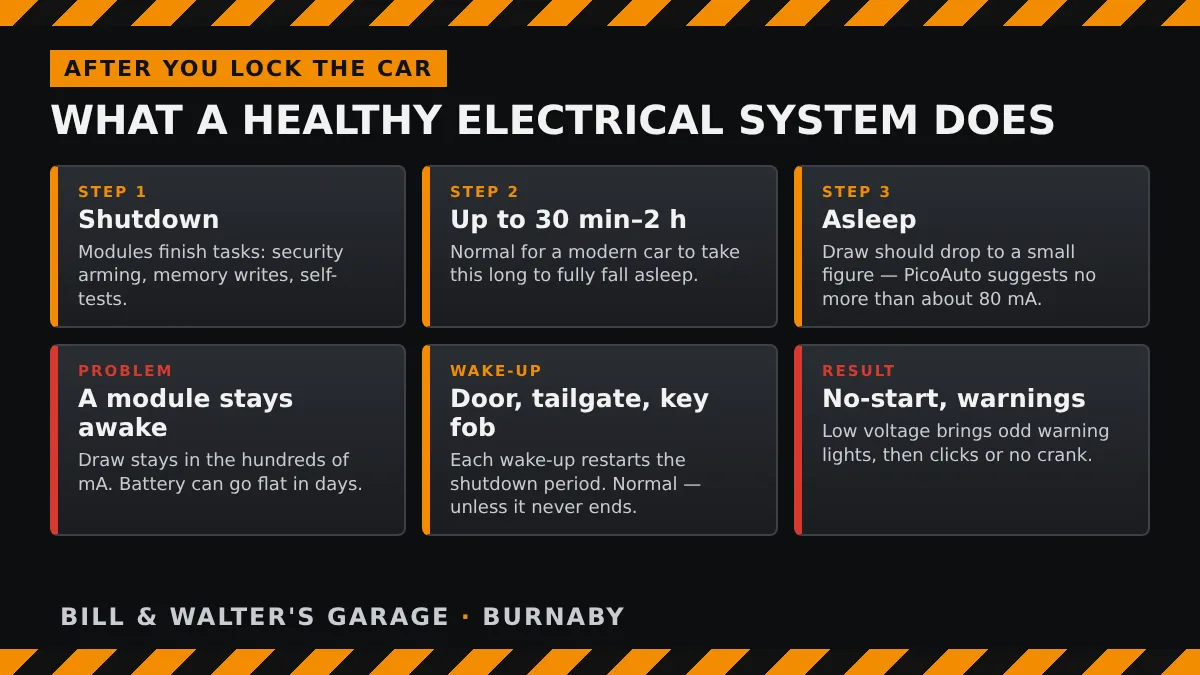
When you switch off and lock a modern Audi or Volkswagen, the electronics don’t simply turn off. PicoAuto, which makes diagnostic scopes, explains that modules first run through a shutdown routine. This includes monitoring, security arming, integrity tests and memory writes. It notes that 30 minutes to 2 hours is not unusual before a modern vehicle is fully asleep. Opening a door or the tailgate wakes the network and starts that timer again.
Even fully asleep, some systems keep sipping power. BCAA points out that the clock, radio memory and onboard computers draw from the battery with the car off. That small draw is normal. The trouble starts when one module never finishes shutting down, or keeps waking the others. Then the draw stays in the hundreds of milliamps instead of dropping to a few dozen. Midtronics, a battery-tester maker, says an abnormal drain above roughly 50 mA can flatten a battery overnight or over a few days.
Common causes of Audi battery drain, ranked
1. A control module that won’t go to sleep
This is the classic cause. An infotainment unit, instrument cluster, amplifier, TV tuner or other module keeps the network awake. PicoAuto documented a 2001 Audi A6 that still drew about 340 mA an hour after locking. The cause was traced to the instrument cluster circuit, and the owner had been replacing the battery roughly twice a year. On owner forums, the same pattern shows up on newer A3, S3, A4 and A8 models (see below).
2. Aftermarket accessories
Dash cams, phone or USB adapters, trackers, remote starters and add-on audio are frequent offenders. A trade tech tip on Volkswagen static-current diagnosis (published by Brake & Front End, from ALLDATA) recommends checking aftermarket add-ons such as tow-bar electrics, radios and DVD players first. Midtronics notes that accessory installation doesn’t always follow proper procedures.
3. A replacement battery that wasn’t coded, or is the wrong type
Audi and Volkswagen use battery energy management. Battery maker VARTA lists Audi and VW among the brands that need the new battery actively registered with a diagnostic tool. VARTA says that if this isn’t done correctly, start-stop can be restricted or fail, and fuel use and comfort functions can be affected. Ross-Tech, maker of the VCDS scan tool, says most modern VW-group vehicles need replacement batteries configured. The coding records the part number, maker and serial number, and changes if the battery technology changes (for example to AGM).
Type matters too. VARTA’s guidance is blunt: an AGM battery must go wherever an AGM was originally fitted. A conventional battery can’t meet the demands of a start-stop system, and the wrong battery means a considerably shorter service life. Battery maker Banner adds that start-stop may rarely or never work with the wrong battery, and features such as seat heating can be limited.
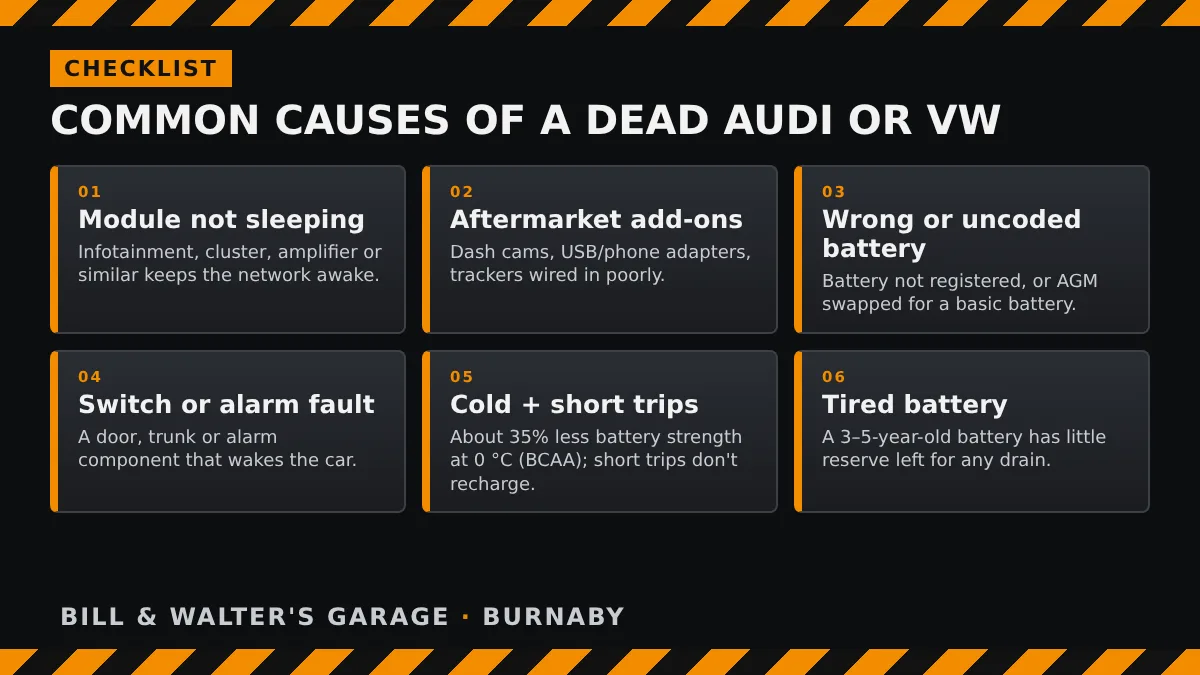
4. A switch, latch or alarm component
A door, trunk or glovebox switch that tells the car a door is open can keep systems awake. Midtronics specifically mentions a faulty door switch causing a constant drain. Alarm components can do the same: one A6 owner’s drain appeared to stop after a faulty alarm horn was replaced.
5. Cold weather and short trips
Cold doesn’t create a drain, but it removes the margin that hides one. BCAA says a battery loses about 35% of its strength at 0 °C. AAA puts it at about 60% at −18 °C. Midtronics notes that trips under about 20 minutes don’t let the alternator fully recharge the battery. BCAA advises driving every 3–4 days until the engine is warm, and says idling alone won’t do it.
6. An ageing battery
BCAA gives 3–5 years as typical battery life. An older battery may pass a quick voltage check but have little reserve left, so even a normal sleep draw pulls it too low. Our article on how long a car battery lasts covers this in more detail.
Recalls: ID.4 and Q4 e-tron 12-volt charging
Electric models have a 12-volt battery too. Transport Canada recall 2025100 covers certain 2024 Q4 e-tron, 2024 ID.4 and 2025 Q4 e-tron vehicles. Moisture can damage the onboard charger with an integrated DC/DC converter, so it may stop charging the 12-volt battery. The vehicle may then not start, or may lose drive power, usually after warning lights and messages. The remedy is a replacement unit (NHTSA campaign 25V-125 in the US). A separate US recall, 22V-956, covered about 1,042 early 2023 rear-wheel-drive ID.4s whose 12-volt battery cable could rub through. Check your VIN on Transport Canada’s recall site.
What owners report about Audi battery drain
Reddit couldn’t be loaded for this article, so these reports come from Audi owner forums. They’re paraphrased, and each links to the original thread.
- An Audi TT owner on AudiWorld measured 160–170 mA with an aftermarket iPod/USB adapter connected and about 40 mA without it. They concluded the adapter was “not allowing the radio to go to ‘sleep’.”
- A 2009 S3 owner on Audi Owners Club went through three batteries and an alternator. Pulling the navigation/phone fuse dropped the draw from about 300 mA to about 10 mA.
- A 2009 A3 Cabriolet owner on Audi Owners Club found a draw of about 760 mA with a new battery. Pulling the climate/OBD or cluster fuse dropped it to about 30 mA. The new battery also hadn’t been coded.
- A B8 A4 owner on AudiWorld saw a normal sleep draw, but the car kept waking itself and pulling several amps. Another owner in the thread traced a drain to a failing trunk amplifier.
- A 2008 A6 owner on AudiWorld had a battery dying anywhere from overnight to a month. The drain seemed to stop after a faulty alarm horn was replaced.
The common thread: new batteries and alternators didn’t solve it. Measuring the draw and isolating the circuit did, or at least pointed in the right direction.
What happens if you ignore Audi battery drain
- Stranding. A no-start at the worst time, often on a cold morning.
- Shorter battery life. Deep discharges wear batteries out. Replacing them repeatedly costs more than finding the cause.
- Electrical gremlins. Low voltage can set fault codes and warning messages that make other diagnosis harder.
- Safety. On the ID.4 and Q4 e-tron recall, the stated risk includes loss of drive power while driving.
What you can check yourself and what needs a shop
Safe things to check at home:
- Unplug dash cams, chargers and adapters for a few days and see if the problem stops.
- Make sure doors, trunk and glovebox close fully, and that interior lights go out.
- Note the battery’s age and any start-stop or electrical warnings.
- Drive long enough to fully recharge, or use a quality maintainer if the car sits.
- Look up your VIN for open recalls.
Leave the rest to a shop. PicoAuto and the ALLDATA tip both warn that pulling fuses or disconnecting the battery can wake modules and hide the real draw. Proper testing means letting the car fully sleep, then measuring current or voltage drop across fuses without disturbing the network. A new battery should also be registered with the correct tool.
Battery drain on the Lower Mainland
Our winters are more wet than frigid, but damp, cold mornings still cut battery strength. Lots of short Burnaby and Vancouver trips, with the wipers, lights, heated seats and defrost all running, don’t give the alternator much time to catch up. Cars that sit during the week and only run errands on weekends are the most likely to show a hidden drain. For more winter prep, see our winter car maintenance checklist.
How Bill & Walter’s diagnoses Audi and VW battery drain
We’re an independent, family-owned shop in Burnaby that has specialised in European vehicles for decades, including Audi and Volkswagen. Every visit starts with a safety inspection. For an Audi battery drain complaint, we test the battery and charging system and scan the modules for faults. We let the car go fully to sleep, then measure the draw and narrow it to a circuit without waking the network. Once the cause is fixed, any replacement battery is the correct type and is registered to the car.
We’re independent, so there’s no franchise or manufacturer sales pressure, just a clear explanation of what we found. Regular customers in the Brentwood area can use free pickup and delivery, and a free courtesy car is available while your car is with us. Call (604) 298-3031 or book an appointment online. We’re at 4406 Dawson St, Burnaby, open Mon–Fri 7:00 AM–5:30 PM and Sat 7:30 AM–4:00 PM.
FAQ
What is a normal parasitic draw on an Audi or VW?
Once the car is fully asleep, the draw should be small. PicoAuto suggests expecting no more than about 80 mA. Midtronics says a drain above roughly 50 mA can flatten a battery within days. It can take 30 minutes to 2 hours for a modern car to fall asleep, so measure only after it has settled.
Why does my Audi battery keep dying even after I replaced it?
A new battery doesn’t fix whatever is draining it. Common causes are a module that won’t sleep, an aftermarket accessory, or a switch or alarm fault. A new battery that wasn’t coded, or is the wrong type for a start-stop car, can also cause problems.
Does a new Audi or VW battery need to be coded?
Usually, yes. VARTA lists Audi and VW among brands that need the new battery registered with a diagnostic tool. Ross-Tech says most modern VW-group vehicles need battery configuration. If it isn’t done correctly, start-stop and some comfort features can be restricted.
Can I put a regular battery in place of an AGM battery?
VARTA says an AGM must be installed wherever an AGM was originally fitted. A conventional battery can’t handle the demands of a start-stop system and will have a much shorter life.
Is my ID.4 or Q4 e-tron affected by the 12-volt recall?
Transport Canada recall 2025100 covers certain 2024 Q4 e-tron, 2024 ID.4 and 2025 Q4 e-tron vehicles. Moisture can stop the onboard charger from charging the 12-volt battery. Check your VIN on Transport Canada’s recall site or with a dealer.
Does cold weather cause battery drain?
Cold doesn’t cause a drain, but it reduces battery strength. BCAA says about 35% is lost at 0 °C. Combined with short trips, that can turn a small hidden drain into a no-start.
Sources
- PicoAuto: Parasitic drain (training)
- PicoAuto: Audi A6 parasitic drain case study
- Midtronics: Six car problems that can kill a car battery
- Midtronics: How driving habits affect battery life
- Brake & Front End: Volkswagen diagnosis for excessive static current draw
- VARTA: The right BEM code for battery replacement
- VARTA: Consequences of fitting the wrong battery in start-stop systems
- Banner Batteries: Consequences of installing the wrong battery
- Ross-Tech Wiki: Battery replacement
- BCAA: Top tips for proper car battery care
- AAA: Winter battery preparation
- Transport Canada recall 2025100 (Volkswagen / Audi)
- NHTSA recall report 25V-125
- NHTSA recall report 22V-956
- AudiWorld: Audi TT electrical draw chased and fixed
- Audi Owners Club: Suspicious battery drain (S3)
- Audi Owners Club: Parasitic battery drain (A3 Cabriolet)
- AudiWorld: Battery drain woes (A4 B8)
- AudiWorld: Parasitic draw 2008 A6 C6
Disclaimer: A dead battery can have more than one cause, including a worn battery, a charging fault or a parasitic drain. This article is general information. A hands-on inspection is the only way to confirm the diagnosis.