BMW spark plug replacement is due far sooner on some engines than owners expect. A turbocharged six like the N54 is commonly serviced at about 45,000 miles (roughly 72,000 km), while BMW intervals across the range run anywhere from 45,000 to 100,000 miles. Worn plugs on a BMW usually show up as misfires, a rough idle, hesitation under boost or a “drivetrain malfunction” warning, and they can take ignition coils down with them if they’re left too long.
Key takeaways
- There is no single BMW spark plug interval. A trade survey of a dozen BMW models found intervals between 45,000 and 100,000 miles (about 72,000–160,000 km).
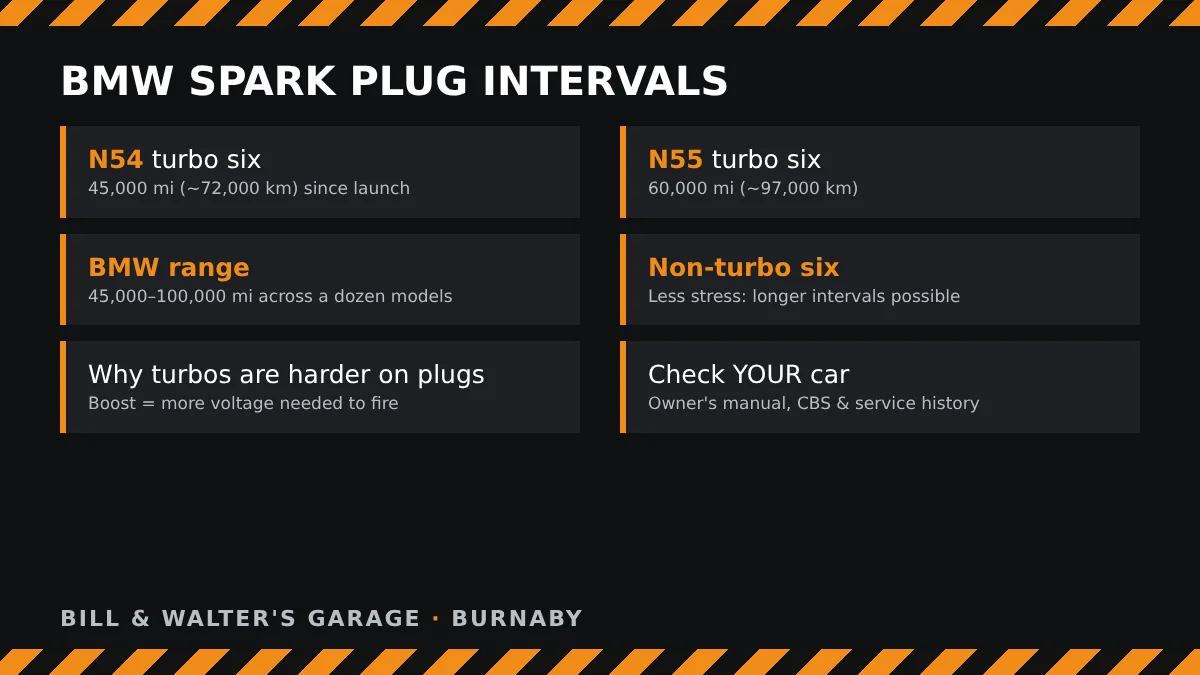
- BMW parts specialist BimmerWorld lists 45,000 miles for the N54 (since its launch) and 60,000 miles for the N55.
- Turbo engines are harder on plugs: higher cylinder pressure needs more voltage to fire, and a worn gap pushes that demand higher still.
- Worn plugs overwork the ignition coils. NGK says plug wear, not the coil itself, is a leading cause of coil failure.
- Oil in the plug wells points to a leaking valve cover gasket, which can cause misfires even with fresh plugs.
BMW spark plug replacement intervals by engine
BMW’s Condition Based Service (CBS) system tracks many maintenance items, but owners often find the plug interval surprising. Here’s what we could verify from reputable sources:
- N54 (2007–2010 335i, 135i, 535i and related models): BimmerWorld says BMW has recommended a 45,000-mile (about 72,000 km) interval for N54 plugs since the engine was introduced. Owners on 5series.net report the same 45k figure in the 535i owner’s manual, even when CBS shows something different.
- N55 (the N54’s single-turbo successor): BimmerWorld lists a 60,000-mile (about 97,000 km) interval.
- Across BMW models: a Tomorrow’s Technician survey found intervals ranging from 45,000 to 100,000 miles, and advises checking the factory schedule and service bulletins for each car.
- Non-turbo sixes: Underhood Service gives the example of a 2012 X5 with a naturally aspirated 3.0 L six, where plugs are “not as taxed” and the interval was 120,000 miles.
For newer four- and six-cylinder engines (N20, B46/B48, B58), go by your owner’s manual and the service history. If you’ve bought a used BMW and don’t know when the plugs were last done, treat them as due.
Why turbo BMWs wear out plugs faster
A spark plug has to jump a gap with a high-voltage spark. Under boost, cylinder pressure is much higher, and it takes more voltage to push a spark across the gap. Plug maker E3 explains that turbo engines see “more intense combustion events” and run tighter gaps to keep the voltage demand down and prevent misfires under boost.
As a plug wears, its gap grows. A wider gap needs even more voltage, so the coil works harder on every firing. In an NGK tech tip published by Underhood Service, NGK explains that this extra load stresses the coil and can even damage the engine computer’s coil driver. That’s why plugs and coils on turbo BMWs are often looked at together.
Signs your BMW needs new spark plugs
- Misfire under load: a stumble or jerk when you accelerate hard or the turbo builds boost, often before you notice anything at idle.
- Rough idle, especially on a cold start.
- Hesitation or a flat, weak feeling when pulling away.
- “Drivetrain malfunction” message with reduced power. BMW Insights links this warning to misfires and notes that N54 and N55 engines are sensitive to ignition problems under boost.
- Check engine light with misfire codes, either generic (P0300 random, P0301–P0306 for a specific cylinder) or BMW-specific codes read with a BMW-capable scan tool.
- Worse fuel economy than you’re used to.
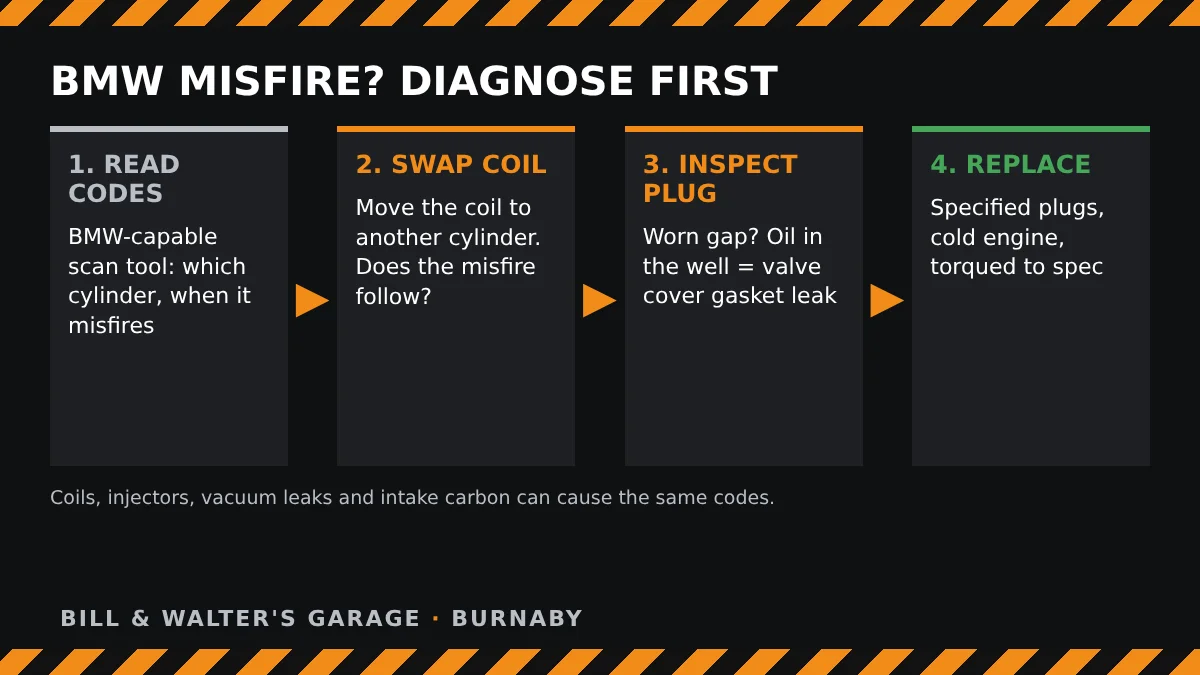
These symptoms aren’t unique to plugs. Coils, injectors, vacuum leaks, oil in the plug wells and carbon on the intake valves can all cause the same misfire codes. For a general rundown of plug wear, see our article on the signs of bad spark plugs.
Common causes of BMW misfires, ranked
1. Worn spark plugs
On a turbo BMW that’s at or past its plug interval, worn plugs are the first suspect. The gap has opened up and the spark is struggling under boost.
2. Failing ignition coils
BMW has issued several service bulletins about coils. SI B12 18 14 (March 2015) covers engine misfires from failed ignition coils on N51, N52, N52K and N52T engines and directs replacing the failed Bosch coils with Delphi coils. An earlier bulletin for the 2010 335, SIB 12 24 05, describes rough running and misfire codes caused by a coil problem. BimmerWorld also suggests replacing coils as preventive maintenance on the N54.
3. Oil in the plug wells
BMW valve cover gaskets harden with age and can let oil seep into the spark plug wells. Tomorrow’s Technician notes that a plug sitting in oil means the valve cover gasket needs replacing. Oil can foul the plug and the coil boot and cause a misfire that comes straight back even after new plugs.
4. Other causes
Leaking injectors, vacuum or boost leaks, and carbon build-up on the intake valves of direct-injection engines can all cause misfires that look like a plug problem. We explain the carbon issue in our article on MINI Cooper carbon build-up, which affects a BMW-designed engine.
What owners report
- In a 5series.net thread about a misfire on an N54 535i, the original poster changed the plugs and wrote: “Plugs changed, and WOW it runs better.” Another owner with misfires on two cylinders at about 66,000 miles replaced plugs and coils, while a third, at 82,000 miles, needed plugs plus walnut blasting of the intake valves.
- Other N54 owners on 5series.net describe changing plugs at around 45,000–50,000 miles, and some had to push back when a dealer went by the CBS display instead.
- On F30 Bimmerpost, a 2015 335i (N55) owner reported a “drivetrain malfunction” warning, lost power and a cylinder 4 misfire. Members recommended swapping that coil to another cylinder to see if the misfire followed it.
- Not every misfire is plugs. A Z4 sDrive35iS owner on Z4-Forum fitted new plugs and coils at about 73,000 miles and still had misfires. The real fix was a valve (rocker) cover gasket, because an oil leak was contaminating two plugs.
- Similarly, a 2007 335xi owner on CarComplaints.com replaced all six plugs and the coils, and the rough running continued.
The lesson from these owners: plugs are often the fix on a high-mileage turbo BMW, but proper diagnosis saves money when they aren’t.
What happens if you ignore worn plugs
Worn plugs don’t fail all at once, so it’s easy to put them off. But as the gap grows, misfires get more frequent, the engine may cut power to protect itself, and the coils take a beating. Unburned fuel from repeated misfires also ends up in the exhaust, where it can overheat and damage the catalytic converter. A car that stumbles or loses power when you’re merging onto the highway is a safety concern, not just an annoyance. A plug job done on time costs far less than plugs, coils and a converter later.
What you can check yourself vs. what needs a shop
Owner checks:
- Look up when the plugs were last replaced in your service records.
- Check your owner’s manual and the CBS display for the plug interval.
- Note when the problem happens: cold start, idle, light cruising or hard acceleration.
- If the check engine light is flashing, ease off and get the car checked promptly. As NAPA Know How explains, a flashing light usually means a misfire severe enough to harm the catalytic converter.
Leave to a shop: BMW plug jobs aren’t as simple as they look. Plugs should be removed from a cold engine, the wells blown out first, and the new plugs tightened to the correct torque. NGK’s installation chart lists 18.0–21.6 lb-ft for a 14 mm flat-seat plug in an aluminum head and warns that over-tightening can break the shell. Underhood Service adds that too much torque can stretch the shell and break its seals, while too little lets the plug overheat. On older N54s, the coil harness clips are also brittle and easy to break.
Lower Mainland driving and your plugs
Plenty of BMWs in Burnaby and Vancouver live a life of short trips, stop-and-go on Highway 1 and the Lougheed corridor, and cold, damp starts through our long wet season. Misfires often show up first on cold mornings and when you put the car under load on hills like those around Burnaby Mountain. If your BMW stumbles in those moments, it’s a good time to check when the plugs were last done.
How Bill & Walter’s handles BMW spark plug replacement
Every visit to Bill & Walter’s starts with a safety inspection. We’re a family-owned independent shop in Burnaby, here since 1956, and European cars are our specialty. For a misfiring BMW, our diagnose & test service reads the BMW fault codes, checks the coils and looks for oil in the plug wells before we recommend parts. When the plugs are due, our spark plug service uses the correct specified plugs, torqued to spec. You get a clear explanation first, with no franchise or manufacturer sales pressure.
See our BMW repair in Burnaby page, call (604) 298-3031, or book online. We’re at 4406 Dawson St, open Monday to Friday 7:00 AM–5:30 PM and Saturday 7:30 AM–4:00 PM, with a free courtesy car while your BMW is with us.
FAQ
How often should BMW spark plugs be replaced?
It depends on the engine. BMW intervals across the range run from about 45,000 to 100,000 miles (roughly 72,000–160,000 km). BimmerWorld lists 45,000 miles for the turbocharged N54 and 60,000 miles for the N55. Check your owner’s manual and service records for your car.
Why do turbo BMWs need spark plugs sooner?
Boost raises cylinder pressure, so it takes more voltage to fire the plug. As the gap wears wider, the voltage demand rises further, which leads to misfires under load and extra stress on the ignition coils.
Can bad spark plugs cause a drivetrain malfunction warning?
Yes. On turbo BMWs, misfires from worn plugs or coils are a common cause of the drivetrain malfunction message, and the car may reduce power to protect itself.
Should I replace the ignition coils with the spark plugs?
Not always. Coils are tested and replaced when they’re faulty. Worn plugs do overload coils, so on high-mileage turbo engines some specialists suggest replacing coils as preventive maintenance. A coil swap test helps show whether a misfire is caused by the coil or the plug.
Why does my BMW still misfire after new spark plugs?
Other faults cause the same codes: failing coils, oil in the plug wells from a leaking valve cover gasket, injector problems, vacuum leaks or carbon on the intake valves. Owners have reported all of these.
Is it safe to drive with a misfire?
It’s best not to put it off. A flashing check engine light usually means a severe misfire that can damage the catalytic converter, and a loss of power in traffic is a safety risk. Have it checked as soon as you can.
Sources
- BimmerWorld, Bosch spark plug for the N54
- BimmerWorld, spark plug for the N55
- Tomorrow’s Technician, BMW Spark Plug Replacement
- Underhood Service, Know your engine when determining spark plug intervals
- Underhood Service, NGK tech tip: leading cause of ignition coil failure
- Underhood Service, The importance of proper spark plug torqueing
- NGK, How to correctly install spark plugs
- E3 Spark Plugs, Spark plug requirements for turbocharged engines
- NAPA Know How, What does a flashing check engine light mean?
- BMW Insights, 335i drivetrain malfunction warning
- BMW SI B12 18 14, Engine misfire due to failed ignition coil (via NHTSA)
- BMW SIB 12 24 05, 2010 BMW 335 rough running (via CarComplaints.com)
- 5series.net, Misfire just started
- 5series.net, Spark plug change at 45k on a 535
- 5series.net, 45k miles spark plug change
- F30 Bimmerpost, 335i drivetrain malfunction and misfire
- Z4-Forum, Misfires
- CarComplaints.com, 2007 BMW 335 running roughly
Disclaimer: misfires and rough running can have more than one cause. This article is general information, and a hands-on inspection is the only way to confirm a diagnosis on your vehicle.