Brake Pad Replacement Burnaby
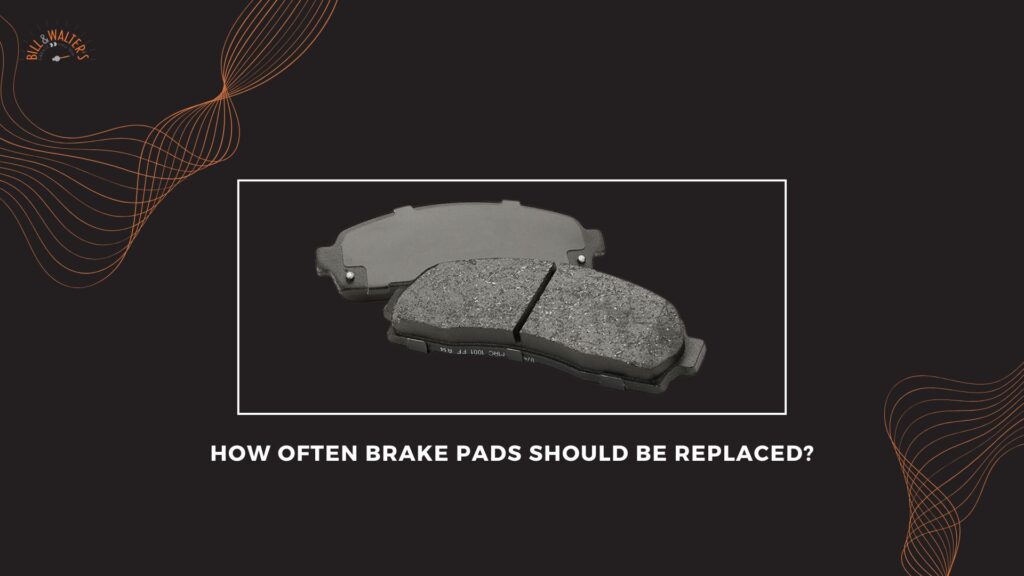
Brake Pad Replacement Burnaby services become necessary when brake pads wear below a safe level, create persistent noise, or reduce the vehicle’s stopping performance. Although many brake pads may last approximately 50,000 to 80,000 kilometres, there is no single replacement interval that applies to every vehicle.
Brake-pad life depends on several factors, including:
- City or highway driving
- Vehicle weight
- Driving style
- Brake-pad material
- Road conditions
- Towing or carrying heavy loads
- Condition of the rotors and calipers
- Frequency of inspections
Burnaby drivers who regularly travel through stop-and-go traffic, steep roads, and wet conditions may experience faster brake wear than drivers who spend most of their time on highways.
The safest approach is not to wait for a specific kilometre reading. Have the braking system inspected regularly and respond quickly when warning signs appear.
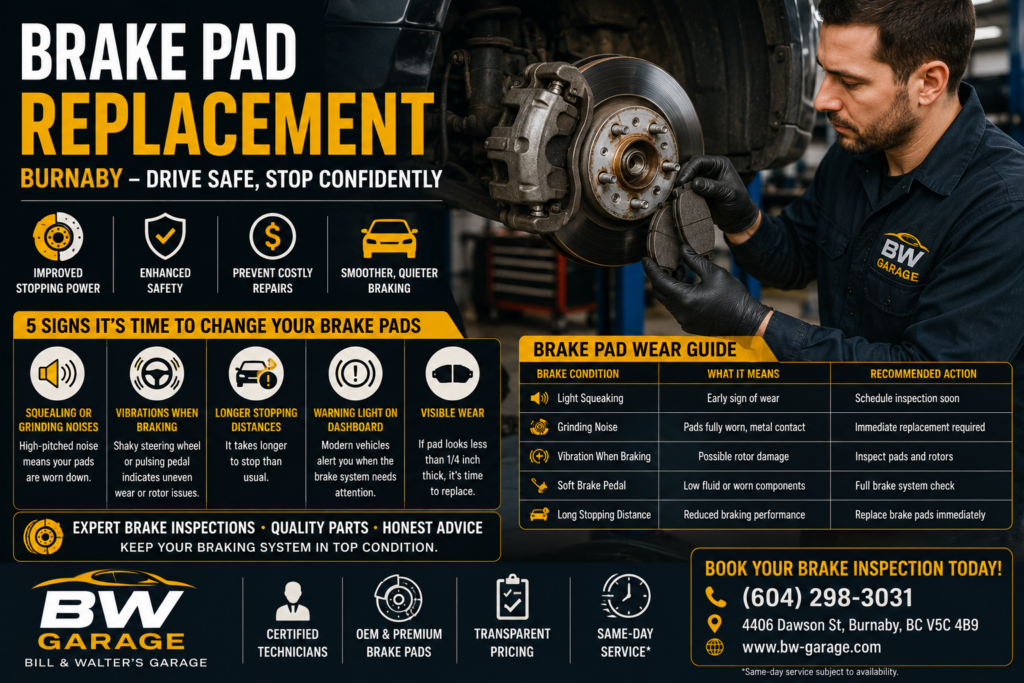
When Should You Change Brake Pads?
Brake pads should be replaced when their remaining friction material reaches the manufacturer’s minimum specification or when wear begins to affect braking performance.
Many vehicles require brake-pad replacement somewhere between 50,000 and 80,000 kilometres, but some pads wear significantly sooner. Others may last longer under lighter driving conditions.
Schedule an inspection sooner if you notice:
- Persistent squeaking or squealing
- Grinding or scraping
- Vibration during braking
- Longer stopping distances
- A soft or unusual brake pedal
- Pulling while stopping
- A dashboard brake warning
- Excessive brake dust
- Visible brake-pad wear
If any of these symptoms are present, book a professional brake inspection and repair in Burnaby rather than waiting for the next routine service.
Why Timely Brake Pad Replacement Matters
Brake pads create the friction required to slow your vehicle. As the friction material becomes thinner, the braking system may become noisier, less responsive, and more likely to damage other components.
Replacing worn brake pads early can help:
- Maintain predictable stopping power
- Protect the brake rotors
- Reduce the risk of caliper damage
- Prevent metal-on-metal contact
- Lower the total repair cost
- Improve braking comfort
- Protect drivers, passengers, and other road users
Once the brake-pad material is completely worn away, the metal backing plate may contact the rotor. This commonly creates a grinding sound and can damage the rotor surface very quickly.
A relatively straightforward brake-pad service can then become a larger repair involving pads, rotors, hardware, and potentially calipers.
Five Signs It Is Time to Change Your Brake Pads
1. Squealing or Squeaking Noise
Many brake pads include a metal wear indicator designed to produce a high-pitched sound as the pad approaches its replacement limit.
An occasional squeak after rain or overnight moisture may be temporary. Persistent squealing, however, should be inspected.
Brake noise can also be caused by:
- Surface rust
- Brake dust
- Low-quality friction material
- Dry contact points
- Worn hardware
- Seized slide pins
- Uneven rotor surfaces
Do not assume every squeak means the pads require immediate replacement, but do not ignore recurring noise.
2. Grinding or Scraping
Grinding is a more serious warning sign.
It may indicate that:
- The friction material is completely worn
- The metal backing plate is contacting the rotor
- A foreign object is trapped near the brake assembly
- A caliper or hardware component is damaged
- The rotor surface has become severely scored
Driving with grinding brakes can reduce stopping performance and increase repair costs rapidly. Arrange an inspection immediately.
3. Vibration When Braking
A vibrating steering wheel, brake pedal, or vehicle body during braking may indicate:
- Rotor thickness variation
- Heat damage
- Uneven pad deposits
- A sticking caliper
- Loose suspension components
- Wheel or tire problems
Brake vibration does not always mean that the brake pads alone are responsible. A complete inspection is required to identify the actual cause.
If the vehicle also pulls or the steering wheel sits off-centre during normal driving, consider a wheel alignment inspection.
4. Longer Stopping Distance
If your vehicle requires more distance to stop than usual, the braking system needs immediate attention.
Possible causes include:
- Thin brake pads
- Overheated brakes
- Contaminated brake fluid
- Rotor damage
- A sticking or seized caliper
- Hydraulic leakage
- Tire or traction problems
Do not compensate by pressing the pedal harder and continuing to drive. Reduced stopping performance is a safety issue.
5. Brake Warning Light
Some vehicles use brake-pad wear sensors, while others display warning lights for:
- Low brake fluid
- ABS faults
- Hydraulic-system problems
- Electronic parking-brake issues
- General braking-system faults
A warning light should be diagnosed rather than simply cleared.
Professional vehicle diagnostics in Burnaby may be required when the warning is connected to ABS sensors, wiring, modules, or electronic brake controls.
Brake Pad Wear Guide
Light or Occasional Squeaking
Possible meaning: Moisture, surface rust, dust, or early pad wear.
Recommended action: Monitor the noise and arrange an inspection if it persists.
Persistent High-Pitched Squealing
Possible meaning: Brake-pad wear indicator contacting the rotor.
Recommended action: Schedule a brake inspection soon.
Grinding Noise
Possible meaning: Friction material may be fully worn and metal may be contacting the rotor.
Recommended action: Stop unnecessary driving and arrange immediate service.
Vibration During Braking
Possible meaning: Rotor damage, uneven deposits, caliper issues, or suspension wear.
Recommended action: Inspect the complete braking and suspension systems.
Soft or Spongy Pedal
Possible meaning: Air, moisture, leakage, hose damage, or master-cylinder problems.
Recommended action: Arrange an urgent hydraulic brake-system inspection.
Longer Stopping Distance
Possible meaning: Reduced friction, overheating, fluid problems, or component failure.
Recommended action: Have the vehicle inspected immediately.
City Driving vs. Highway Driving
Brake pads do not wear at the same rate on every vehicle.
City Driving
Burnaby drivers who regularly travel through Metrotown, Brentwood, Lougheed, and other busy areas often use their brakes repeatedly during:
- Traffic congestion
- Intersections
- Short trips
- Parking
- Hills
- Wet-weather driving
This repeated braking creates heat and friction, which can accelerate pad wear.
City-driven vehicles generally benefit from more frequent brake inspections.
Highway Driving
Highway driving usually involves fewer complete stops and less frequent pedal use. As a result, brake pads may last longer.
However, highway vehicles can still develop:
- Corrosion
- Seized calipers
- Uneven pad wear
- Fluid deterioration
- Rotor problems
- Brake issues caused by towing or heavy loads
Longer pad life does not eliminate the need for regular inspection.
How Often Should Burnaby Drivers Inspect Their Brakes?
The vehicle manufacturer’s maintenance schedule should remain the primary reference.
As a practical guideline, consider having the brakes checked:
- During routine vehicle service
- When rotating or replacing tires
- Before winter
- Before a long road trip
- After buying a used vehicle
- When any warning symptom appears
- At least once a year for vehicles used heavily in city traffic
A mechanic should evaluate actual component condition rather than recommending replacement based only on mileage.
British Columbia vehicle regulations require braking systems to remain effective and adequately maintained. Drivers can review the provincial requirements in the BC Motor Vehicle Act Regulations.
What Happens During a Professional Brake Inspection?
A proper inspection should examine more than the visible outer brake pad.
Technicians may inspect:
Brake-Pad Thickness
The inner and outer pads are measured and compared. Uneven wear can indicate a seized slide pin, sticking caliper, or damaged hardware.
Brake Rotors
Rotors are checked for:
- Scoring
- Cracks
- Heat spots
- Corrosion
- Thickness
- Uneven wear
- Distortion
Brake Calipers
The technician confirms that caliper pistons and slide pins move correctly and apply pressure evenly.
Brake Fluid
The fluid is checked for:
- Low level
- Contamination
- Excess moisture
- Leakage
- Deterioration
Brake Hoses and Lines
Hoses and lines are inspected for:
- Cracks
- Bulges
- Corrosion
- Chafing
- Fluid leakage
Brake Hardware
Clips, shims, brackets, slide pins, and contact points should be cleaned, inspected, lubricated, or replaced when necessary.
Parking Brake and ABS
The parking brake, warning lights, sensors, and ABS-related components may also require inspection.
Road Test
A road test can help assess:
- Noise
- Vibration
- Pulling
- Pedal feel
- Stopping performance
- ABS operation
Do Rotors Always Need Replacement with Brake Pads?
No. Rotors do not automatically require replacement every time brake pads are changed.
Rotor replacement depends on:
- Remaining thickness
- Surface condition
- Heat damage
- Cracks
- Scoring
- Corrosion
- Manufacturer specifications
- Vibration or pulsation
A rotor may remain serviceable if it is within specification and in good condition. Severely damaged or undersized rotors should be replaced.
Ask the technician to explain the measurements and condition before approving rotor replacement.
Can Brake Pads Wear Unevenly?
Yes. Uneven pad wear is common when part of the brake system is not moving correctly.
Possible causes include:
- Seized caliper slide pins
- Sticking caliper pistons
- Damaged hardware
- Incorrect installation
- Corrosion
- Brake-hose restrictions
- Suspension or alignment problems
Replacing only the pads without correcting the cause may result in the same problem returning.
Can Brake Pads Wear Out Suddenly?
Brake pads usually wear gradually, but the symptoms may appear suddenly when they reach a critical thickness.
A driver may notice an abrupt change because:
- The wear indicator begins contacting the rotor
- The friction material separates
- A caliper seizes
- A brake hose fails
- A rotor becomes damaged
- One pad wears much faster than the others
A sudden change in braking performance should be treated seriously.
Do New Brake Pads Improve Braking Performance?
Properly installed brake pads can improve:
- Pedal response
- Stopping consistency
- Noise
- Smoothness
- Driver confidence
However, new pads will not correct every braking problem.
If the rotors, calipers, fluid, hoses, tires, or suspension components are damaged, those issues must also be addressed.
New pads and rotors may also require an appropriate bedding procedure so the friction surfaces develop even contact.
OEM vs. Aftermarket Brake Pads
Not all aftermarket brake pads are low quality, and OEM pads are not automatically the best choice for every driver.
The correct option depends on:
- Vehicle design
- Driving conditions
- Noise expectations
- Dust levels
- Heat resistance
- Budget
- Warranty
- Manufacturer requirements
High-quality aftermarket pads from reputable manufacturers may provide suitable performance. For safety-critical repairs, avoid choosing unknown components based only on the lowest price.
Ask the repair shop to explain:
- The pad manufacturer
- Friction material
- Warranty
- Expected noise and dust
- Why the part is recommended
- Whether it meets the vehicle’s specifications
Why Burnaby Drivers Choose Bill & Walter’s Garage
Bill & Walter’s Garage provides brake inspections, brake-pad replacement, rotor service, caliper repair, brake-fluid service, ABS diagnostics, and related automotive repairs in Burnaby.
Customers can expect:
- Professional diagnosis
- Clear estimates before repair
- Quality replacement parts
- Inspection of related brake components
- Repair recommendations based on actual condition
- Same-day service for many brake repairs when parts and appointment capacity are available
The shop services domestic, import, and European vehicles.
Frequently Asked Questions
How long do brake pads usually last?
Many brake pads may last between 50,000 and 80,000 kilometres, but driving style, vehicle weight, road conditions, and pad material can produce significantly shorter or longer service life.
How do I know my brake pads are worn?
Common signs include persistent squealing, grinding, vibration, longer stopping distances, warning lights, or visible thinning of the pad material.
Can I drive with squeaky brakes?
Temporary squeaking caused by moisture may not be dangerous. Persistent noise should be inspected because it may indicate pad wear or damaged hardware.
Can I drive with grinding brakes?
Driving with grinding brakes is not recommended. Metal-on-metal contact can damage the rotors and reduce stopping performance.
Do brake pads and rotors need replacement together?
Not always. Rotor condition and measurements determine whether replacement is required.
How thick should brake pads be?
Replacement specifications vary by vehicle and brake-pad design. A professional technician should measure the pads and compare them with manufacturer requirements.
Why does my car pull when braking?
Possible causes include a sticking caliper, uneven pad wear, hydraulic problems, tire issues, suspension wear, or alignment problems.
Does city driving wear brake pads faster?
Usually, yes. Frequent stopping creates more friction and heat than steady highway driving.
How long does brake-pad replacement take?
Timing depends on the vehicle, component condition, corrosion, parts availability, and whether rotors or calipers also require service.
Book Brake Pad Replacement in Burnaby
If your vehicle is squealing, grinding, vibrating, pulling, or taking longer to stop, do not wait for the problem to become more expensive.
Bill & Walter’s Garage provides professional brake inspections and brake-pad replacement for Burnaby drivers.
Book your brake service or call the shop to discuss your symptoms.
Bill & Walter’s Garage
4406 Dawson St, Burnaby, BC V5C 4B9
(604) 298-3031
Want to understand how the whole braking system works together? Read our guide to car brake components.