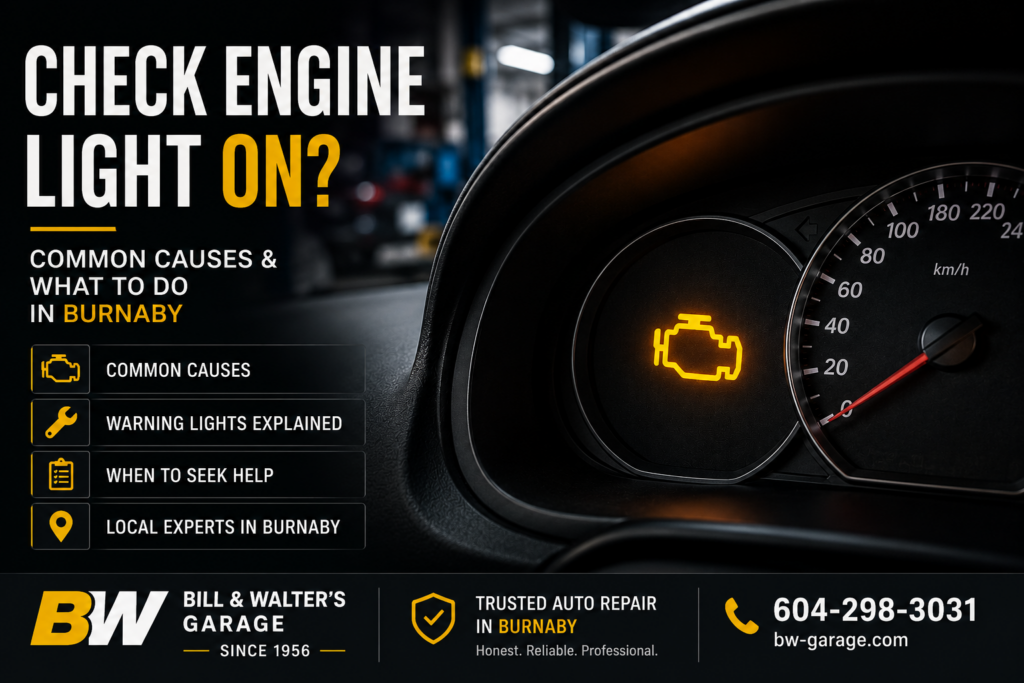
Seeing the check engine light appear on your dashboard can be concerning, especially when your vehicle seems to be driving normally.
Sometimes, the cause may be relatively simple. In other situations, a check engine light can indicate a mechanical or electrical problem that should be diagnosed as soon as possible.
The challenge is that the check engine light does not tell you exactly what is wrong with your vehicle.
Modern vehicles use complex computer systems and sensors to monitor engine performance, emissions, fuel delivery, ignition, and many other components. When the vehicle’s computer detects a problem, it may store a diagnostic trouble code and turn on the check engine light.
If your check engine light is on, proper vehicle diagnostics can help identify the actual cause of the problem before unnecessary parts are replaced.
At Bill & Walter’s Garage, our experienced automotive technicians provide professional vehicle diagnostics and auto repair services in Burnaby. We focus on accurate diagnosis, clear communication, and helping customers understand what their vehicles actually need.
What Does the Check Engine Light Mean?
The check engine light is part of your vehicle’s onboard diagnostic system.
When the vehicle’s computer detects a problem that may affect engine performance, emissions, or other monitored systems, it stores a diagnostic trouble code.
Depending on the severity and type of problem, the check engine light may remain solid or begin flashing.
A check engine light does not automatically mean that your engine has suffered serious damage.
However, it should not be ignored.
The underlying problem may become worse over time or affect other vehicle components.
The best approach is to have the vehicle properly diagnosed to determine why the warning light appeared.
Solid vs Flashing Check Engine Light: What Is the Difference?
Understanding the difference between a solid and flashing check engine light is important.
Solid Check Engine Light
A solid check engine light usually indicates that the vehicle’s computer has detected a problem that requires attention.
Depending on the cause, the vehicle may continue to drive normally.
Common causes may include:
- Emissions system problems
- Sensor failures
- Fuel system issues
- Ignition problems
- Air intake problems
Even if the vehicle appears to be operating normally, scheduling a diagnostic inspection is recommended.
Flashing Check Engine Light
A flashing check engine light may indicate a more serious problem.
One common cause is a severe engine misfire.
Continuing to drive with an active misfire may damage the catalytic converter and potentially cause additional problems.
If your check engine light begins flashing, especially if the vehicle is shaking, losing power, or running poorly, you should reduce driving and have the vehicle inspected as soon as possible.
1. Loose or Damaged Gas Cap
One of the simplest possible causes of a check engine light is a loose or damaged gas cap.
The fuel system is designed to maintain a sealed environment.
If the gas cap is loose, cracked, or no longer sealing correctly, the vehicle may detect a leak in the evaporative emissions system.
Before assuming that your vehicle needs a major repair, check whether the gas cap is properly tightened.
However, even after tightening the cap, the check engine light may not immediately disappear.
The vehicle’s computer may need to complete several driving cycles before determining that the problem has been corrected.
If the warning light remains on, professional diagnostics may be necessary.
2. Faulty Oxygen Sensor
Oxygen sensors monitor the amount of oxygen in the vehicle’s exhaust system.
This information helps the engine computer adjust the air-fuel mixture for efficient engine operation.
A failing oxygen sensor may contribute to:
- Reduced fuel efficiency
- Increased emissions
- Poor engine performance
- Check engine light activation
Ignoring a faulty oxygen sensor may eventually affect other components, including the catalytic converter.
However, a diagnostic trouble code related to an oxygen sensor does not always mean the sensor itself needs replacement.
Wiring problems, exhaust leaks, fuel system issues, or other conditions may cause similar codes.
This is why proper diagnosis is important before replacing parts.
3. Engine Misfire
An engine misfire occurs when one or more cylinders do not complete the combustion process correctly.
Possible causes include:
- Worn spark plugs
- Failing ignition coils
- Fuel injector problems
- Vacuum leaks
- Low engine compression
- Fuel delivery issues
Symptoms of an engine misfire may include:
- Rough idling
- Engine shaking
- Reduced acceleration
- Loss of power
- Increased fuel consumption
A serious misfire may cause the check engine light to flash.
Driving for an extended period with an active misfire can potentially damage the catalytic converter and other vehicle components.
4. Catalytic Converter Problems
The catalytic converter is an important part of the vehicle’s emissions system.
Its purpose is to help reduce harmful exhaust emissions.
A failing or inefficient catalytic converter may trigger the check engine light.
Possible symptoms include:
- Reduced engine performance
- Poor acceleration
- Unusual exhaust smells
- Reduced fuel efficiency
Catalytic converters can be expensive to replace.
However, converter problems are sometimes caused by another underlying issue, such as an unresolved engine misfire or fuel system problem.
Replacing the catalytic converter without identifying the original cause may result in the new component being damaged again.
Proper diagnostics are essential before recommending replacement.
5. Mass Airflow Sensor Problems
The mass airflow sensor measures the amount of air entering the engine.
The vehicle’s computer uses this information to determine how much fuel should be delivered.
A dirty or failing mass airflow sensor may cause:
- Rough idling
- Poor acceleration
- Reduced fuel economy
- Difficulty starting
- Check engine light activation
However, similar symptoms may also be caused by air intake leaks, wiring problems, or other engine management issues.
Testing and diagnosis can help identify the actual cause.
6. Spark Plug or Ignition Coil Problems
Spark plugs and ignition coils are essential components of the ignition system.
Spark plugs create the spark required to ignite the air-fuel mixture inside the engine.
Ignition coils provide the electrical energy needed for this process.
Worn spark plugs or failing ignition coils may cause:
- Engine misfires
- Rough idling
- Poor acceleration
- Difficulty starting
- Increased fuel consumption
- Check engine light activation
Ignoring ignition system problems can lead to additional damage and increased repair costs.
7. EVAP System Leak
The evaporative emissions control system, commonly called the EVAP system, prevents fuel vapours from escaping into the atmosphere.
An EVAP system problem may trigger the check engine light even when the vehicle appears to drive normally.
Possible causes include:
- Loose gas cap
- Damaged hoses
- Faulty purge valve
- Faulty vent valve
- Leaks in the EVAP system
Finding a small EVAP leak may require specialized diagnostic equipment.
A professional automotive technician may use a smoke test or other diagnostic procedures to locate the leak.
8. Coolant Temperature Sensor Problems
The engine coolant temperature sensor monitors the temperature of the engine coolant.
The vehicle’s computer uses this information to adjust engine operation.
A failing coolant temperature sensor may cause:
- Poor fuel economy
- Difficulty starting
- Incorrect temperature readings
- Engine performance problems
- Check engine light activation
Because these symptoms can overlap with other mechanical problems, diagnosis is necessary before replacing the sensor.
9. Vacuum Leaks
Modern engines depend on a properly sealed air intake and vacuum system.
A vacuum leak allows unmetered air to enter the engine.
This can affect the air-fuel mixture and trigger the check engine light.
Possible symptoms include:
- Rough idle
- High idle speed
- Engine hesitation
- Reduced performance
- Poor fuel economy
Vacuum leaks may be caused by damaged hoses, intake system problems, or failed gaskets.
10. Battery or Electrical System Problems
Modern vehicles depend heavily on electronic systems.
Low voltage, charging system problems, wiring issues, or electrical faults may sometimes contribute to warning lights and diagnostic trouble codes.
Possible causes include:
- Weak battery
- Alternator problems
- Damaged wiring
- Loose electrical connections
- Sensor circuit problems
Electrical problems can sometimes be difficult to diagnose without proper testing equipment and experience.
Can I Keep Driving With the Check Engine Light On?
The answer depends on the condition of the vehicle and the cause of the warning light.
If the check engine light is solid and the vehicle appears to be operating normally, you may be able to drive for a limited period.
However, the vehicle should still be diagnosed.
If the check engine light is flashing or the vehicle is experiencing serious symptoms, continued driving may cause additional damage.
Warning signs that require immediate attention include:
- Flashing check engine light
- Engine overheating
- Severe shaking
- Significant loss of power
- Unusual engine noises
- Smoke
- Strong burning smells
If you are unsure whether your vehicle is safe to drive, contact an automotive repair professional for advice.
Why You Should Not Simply Clear the Check Engine Light
Some vehicle owners use an inexpensive code reader to clear the check engine light.
Clearing the code does not repair the underlying problem.
The warning light may return after the vehicle’s computer detects the issue again.
More importantly, simply clearing diagnostic trouble codes may make it more difficult to understand the conditions that caused the problem.
Proper diagnosis involves more than reading and deleting codes.
Is Reading a Trouble Code the Same as Diagnosing the Vehicle?
No.
This is one of the most common misunderstandings about automotive diagnostics.
A diagnostic trouble code identifies the system or condition where the vehicle’s computer detected a problem.
It does not necessarily identify the exact failed part.
For example, an oxygen sensor code does not automatically mean that the vehicle needs a new oxygen sensor.
The actual cause could involve:
- Wiring
- Exhaust leaks
- Fuel delivery problems
- Air intake problems
- Other mechanical conditions
Replacing parts based only on a trouble code can result in unnecessary repair costs.
Professional vehicle diagnostics involve testing the system and identifying the actual cause of the problem.
Modern vehicles use standardized onboard diagnostic systems to help identify emissions-related and vehicle performance problems. You can learn more about onboard diagnostics from the U.S. Environmental Protection Agency’s OBD information.
How Much Does Check Engine Light Diagnosis Cost?
The cost of vehicle diagnostics depends on several factors, including:
- Vehicle make and model
- Complexity of the problem
- Type of diagnostic testing required
- Time needed to identify the cause
Some problems can be diagnosed relatively quickly.
Other intermittent, electrical, or complex mechanical issues may require additional testing.
An accurate diagnosis can save money by reducing unnecessary parts replacement and identifying the actual cause of the problem.
Professional Check Engine Light Diagnosis in Burnaby
If your check engine light is on, the first step should be identifying why the warning light appeared.
At Bill & Walter’s Garage, our experienced automotive technicians provide professional vehicle diagnostics and auto repair services in Burnaby.
Our approach focuses on:
- Accurate vehicle diagnostics
- Honest recommendations
- Clear communication
- Transparent explanations
- Quality workmanship
We believe customers should understand what is happening with their vehicles and why a repair is being recommended.
If you are dealing with a Check Engine Light in Burnaby, Bill & Walter’s Garage can provide professional diagnostics to identify the cause of the problem.
If your check engine light is on, flashing, or accompanied by unusual vehicle performance, contact Bill & Walter’s Garage to schedule a diagnostic inspection.
Frequently Asked Questions About Check Engine Lights
What is the most common reason for a check engine light?
There is no single cause that applies to every vehicle. Common reasons include emissions system problems, ignition system faults, sensor issues, EVAP leaks, and engine misfires.
Can a loose gas cap cause the check engine light?
Yes. A loose or damaged gas cap may cause an EVAP system leak and trigger the check engine light.
Is it safe to drive with a check engine light?
It depends on the cause and condition of the vehicle. A solid warning light should be diagnosed, while a flashing check engine light may indicate a more serious problem requiring immediate attention.
Why is my check engine light flashing?
A flashing check engine light may indicate a serious engine misfire or another condition that could cause additional vehicle damage.
Can I diagnose a check engine light myself?
A basic code reader can identify stored diagnostic trouble codes. However, reading a code is not the same as diagnosing the actual cause of the problem.
Where can I get my check engine light diagnosed in Burnaby?
Bill & Walter’s Garage provides professional vehicle diagnostics and auto repair services in Burnaby. Our experienced technicians can inspect your vehicle, perform diagnostic testing, and explain the recommended repairs.