
Noisy AC Compressor in Burnaby
A noisy AC compressor in Burnaby should not be ignored. Clicking, grinding, rattling, squealing, hissing, or knocking sounds when the air conditioning is running may indicate a worn belt, damaged pulley, faulty compressor clutch, refrigerant leak, loose mounting hardware, or internal compressor failure.
Some sounds may be minor and inexpensive to repair. Others can indicate a developing failure that may spread metal contamination through the air-conditioning system and significantly increase repair costs.
Bill & Walter’s Garage provides AC diagnostics, leak detection, refrigerant service, compressor testing, electrical diagnosis, and complete auto AC repair in Burnaby.
This guide explains what different AC noises may mean, how technicians diagnose the problem, which checks are safe for drivers, and when professional service is required.
Quick Answer: Why Is My Car AC Compressor Making Noise?
A noisy AC compressor may be caused by:
- A worn compressor clutch
- Internal compressor damage
- Failing bearings
- A slipping serpentine belt
- A weak belt tensioner
- Low or incorrect refrigerant charge
- A refrigerant leak
- Loose compressor mounts
- A damaged pulley
- Debris near the condenser or cooling fan
- Excessive pressure inside the system
- Electrical relay or wiring problems
The sound alone usually cannot confirm which component has failed. A proper inspection may require belt testing, refrigerant-pressure measurements, leak detection, electrical diagnosis, and compressor-clutch evaluation.
What Does Each AC Compressor Noise Mean?
Different noises can help narrow down the possible problem, but they should not be treated as a final diagnosis.
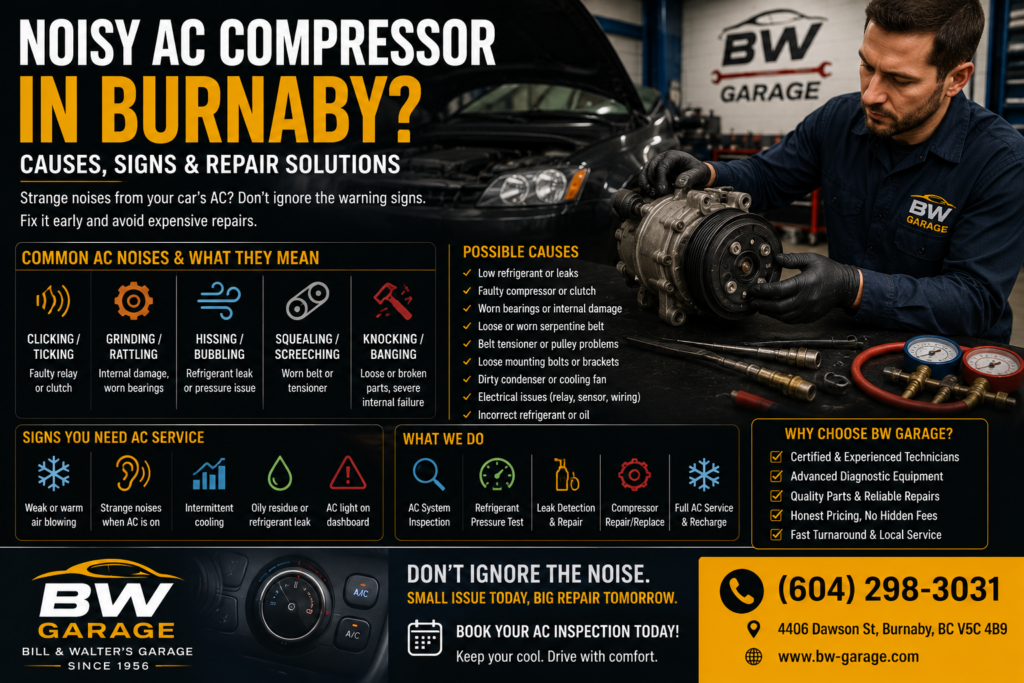
Clicking or Ticking
A brief click when the AC turns on can be normal because the compressor clutch may be engaging.
Repeated, rapid, or unusually loud clicking may indicate:
- A weak compressor-clutch relay
- Electrical voltage problems
- A damaged clutch
- Low refrigerant pressure causing frequent cycling
- A faulty pressure sensor or switch
- Loose wiring or connectors
If the AC repeatedly turns on and off while producing clicking sounds, the system should be inspected.
Grinding Noise
Grinding is one of the more serious warning signs.
Possible causes include:
- Worn compressor bearings
- Internal compressor damage
- A failing clutch bearing
- Metal-to-metal contact
- A damaged pulley
- Severe belt misalignment
Continuing to operate the AC with a grinding compressor can cause additional damage. Turn the AC off and arrange professional inspection.
Rattling Noise
Rattling may come from:
- Loose compressor mounting bolts
- A worn clutch assembly
- Damaged brackets
- A loose heat shield
- Debris near the condenser or fan
- Internal compressor components
- A worn tensioner or pulley
The technician should first determine whether the noise is coming from the compressor itself or from a neighbouring component.
Hissing Sound
A brief hissing sound immediately after the AC is switched off may sometimes be caused by refrigerant pressure equalizing inside the system.
Persistent hissing may indicate:
- A refrigerant leak
- A damaged hose
- A leaking service port
- An expansion-valve problem
- An evaporator leak
- Excessive system pressure
A refrigerant leak should be located and repaired before the system is recharged. Simply adding more refrigerant does not correct the underlying problem.
Bubbling or Gurgling
Bubbling sounds may be associated with:
- Low refrigerant charge
- Air or moisture inside the system
- Incorrect refrigerant service
- Refrigerant flow through the expansion device
- A drainage or evaporator issue
These symptoms require pressure testing and system evaluation.
Squealing or Screeching
High-pitched squealing often originates outside the compressor.
Possible causes include:
- A slipping serpentine belt
- Belt contamination
- A weak automatic tensioner
- A damaged idler pulley
- A seized compressor pulley
- Excessive compressor resistance
A belt that is slipping because the compressor is beginning to seize can fail suddenly and may affect other engine accessories.
For related inspection, review Bill & Walter’s Garage’s belts and hoses service.
Knocking or Banging
Loud knocking is a major warning sign.
It may indicate:
- Broken internal compressor components
- A loose compressor mount
- Severe bearing damage
- A damaged clutch
- A failing pulley
- Refrigerant slugging or abnormal internal pressure
Turn off the AC and schedule an inspection. Continuing to run the system may increase the damage.
Common Causes of a Noisy Car AC Compressor
1. Internal Compressor Failure
The compressor circulates refrigerant and creates the pressure difference required for the AC system to cool the cabin.
Its internal moving parts can wear because of:
- Age
- Insufficient lubrication
- Refrigerant loss
- Contamination
- Excessive system pressure
- Incorrect refrigerant service
- Previous system failure
Internal damage commonly produces grinding, rattling, or knocking.
If the compressor fails mechanically, technicians must determine whether metal debris has entered the rest of the system. Replacing only the compressor without addressing contamination may cause the new unit to fail.
2. Worn Compressor or Clutch Bearings
Bearings allow the compressor pulley and clutch assembly to rotate smoothly.
As bearings wear, drivers may hear:
- Grinding
- Growling
- Squealing
- Whining
- Rattling
The sound may occur whenever the engine is running or only when the AC engages, depending on which bearing is damaged.
3. Compressor Clutch Problems
On vehicles with a traditional clutch-driven compressor, the clutch engages when cooling is requested.
A damaged clutch may:
- Click repeatedly
- Slip
- Overheat
- Engage inconsistently
- Produce burning smells
- Prevent the compressor from operating
In some vehicles, the clutch or pulley can be serviced separately. In others, replacement of the complete compressor assembly may be more practical.
4. Low Refrigerant Charge
Refrigerant does more than provide cooling. The system also relies on the correct refrigerant and oil circulation for compressor operation.
Low refrigerant may result from a leak and can contribute to:
- Weak cooling
- Frequent compressor cycling
- Hissing
- Bubbling
- Compressor strain
- Reduced lubrication circulation
A low charge should not be corrected by blindly adding refrigerant. The cause of the loss should be identified first.
5. Refrigerant Leak
Common leak locations include:
- Compressor seals
- AC hoses
- Service ports
- Condenser
- Evaporator
- O-rings
- Expansion valve connections
Bill & Walter’s Garage lists leak detection, hose inspection, refrigerant service, compressor testing, condenser checks, and evaporator checks among its current AC services.
Professional leak detection may involve electronic tools, ultraviolet dye, nitrogen or forming-gas testing, or pressure evaluation depending on the system and repair procedure.
6. Incorrect Refrigerant or Improper Charge
Modern vehicles may use different refrigerants and compressor oils.
Using the wrong:
- Refrigerant type
- Refrigerant quantity
- Compressor oil
- Oil quantity
- Service equipment
can reduce performance or damage the system.
The refrigerant should be identified from the vehicle manufacturer’s label and service information before any work begins.
The U.S. Environmental Protection Agency advises that motor-vehicle air-conditioning refrigerants must be handled using proper equipment and procedures, and refrigerant should not be intentionally released into the atmosphere. Drivers should leave refrigerant recovery and charging to trained professionals. Review the EPA’s motor-vehicle air-conditioning guidance.
7. Expansion Valve or Orifice-Tube Problems
The expansion device controls refrigerant flow into the evaporator.
A restriction or malfunction may cause:
- Hissing
- Weak cooling
- Pressure imbalance
- Frost on AC lines
- Compressor cycling
- Unusual refrigerant-flow noise
Pressure and temperature readings help technicians evaluate whether the restriction is in the expansion device, condenser, evaporator, or another part of the system.
8. Serpentine-Belt Problems
The serpentine belt may drive the AC compressor along with the alternator, water pump, or power-steering system on some vehicles.
A worn belt may show:
- Cracks
- Glazing
- Fraying
- Contamination
- Missing ribs
- Squealing during startup
- Noise when the AC engages
If the compressor begins to seize, it may place excessive strain on the belt and tensioner.
9. Weak Belt Tensioner or Damaged Pulley
A weak tensioner may allow the belt to vibrate or slip.
Symptoms may include:
- Squealing
- Chirping
- Belt flutter
- Rattling
- Uneven belt wear
- Noise that changes when the AC turns on
The compressor, belt, tensioner, and related pulleys should be inspected as one system.
10. Loose Mounting Bolts or Brackets
Loose hardware can allow the compressor to vibrate against its mount.
The resulting noise may sound like internal compressor damage even when the compressor itself is still functional.
Technicians should inspect:
- Mounting bolts
- Brackets
- Bushings
- Heat shields
- Line supports
- Nearby engine components
11. Condenser or Cooling-Fan Debris
Leaves, stones, broken plastic, or damaged fan blades can create rattling noises near the front of the vehicle.
Because the compressor, condenser, radiator, and fans operate together, a noise near the AC system may not originate from the compressor.
12. Electrical Problems
The AC system relies on:
- Relays
- Fuses
- Pressure sensors
- Temperature sensors
- Control modules
- Wiring
- Connectors
Electrical faults can cause irregular clutch engagement, rapid cycling, or intermittent compressor operation.
A professional vehicle diagnostic test in Burnaby can help identify electrical or control-system problems when the symptoms are not purely mechanical.
Is It Safe to Drive with a Noisy AC Compressor?
It depends on the sound and the cause.
You may be able to drive with the AC switched off if:
- The noise disappears completely when the AC is turned off
- The belt remains properly aligned
- There is no burning smell
- The engine temperature remains normal
- No warning lights appear
- The compressor pulley rotates normally
Stop driving or arrange towing if:
- The belt is smoking or shredding
- The pulley is wobbling
- The compressor appears seized
- The engine begins overheating
- A burning smell appears
- Loud grinding or banging continues with the AC off
- Other engine accessories stop working
- The battery warning light appears
On vehicles where one belt drives multiple accessories, a seized compressor can damage the belt and affect charging or cooling-system operation.
What Can Drivers Check Safely?
Without opening the refrigerant system, drivers can safely check:
- Whether the noise occurs only when the AC is on
- Whether cooling performance has become weaker
- Whether the belt is visibly cracked or frayed
- Whether there is a burning smell
- Whether the compressor pulley appears to wobble
- Whether the cooling fans operate
- Whether a warning light is present
- Whether water under the vehicle is normal condensation or another fluid
Do not:
- Release refrigerant
- Connect unverified recharge cans
- Mix refrigerants
- Bypass pressure switches
- Touch moving belts or pulleys
- Open pressurized AC lines
- Assume the system only needs a recharge
Consumer recharge kits may temporarily mask a leak and can lead to overcharging or contamination when used incorrectly.
How Mechanics Diagnose AC Compressor Noise
A professional AC inspection may include:
Customer Symptom Review
The technician asks:
- When the noise occurs
- Whether it changes with engine speed
- Whether it appears only when cooling is requested
- Whether the AC still blows cold
- Whether previous AC repairs were performed
Visual Inspection
The technician checks:
- Belt condition
- Pulley alignment
- Compressor mounting
- Hose condition
- Refrigerant residue
- Electrical connectors
- Cooling fans
- Condenser condition
Noise Isolation
A mechanic’s stethoscope or electronic listening tool may help separate compressor noise from tensioner, alternator, fan, or pulley noise.
Compressor-Clutch Test
On clutch-equipped systems, the technician observes engagement and checks for slipping, excessive clearance, heat, or irregular cycling.
Refrigerant Pressure and Temperature Tests
High-side and low-side readings help evaluate:
- Refrigerant charge
- Compressor performance
- Expansion-device function
- Condenser airflow
- System restrictions
Pressure readings alone are not enough; ambient temperature and vent temperature must also be considered.
Leak Detection
The system may be checked with:
- Electronic detection
- UV dye
- Visual inspection
- Pressure testing
- Approved tracer gas
Electrical Diagnosis
The technician may test:
- Relays
- Fuses
- Pressure sensors
- Control signals
- Wiring voltage
- Grounds
- Module commands
Refrigerant Identification
Before recovery or charging, the shop may confirm which refrigerant is present to reduce the risk of contamination.
Can a Noisy Compressor Be Repaired?
Sometimes.
The correct repair depends on the failed component and vehicle design.
Possible repairs include:
- Replacing a belt
- Replacing a belt tensioner
- Replacing an idler pulley
- Tightening or replacing mounts
- Repairing wiring
- Replacing a relay
- Repairing a refrigerant leak
- Replacing a compressor clutch or bearing
- Replacing the compressor
- Replacing contaminated components
- Flushing approved parts of the system
- Replacing the receiver-drier or accumulator
- Evacuating and recharging the system
Not every compressor clutch or bearing is separately serviceable.
Why Compressor Replacement Can Become Expensive
A compressor replacement may involve more than installing one component.
Depending on the failure, the repair may require:
- Compressor replacement
- Refrigerant recovery
- System evacuation
- New O-rings
- New compressor oil
- Receiver-drier or accumulator replacement
- Expansion valve replacement
- Condenser replacement
- System flushing where permitted
- Refrigerant recharge
- Leak testing
- Performance testing
If internal metal contamination has spread through the system, replacing only the compressor may lead to repeat failure.
How Much Does Noisy AC Compressor Repair Cost?
The cost depends on:
- Vehicle make and model
- Compressor type
- Refrigerant type
- Parts availability
- Labour access
- Cause of the noise
- Whether contamination is present
- Whether the clutch can be repaired separately
- Leak location
- Related belt or tensioner damage
A belt or relay repair generally costs less than compressor replacement. A system containing contamination or multiple leaks can cost significantly more.
Bill & Walter’s Garage states that it inspects the AC system and provides a clear estimate before repairs begin.
Avoid publishing fixed prices unless the shop plans to review and update them regularly.
How to Reduce the Risk of AC Compressor Failure
Run the AC Periodically
Periodic operation can help circulate refrigerant oil through the system. Many vehicles also use the AC during defrost operation.
Address Weak Cooling Early
A system that gradually loses cooling may have a leak or pressure problem.
Inspect Belts and Tensioners
A damaged drive belt or pulley can place additional strain on the compressor.
Avoid Blind Refrigerant Recharges
Low refrigerant normally indicates leakage. Find the cause before adding more.
Replace the Cabin Filter When Required
A severely restricted cabin filter can reduce airflow, although it generally does not directly cause compressor grinding.
Keep the Condenser Clear
Restricted condenser airflow can increase system pressure and reduce cooling.
Follow Manufacturer Service Information
Refrigerant, oil, charge quantity, and repair procedures vary by vehicle.
Frequently Asked Questions
Why does my AC click when I turn it on?
One click may be normal clutch engagement. Repeated clicking may indicate low refrigerant pressure, a weak relay, electrical trouble, or clutch problems.
Why does my car AC grind only when it is on?
The compressor clutch, bearing, pulley, or internal compressor components may be damaged. Turn off the AC and arrange inspection.
Can low refrigerant make the compressor noisy?
Yes. Low refrigerant caused by a leak may affect cycling and lubricant circulation, but the system must be tested before more refrigerant is added.
Is hissing from the AC always a leak?
No. Brief pressure equalization can create hissing after shutdown. Persistent hissing, weak cooling, or oily residue may indicate a leak.
Can I replace only the compressor clutch?
On some vehicles, yes. On others, the complete compressor must be replaced. Access, parts availability, and internal compressor condition influence the decision.
Will an AC recharge fix compressor noise?
Not necessarily. A recharge cannot repair damaged bearings, belts, pulleys, mounting brackets, electrical faults, or internal compressor failure.
Can I drive with the AC turned off?
Possibly, if the noise stops and the compressor pulley and belt operate normally. Loud noise, belt damage, burning smells, or overheating require immediate attention.
Why is my AC noisy but still cold?
A clutch bearing, belt, tensioner, fan, mount, or early internal compressor problem may produce noise before cooling performance fails.
Do electric and hybrid vehicles use different compressors?
Many hybrids and electric vehicles use high-voltage electric compressors that require compatible refrigerant oil, tools, and service procedures. Bill & Walter’s Garage currently states that it services AC systems on cars, SUVs, trucks, vans, hybrids, and electric vehicles.
Book AC Compressor Diagnosis in Burnaby
If your AC system is clicking, grinding, rattling, squealing, hissing, or knocking, avoid guessing or repeatedly adding refrigerant.
Bill & Walter’s Garage provides AC-system diagnostics, leak detection, compressor testing, refrigerant service, electrical diagnosis, condenser and evaporator checks, and complete auto air-conditioning repair in Burnaby.
Book your auto AC inspection or call the garage to explain the noise.
Bill & Walter’s Garage
4406 Dawson St, Burnaby, BC V5C 4B9
(604) 298-3031
Monday–Friday: 7:00 AM–5:30 PM, Saturday: 7:30 AM–4:00 PM