Oil change in Burnaby intervals should be based on your vehicle manufacturer’s schedule, oil specification, engine type, driving habits, and operating conditions—not one universal kilometre rule.
Frequent short trips, stop-and-go traffic, extended idling, cold starts, towing, and humid conditions may place a vehicle in a severe-service category. Under those conditions, engine oil may require earlier replacement than it would during long, steady highway driving.
This guide explains how vehicle type, weather, mileage, and driving habits affect oil-change timing, which warning signs deserve attention, and how to choose the correct service interval for your car.
Why Regular Oil Changes Matter
Engine oil performs several critical functions:
- Lubricates moving engine components
- Reduces friction and wear
- Carries heat away from internal parts
- Suspends contaminants and deposits
- Helps protect against corrosion
- Supports sealing between piston rings and cylinder walls
As oil ages, heat, fuel dilution, moisture, combustion by-products, and contaminants can reduce its protective ability.
Delayed oil changes may contribute to:
- Sludge formation
- Increased internal wear
- Reduced engine efficiency
- Poor lubrication during startup
- Overheating
- Turbocharger damage
- Expensive engine repairs
Routine oil-change and filter service in Burnaby is one of the simplest ways to protect engine performance and longevity.
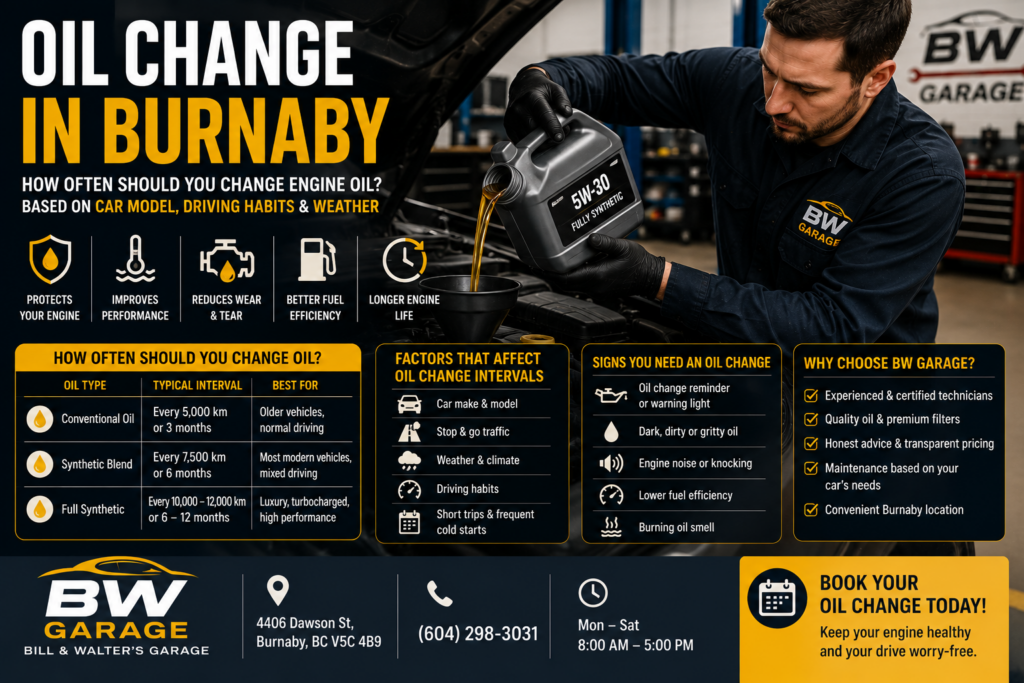
How Often Should You Change Engine Oil?
There is no single interval that applies to every vehicle.
The correct interval should be determined by:
- The owner’s manual
- The vehicle’s oil-life monitoring system
- The required oil viscosity and specification
- Normal versus severe driving conditions
- Vehicle age, condition, and oil consumption
Many modern vehicles use oil-life monitoring systems that calculate service timing based on operating conditions. Manufacturer-recommended intervals can vary significantly by model, year, engine, and required oil type.
Avoid automatically applying rules such as “every 5,000 kilometres” or “every six months” to every vehicle.
Conventional vs. Synthetic Oil
Conventional Oil
Conventional oil may be suitable for some older engines or vehicles designed for it, but it generally provides less resistance to oxidation, extreme temperatures, and deposit formation than modern synthetic oils.
Synthetic Oil
Synthetic oil is commonly required in newer vehicles, turbocharged engines, European vehicles, hybrids, and high-performance applications.
Potential advantages include:
- Better cold-start flow
- Greater resistance to high-temperature breakdown
- Improved deposit control
- Stronger protection under demanding conditions
- Longer service intervals when approved by the manufacturer
Synthetic oil does not mean that the oil can remain in the engine indefinitely. The correct specification and manufacturer interval still apply.
How Vehicle Make and Model Affect Oil-Change Frequency
Different engines have different lubrication requirements.
European and Luxury Vehicles
Many BMW, Mercedes-Benz, Audi, Volkswagen, and other European models require specific manufacturer-approved synthetic oils.
Using only the correct viscosity is not enough. The oil may also need to meet a manufacturer specification such as a particular BMW, Mercedes-Benz, Volkswagen, or Porsche approval.
Extended factory intervals may be permitted, but oil level and condition should still be checked regularly.
Older or High-Mileage Vehicles
Older engines may:
- Consume oil
- Leak oil
- Contaminate oil faster
- Develop sludge or deposits
- Require more frequent level checks
High-mileage oil may help in some applications, but it does not repair mechanical wear or eliminate leaks.
Turbocharged Engines
Turbochargers operate at high temperatures and depend on clean, correctly specified oil.
Delayed service or incorrect oil may contribute to:
- Carbon deposits
- Restricted oil passages
- Turbo bearing wear
- Reduced turbocharger life
Hybrids
Hybrid engines may run less often, but repeated engine starts, short operating periods, and moisture accumulation can still affect oil condition.
Follow the hybrid manufacturer’s maintenance schedule rather than assuming reduced engine use automatically allows longer intervals.
Trucks and SUVs
Towing, carrying heavy loads, frequent idling, and steep-road driving can place additional stress on oil and engine components.
Drivers using vehicles for commercial or heavy-duty work should review the severe-service schedule.
How Burnaby Driving Conditions Affect Engine Oil
Burnaby’s climate is moderate compared with many parts of Canada, but local driving patterns can still affect oil life.
Short Trips
Short trips may prevent the engine and oil from reaching full operating temperature.
This can allow:
- Moisture to remain in the oil
- Fuel dilution to increase
- Deposits to form
- The battery to recharge incompletely
- Condensation to remain in the exhaust system
Repeated short-distance driving is commonly classified as severe service by vehicle manufacturers.
Stop-and-Go Traffic
Traffic along Kingsway, Lougheed Highway, Metrotown, Brentwood, and other busy areas can involve extended idling and repeated acceleration.
The engine may accumulate operating time even when the odometer increases slowly.
Cold Starts
Oil flows more slowly when temperatures are low. Correct viscosity is important because the engine needs rapid lubrication during startup.
Use the viscosity and specification listed by the manufacturer rather than selecting a heavier or lighter oil based on general advice.
Damp Conditions
Humidity does not automatically ruin engine oil, but frequent short trips in damp conditions can prevent moisture from evaporating fully.
Summer Heat and Long Idling
High temperatures, traffic congestion, and extended idling can increase engine and oil temperature.
Vehicles with cooling-system problems, low oil level, or incorrect oil are at greater risk.
Driving Habits That May Require Earlier Oil Changes
You may need to follow the manufacturer’s severe-service interval if you regularly:
- Make repeated short trips
- Drive mainly in stop-and-go traffic
- Idle for long periods
- Tow a trailer
- Carry heavy loads
- Drive in dusty conditions
- Operate in extreme heat or cold
- Use the vehicle commercially
- Drive aggressively
- Make frequent cold starts
Severe-service conditions can require more frequent oil changes than normal highway operation.
Signs Your Vehicle May Need Oil Service
Do not rely on oil colour alone. Modern detergent oils can darken while still functioning normally.
Schedule an inspection if you notice:
- Oil-pressure warning light
- Oil-level warning
- Overdue maintenance reminder
- Low oil level
- Visible oil leaks
- Burning-oil smell
- Blue exhaust smoke
- Engine ticking or knocking
- Unusual engine noise
- Sudden increase in oil consumption
- Reduced engine performance
Important: Oil-Pressure Warning Light
An oil-pressure warning light is not simply an oil-change reminder.
If it remains illuminated while the engine is running:
- Stop driving when safe.
- Turn off the engine.
- Check the oil level if it is safe to do so.
- Do not continue driving if the level is low, a leak is visible, or the warning remains on.
Low oil pressure can cause severe engine damage very quickly.
If a warning light or performance issue appears, professional vehicle diagnostics in Burnaby can help identify whether the problem involves oil pressure, sensors, leaks, ignition, or another system.
How to Check Engine Oil Correctly
If your vehicle uses a dipstick:
- Park on level ground.
- Turn off the engine.
- Wait according to the owner’s manual.
- Remove and wipe the dipstick.
- Reinsert it fully.
- Remove it again and check the level.
- Add only the approved oil if required.
- Avoid overfilling.
Some vehicles use an electronic oil-level system instead of a traditional dipstick. Follow the dashboard instructions or owner’s manual.
Check the level more frequently if the engine is older, turbocharged, leaking, or known to consume oil.
What Oil Should You Use?
Use the exact oil required by the manufacturer.
Confirm:
- SAE viscosity
- API or ILSAC classification
- Manufacturer approval
- Conventional or synthetic requirement
- Oil capacity
- Filter specification
The American Petroleum Institute’s official motor-oil guidance explains current API certification marks and engine-oil performance categories. Visit the API Motor Oil Guide for general oil-standard information.
Do not select oil based only on brand, price, or a mechanic’s generic preference.
Oil Change vs. Adding Oil
Adding oil and changing oil are not the same service.
Adding oil corrects a low level, but it does not remove:
- Contaminants
- Degraded additives
- Moisture
- Fuel dilution
- Sludge
- A dirty filter
A vehicle that repeatedly needs oil between services may have:
- External leaks
- Internal oil consumption
- Worn piston rings
- Valve-seal problems
- Turbocharger leakage
- PCV-system issues
Repeated top-ups should be investigated.
What Should Be Included in an Oil Change?
A professional oil service should normally include:
- Correct engine oil
- New oil filter
- Oil-level verification
- Drain-plug and sealing-washer inspection
- Leak check
- Maintenance reminder reset
- Basic visual inspection
Depending on the service package, technicians may also inspect:
- Fluid levels
- Tires
- Brakes
- Battery
- Belts and hoses
- Suspension
- Warning lights
- Visible leaks
Bill & Walter’s Garage lists oil changes as part of its Burnaby maintenance services and states that scheduled maintenance should follow manufacturer recommendations for the specific make and model.
Why the Oil Filter Matters
The oil filter captures contaminants circulating through the lubrication system.
Reusing an old filter can:
- Restrict oil flow
- Reduce filtration
- Leave contaminated oil in the system
- Affect oil pressure under some conditions
Use a filter that meets the engine manufacturer’s specifications.
What Happens If You Delay an Oil Change?
Repeatedly exceeding the correct interval may contribute to:
- Oil oxidation
- Additive depletion
- Sludge
- Restricted oil passages
- Timing-system wear
- Turbocharger damage
- Increased oil consumption
- Bearing wear
- Engine failure
One slightly overdue oil change does not automatically destroy an engine, but consistently neglected service increases risk.
Should You Change Oil Before Winter?
An oil change before winter may be useful when:
- Service is already due
- The oil is near the end of its interval
- The wrong viscosity is installed
- The vehicle makes many short trips
- Oil level is low
- The engine has known sludge or consumption issues
Do not replace fresh, correctly specified oil solely because winter is approaching.
For broader seasonal preparation, review our guide to winter engine and cold-start problems.
Why Follow Factory-Scheduled Maintenance?
Factory maintenance schedules coordinate oil changes with other inspections and services.
Depending on the vehicle, scheduled maintenance may include:
- Oil and filter
- Brake inspection
- Cabin and engine filters
- Spark plugs
- Coolant
- Transmission fluid
- Belts
- Battery
- Tire rotation
- Safety checks
Bill & Walter’s Garage provides factory-scheduled maintenance in Burnaby based on manufacturer recommendations.
Frequently Asked Questions
How often should I change engine oil?
Follow the owner’s manual or oil-life monitor. The interval varies by vehicle, oil specification, and operating conditions.
Is 5,000 kilometres always the correct interval?
No. Some vehicles require shorter intervals, while many modern vehicles allow longer intervals with approved oil.
Can synthetic oil last 10,000 kilometres?
Some vehicles permit that interval or longer, while others do not. Follow the manufacturer’s schedule.
Should I change oil based on time or kilometres?
Follow whichever limit the manufacturer reaches first when both time and distance are specified.
Does short-trip driving affect engine oil?
Yes. Repeated short trips may prevent moisture and fuel contamination from evaporating fully.
Can I mix synthetic and conventional oil?
Mixing compatible oils is generally possible in an emergency, but the final oil should meet the vehicle’s required specification.
Why does my oil turn dark quickly?
Detergent oil can darken as it suspends contaminants. Colour alone does not determine whether the oil has failed.
Why is my car losing oil?
Possible causes include leaks, burning oil, PCV problems, worn engine components, or turbocharger issues.
Does an oil change fix an oil-pressure warning?
Not necessarily. Low pressure can be caused by low oil, a faulty sensor, pump problems, internal wear, or blockage. The cause must be diagnosed.
Book an Oil Change in Burnaby
Regular oil service helps protect the engine, maintain efficiency, and identify leaks or developing problems before they become expensive.
Bill & Walter’s Garage provides oil and filter changes, factory-scheduled maintenance, diagnostics, brakes, battery service, and general auto repair for domestic, import, and European vehicles in Burnaby.
Contact Bill & Walter’s Garage to request an appointment.
Bill & Walter’s Garage
4406 Dawson St, Burnaby, BC V5C 4B9
(604) 298-3031
Monday–Friday: 7:00 AM–5:30 PM, Saturday: 7:30 AM–4:00 PM