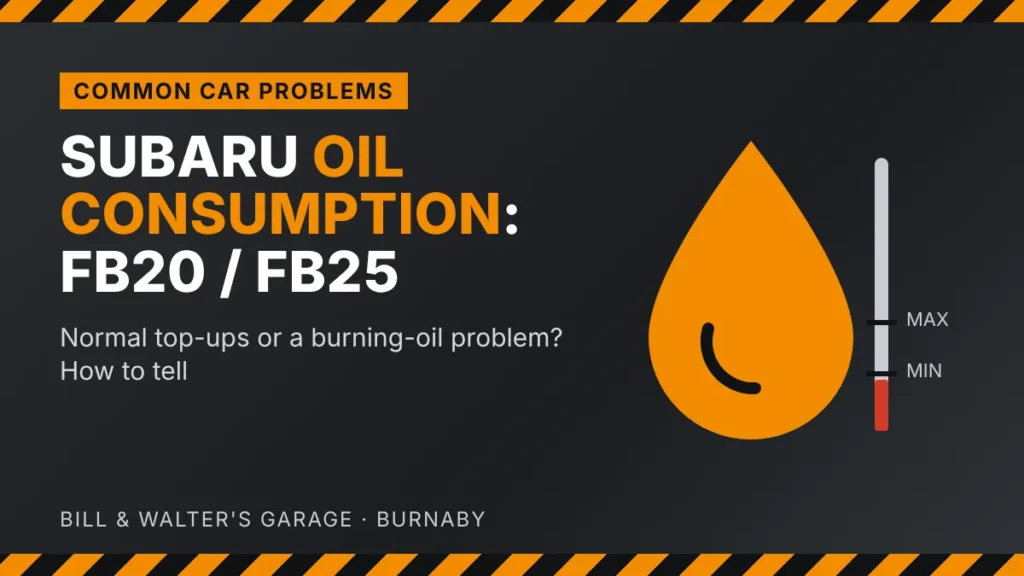
Some Subaru oil consumption is normal. But many 2011–2015 Foresters, Imprezas, XV Crosstreks, Legacys and Outbacks with the first-generation FB20/FB25 boxer engine burn far more oil than they should. Subaru traced the problem to the piston oil control rings and later replaced short blocks under warranty. If your Subaru needs topping up between oil changes, check it regularly, measure how much it uses and get it looked at before the level runs dangerously low.
Quick answer: key takeaways
- Most affected: 2011–2015 Subaru models with the early 2.0L FB20 and 2.5L FB25 engines (see the list below).
- Cause named by Subaru: the oil control piston rings. The repair in Subaru’s 2014 bulletin is a new short block.
- Subaru’s own guideline: see a dealer if the engine uses more than 1 litre per 2,000 km after break-in.
- Subaru Canada extended the warranty on many 2011–2015 models to 8 years / 160,000 km. Most of those cars are now past that window.
- The real danger is running low: low oil can destroy the engine, and burning oil can damage the catalytic converter.
What’s normal oil use for a Subaru?
Every engine uses some oil. In Subaru’s 2012 Impreza owner’s manual, Subaru tells owners to contact a dealer if consumption after break-in is “more than 1 quart per 1,200 miles or 1 liter per 2,000 kilometers”. The same manual also tells owners to check the oil level at each fuel stop (2012 Impreza owner’s manual). In other words, Subaru expects owners to watch the dipstick, not just wait for the next oil change.
Subaru’s bulletin also notes that some consumption is normal, and that a slightly low reading near the next scheduled service isn’t by itself a sign of a problem (Subaru TSB 02-157-14R). The concern is a steady, measurable loss that is more than Subaru’s guideline.
Symptoms of excessive Subaru oil consumption
- Dipstick reads low between changes. This is the most common sign, often found when the oil is changed or during a top-up.
- Low oil warning light. Some FB models have an oil level switch. Subaru’s repair included reprogramming the oil-level detection and, on most models, replacing the switch (TSB).
- No visible leaks. The oil is going somewhere. With no drips on the driveway, burning it is the likely answer.
- Blue-grey exhaust smoke on start-up or under acceleration in more advanced cases.
- Oil residue in the intake. Subaru tells technicians to look for oil in the air filter housing and throttle body when checking the PCV system.
Common causes, ranked
1. Piston oil control rings (early FB engines)
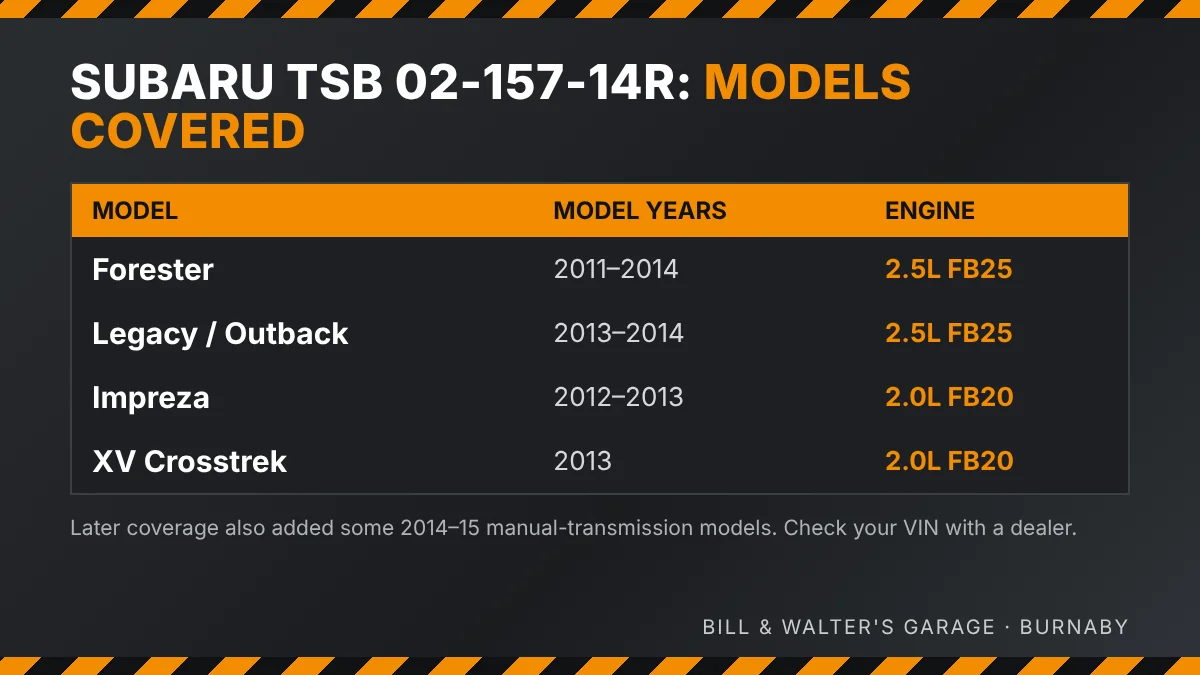
Subaru’s bulletin 02-157-14R is titled “Surface Treatment Change To Oil Control Piston Rings”. It covers 2013–14 Legacy and Outback 2.5L FB, 2011–14 Forester 2.5L FB, and 2012–13 Impreza and 2013 XV Crosstrek 2.0L FB. Confirmed cases “will no longer be repaired with piston ring replacement”. Instead, they get a new short block (Subaru TSB 02-157-14R). Cars.com reports that later coverage also included some 2015 Forester and 2014–15 Impreza and XV Crosstrek models with manual transmissions (Cars.com).
2. PCV system faults
The positive crankcase ventilation (PCV) system pulls oil vapour from the crankcase into the intake. If the valve or oil separator fails, more oil gets drawn in and burned. Subaru’s test procedure starts by checking PCV operation (TSB), and a Subaru dealer notes that a faulty PCV valve raises consumption (Subaru of Ontario).
3. Wrong oil or stretched oil-change intervals
Most of these engines are specified for 0W-20 synthetic. The same dealer says the wrong viscosity or conventional oil may increase consumption, and that long oil-change intervals and short trips also play a part (Subaru of Ontario).
4. Leaks that look like consumption
Leaks from valve cover gaskets, seals or the oil pan can also lower the level. Rule out leaks before you assume the engine is burning oil. Subaru’s test procedure does this first too.
Warranty extension and the class action
In the US, Subaru of America extended the powertrain warranty “to 8 years or 100,000 miles for engine oil consumption concerns” on specific models (Subaru retailer notice, 2016). This was part of the Yaeger v. Subaru of America class-action settlement. The lawsuit had alleged that ring replacement often didn’t solve the problem (CarComplaints).
In Canada, the Automobile Protection Association (APA) reports that Subaru Canada extended the warranty to 8 years / 160,000 km on many 2011–2015 models (APA; see also the model list quoted on BITOG). We found no separate Canadian class action. Counting from in-service dates, most cars are now past the 8-year window. If your car is a late-registered example, call a Subaru dealer with your VIN to confirm whether anything still applies.
Did later engines fix it? Torque News, citing Consumer Reports, says the data showed significant improvement after the 2014 model year (Torque News). The APA, on the other hand, says it still hears of problems on some 2016–17 models (APA). So check the oil on any Subaru, whatever the year.
What owners report
- A 2013 Outback FB25 owner on Bob Is The Oil Guy uses about a quart every 1,300–1,400 miles. A new PCV valve, different oils and engine flushes didn’t help, and the owner calls the early FB25 “notorious for oil burning” (BITOG).
- On r/subaru, a 2012 Forester owner at about 156,000 miles describes the engine dying with a screeching noise and an empty dipstick, a month after adding three quarts. Commenters pointed to worn rings (Reddit r/subaru).
- A CarTalk thread follows a 2012 Forester that burned oil from new. The dealer ended up installing short blocks and catalytic converters under warranty after about two years of documented oil use (CarTalk).
- On CarGurus Canada, a 2012 Forester owner found no oil on the dipstick only 700 miles after a short block replacement (CarGurus.ca). Subaru’s bulletin notes that new rings take time to seat, but this kind of loss needs follow-up.
The lesson from these owners: keep a written log of every top-up. It’s the evidence a technician, a dealer or a warranty claim will ask for.
What happens if you ignore it
Burning a litre every couple of thousand kilometres is a nuisance. Running the engine low is how it turns into a failure. RepairPal warns that letting the oil level get too low “can lead directly to engine failure”, and that oil in the exhaust can destroy the catalytic converter (RepairPal). Bearings starved of oil can seize, and an engine that seizes at highway speed is a safety problem as well as an expensive one.
What you can check yourself vs. what needs a shop
Safe for owners
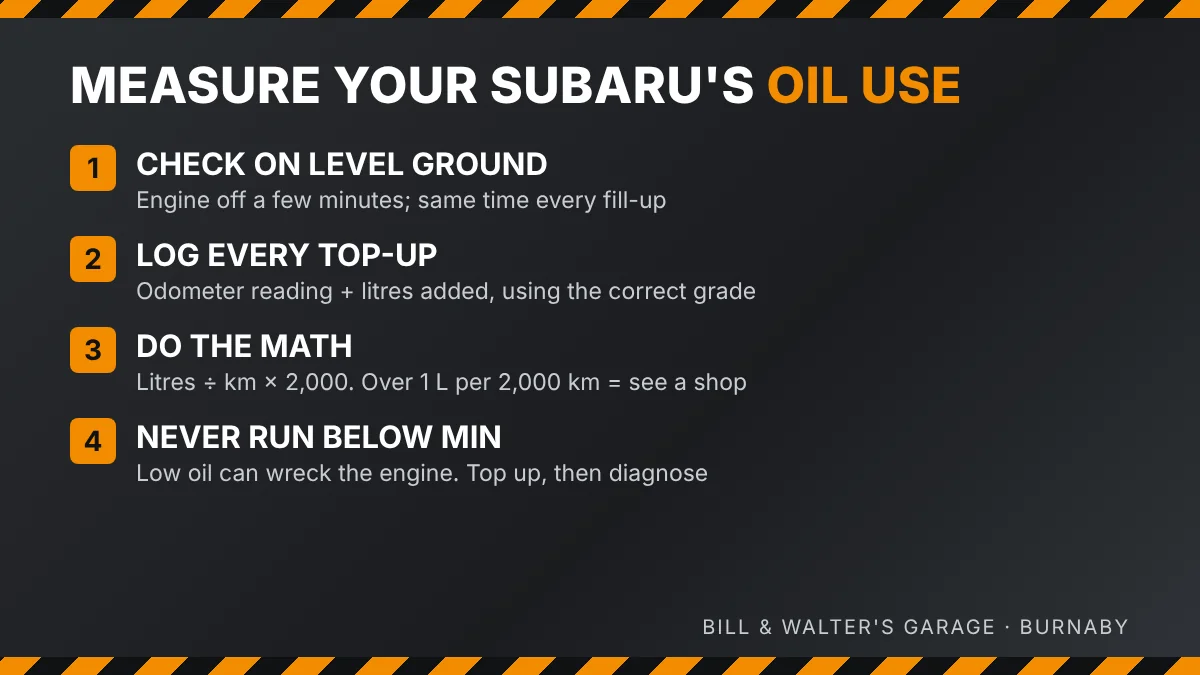
- Park on level ground and check the dipstick with the engine off for a few minutes. Do it at the same time each week or every fill-up, as Subaru suggests.
- Write down the odometer reading and how much oil you add each time. Use the grade in your owner’s manual.
- Work out your rate: litres added ÷ kilometres driven × 2,000. More than 1 L per 2,000 km is beyond Subaru’s guideline.
- Look under the car for fresh drips and around the engine for wet, oily areas.
- Never let the level fall below the lower mark. Top up, then get it diagnosed.
Leave to a shop
Confirming ring-related consumption takes a controlled test. Subaru’s procedure checks for leaks and PCV faults first, then changes the oil, and the car returns after at least 1,200 miles (about 2,000 km) without the owner adding oil in between (TSB). Inspecting the PCV system, checking for leaks and doing compression or leak-down tests all belong in a shop.
Why this matters for Lower Mainland drivers
Foresters, Outbacks and Crosstreks are everywhere in Metro Vancouver. Lots of them do short city trips in Burnaby and Vancouver, then long climbs to the ski hills or up the Sea-to-Sky. That mix is hard on an engine that’s slowly using oil. Short trips make it easy to forget the dipstick, and a sustained climb with a low level is when damage happens. A quick check before any mountain trip is a good habit. Many of these cars are also now high-kilometre used vehicles, so a pre-purchase inspection should include asking for oil-consumption history.
How Bill & Walter’s diagnoses it
Bill & Walter’s Garage has been family-owned in Burnaby since 1956. We specialise in European vehicles and service all other makes, including Subaru. Every visit starts with a safety inspection. For an oil-consumption concern we:
- Confirm the oil level and grade, and review your top-up log and service history.
- Look for external leaks and inspect the PCV system and intake for oil residue.
- Scan for codes. Misfires or catalyst codes can point to oil burning (see our check engine light guide).
- Where needed, run a measured consumption check and compression or leak-down tests, then explain the options in plain language. We’re independent, so there’s no franchise or manufacturer sales pressure.
Regular oil changes with the right specification are the simplest protection (see our car maintenance page). You get a free courtesy car while we work, and regular customers in the Brentwood area also get free pickup and delivery.
Topping up your Subaru between oil changes? Call (604) 298-3031 or book online. We’re at 4406 Dawson St, Burnaby, open Mon–Fri 7:00 AM–5:30 PM and Sat 7:30 AM–4:00 PM.
FAQ
How much oil consumption is normal for a Subaru?
Subaru’s 2012 Impreza owner’s manual says to contact a dealer if consumption after break-in is more than 1 litre per 2,000 km (1 quart per 1,200 miles). Using less than that is within Subaru’s guideline, though you should still check the level regularly.
Which Subarus have the oil consumption problem?
Subaru’s bulletin 02-157-14R covers 2011–14 Forester 2.5L, 2013–14 Legacy and Outback 2.5L, and 2012–13 Impreza and 2013 XV Crosstrek 2.0L FB engines. Some 2014–15 manual-transmission models were added to later coverage.
Is Subaru oil consumption still covered under warranty in Canada?
Subaru Canada extended coverage to 8 years / 160,000 km on many 2011–2015 models, according to the APA. Most of those vehicles are now past that window. A Subaru dealer can check your VIN.
Can a PCV valve cause a Subaru to burn oil?
Yes. A faulty PCV valve or oil separator can increase oil consumption, which is why Subaru’s test procedure checks PCV operation before anything else.
Will burning oil damage my catalytic converter?
It can. Oil burned in the engine goes into the exhaust, and RepairPal notes that too much oil in the exhaust can destroy the catalytic converter. Fixing consumption early protects the converter.
Can I keep driving a Subaru that burns oil?
Many owners do, as long as they check the level often and top it up. The danger is letting it run low, which can cause engine failure. Get it diagnosed so you know the cause and the rate.
Sources
- Subaru TSB 02-157-14R: Surface Treatment Change To Oil Control Piston Rings (NHTSA file)
- Subaru of America: Powertrain warranty extension for oil consumption (NHTSA file, 2016)
- CarComplaints: Subaru oil consumption class action lawsuit
- Cars.com: 2011–15 Subaru oil consumption update
- Automobile Protection Association: Subaru oil consumption
- BITOG: Subaru warranty extension, high oil consumption (Canada model list)
- 2012 Subaru Impreza owner’s manual: engine oil consumption
- Subaru of Ontario: Subaru oil consumption, what owners should know
- Torque News: Subaru engines, models and years that burn oil
- RepairPal: Car burning oil
- BITOG: 2013 Subaru 2.5L oil burn
- Reddit r/subaru: 2012 Forester ran out of oil
- CarTalk: 2012 Subaru Forester, more on oil-burning Subies
- CarGurus.ca: 2012 Forester excessive oil consumption after short block
Disclaimer: Low oil and smoke can have more than one cause. This article is general information. A hands-on inspection is the only way to confirm the diagnosis for your vehicle.