MINI Cooper oil consumption is partly normal: MINI says every engine uses some oil, and its turbocharged engines use more than most. A MINI service bulletin treats up to about one quart (just under a litre) every 750 miles, roughly 1,200 km, as within spec. The real danger is not the oil use itself but running the engine low, which on the 2007–2010 Cooper S N14 engine is linked to timing chain and engine damage.
Quick answer: key takeaways
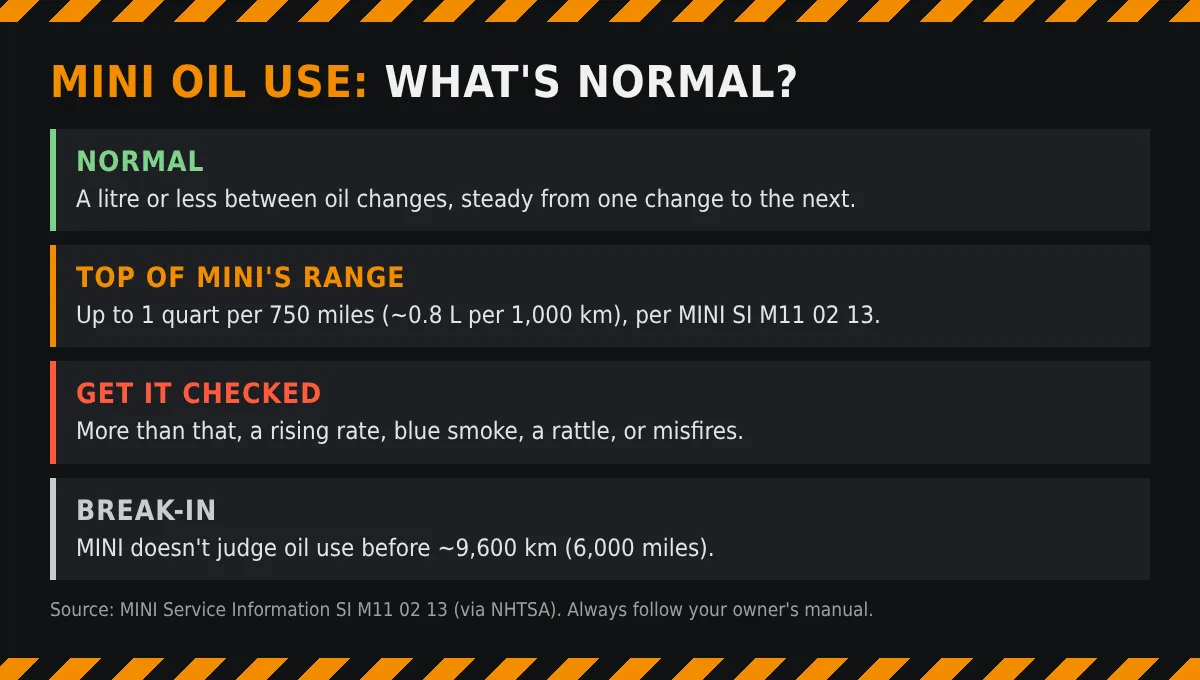
- MINI service bulletin SI M11 02 13 says MINI engines can use up to 1 quart of oil per 750 miles (about 0.8 L per 1,000 km) and still be considered normal.
- MINI won’t treat oil use as a complaint until the engine has covered at least 6,000 miles (about 9,600 km), because new engines use more while they break in.
- The 2007–2010 Cooper S with the N14 turbo engine has the strongest reputation for oil use, carbon build-up and timing chain wear. The later N18 engine fixed many of those issues.
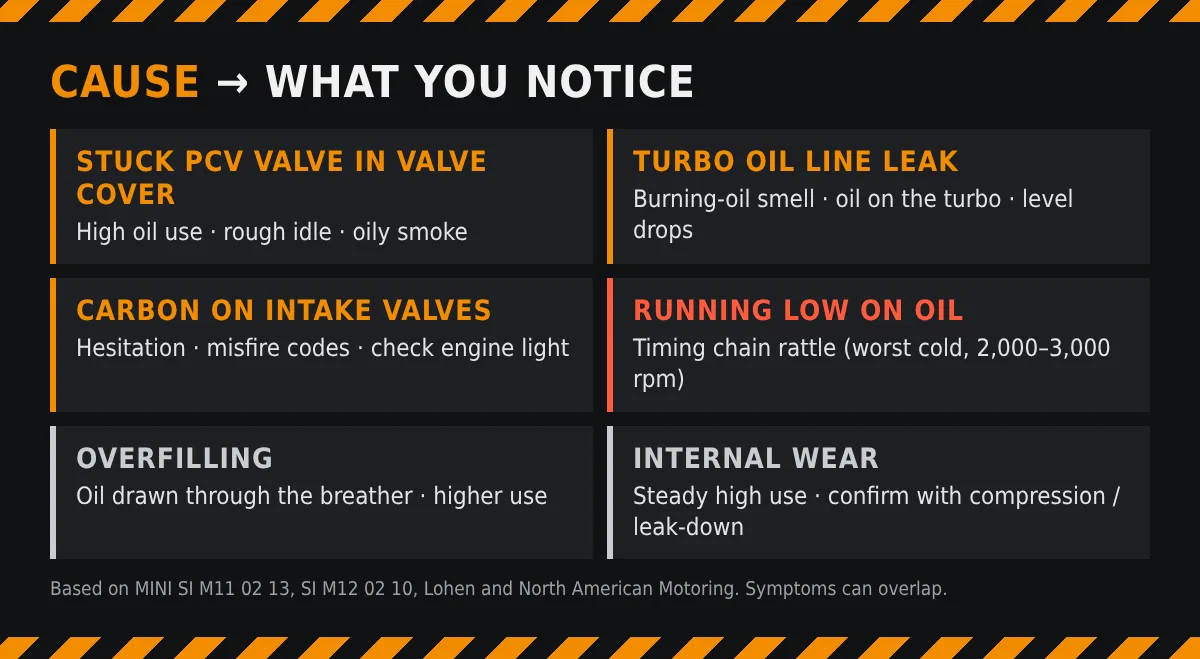
- Common causes of heavy use: a stuck crankcase ventilation (PCV) valve in the valve cover, turbo oil leaks, overfilling and external leaks.
- Check the level often. Running low is what turns normal oil use into an engine repair.
Is MINI Cooper oil consumption normal?
Yes, within limits. The MINI owner’s manuals for several generations say oil consumption depends on how and where you drive. Sporty driving, a lot of idling, the break-in period and the wrong oil can all increase it (MINI owner’s manual, 2017). None of the owner’s manuals we checked give a figure.
The figure comes from the dealer side. In Service Information SI M11 02 13, “Engine Oil Consumption”, MINI tells technicians that its engines can use up to 1 quart per 750 miles, that turbocharged engines use more oil by design, and that complaints on engines under 6,000 miles cannot be considered. It also lists two owner-side causes of higher use: overfilling and a faulty crankcase ventilation valve. To confirm a complaint, the bulletin has the technician drain and measure the oil, drive about 1,000 miles, then drain and measure again.
In practical terms, a MINI that needs a litre between oil changes is behaving well. One that needs a litre every 1,000–1,500 km is close to the top of what MINI calls normal. If it needs more than that, or the rate is climbing, it’s worth finding out why.
Symptoms: how MINI owners notice oil consumption
- Low oil level warning on the dash. On cars with electronic oil measurement, the manual notes a fresh reading needs about 30 minutes of normal driving.
- Dipstick or oil-level reading dropping between changes. On the 2005-era cars, MIN to MAX is about one litre, and MINI says to add oil within 50 km of the warning (MINI owner’s manual, 2005).
- Blue-grey or oily smoke from the tailpipe, especially after idling.
- Rough idle, which can come from a faulty breather (PCV) valve.
- Hesitation when you accelerate, often from carbon on the intake valves.
- Misfire codes and a check engine light.
- A rattle from the engine, often worst on a cold engine between 2,000 and 3,000 rpm. On the N14, that is a timing chain warning sign.
Common causes of high oil consumption in a MINI Cooper
These are listed roughly from most to least common on the second-generation (2007–2013) cars, which generate most of the complaints.
1. N14 turbo engine design (2007–2010 Cooper S)
The N14 in the R55, R56 and R57 Cooper S was MINI’s first direct-injection engine, and enthusiasts on North American Motoring (NAM) describe it as having “a reputation for high oil consumption.” The UK MINI specialist Lohen lists timing chain problems, valve coking and excessive oil consumption among N14 issues. It says many of these were fixed in the N18 engine that replaced it around 2010–2011, although coking still happens less often on the N18.
The turbocharger is cooled and lubricated by engine oil, and MINI’s own bulletin accepts that turbo engines use more oil. That is part of why a Cooper S tends to use more oil than a non-turbo Cooper.
2. A stuck crankcase ventilation (PCV) valve in the valve cover
On the N14, the crankcase breather valves are built into the valve cover. Owners on NAM report that this internal PCV is known to stick open, and a NAM thread quoting the Bentley repair manual explains why it matters. A leaking breather applies full intake vacuum to the crankcase, which pulls oil mist into the intake and can cause high oil use, an uneven idle and oily smoke. Members note that updated valve-cover designs exist and that the breather is usually replaced with the cover, not on its own.
3. Turbo oil feed and return line leaks
Higher-mileage N14 engines often leak at the turbo oil feed line connections. Oil can drip onto the hot turbo, so you may smell burning oil as well as see the level drop (NAM N14 maintenance FAQ). An external leak like this uses oil just as surely as burning it does, and oil on hot exhaust parts is a fire risk.
4. Overfilling
MINI’s bulletin lists overfilling as a cause of increased consumption. Excess oil can be churned up and drawn through the ventilation system. When you top up, add a little at a time and recheck, and don’t go above the maximum mark.
5. Worn internal engine parts
On older, high-mileage engines, internal wear can also add to oil use. The only way to tell is to test, not guess. When a Pelican Parts forum member asked about a 2007 Cooper S that was using about a quart every 1,000 miles, the moderator suggested a compression test and leak-down test first (Pelican Parts forum).
Why oil consumption matters on a MINI: carbon and timing chains
Oil use on its own is a running cost. What it leads to is the bigger issue.
- Carbon build-up on the intake valves. In a direct-injection engine, fuel no longer washes over the intake valves, so oil vapour from the PCV system bakes onto them (NAM). MINI’s own bulletin on N14 misfires, SI M12 02 10, names intake-valve carbon, clogged injector tips and short low-load trips as causes. It lists walnut-shell blasting of the intake as a fix. Lohen suggests carbon cleaning roughly every 30,000–40,000 miles (about 50,000–65,000 km) on cars used for a lot of stop-start driving.
- Timing chain wear. Lohen says the main reasons it sees N14 engines fail are low oil levels leading to oil starvation, and timing chain failure. It describes a rattle that is worse at 2,000–3,000 rpm on a cold engine, and says a rattle that is still there when the engine is warm “indicates a significant problem.”
What MINI owners report
Owner experiences vary a lot, which is part of why this topic causes so much confusion. In a long-running DC Metro MINIs poll, owners reported a wide range of oil use. Several 2007 Cooper S owners reported topping up regularly, and one with over 190,000 km said “1 quart more or less every 1K” miles. A few non-turbo and later Cooper S owners said they rarely needed to add anything. Another 2010 Cooper S owner said a valve cover replacement seemed to help, until the problem appeared to return.
On NAM, a contributor explains that the diaphragm valves inside the original N14 cover tend to gum up, and that later covers use a different valve design. In the N14 FAQ thread, the advice that comes up again and again is simple: check the oil every time you fill up.
These are individual owner reports, not statistics. They show the pattern: the 2007–2010 Cooper S turns up most often, and PCV problems and oil leaks are common causes that can be fixed.
What happens if you ignore it
- Low oil and oil starvation can damage bearings, the turbo and the timing chain.
- A failing timing chain can jump or break. On an interference engine like this, that can mean valves contacting pistons, and that is a major engine repair.
- Carbon build-up gets worse over time, leading to misfires, rough running and hesitation.
- Oil on a hot turbo or exhaust is a burning smell at best and a fire hazard at worst.
- Misfires sending unburned fuel into the exhaust can damage the catalytic converter.
A breather valve or a leaking line is a far smaller job than any of these. Catching it early saves money and keeps the car reliable.
What you can check yourself and what needs a shop
Safe checks at home
- Check the oil level on level ground, following your owner’s manual. Older cars have a dipstick. Newer ones show the level in the vehicle menu after a drive.
- Keep a simple log: date, odometer reading and how much oil you added. That gives you a real consumption rate instead of a guess.
- Use only the oil grade and approval listed in your manual, and don’t overfill.
- Look under the car where it’s parked for fresh drips, and watch for blue smoke or a burning smell after a drive.
Leave these to a shop
- Testing the crankcase ventilation system. MINI’s procedure measures crankcase pressure with special equipment.
- Finding leaks around the turbo, valve cover and oil filter housing, which needs the car on a hoist.
- Compression and leak-down tests to check internal wear.
- Inspecting the intake valves for carbon, and timing chain checks.
The Lower Mainland angle: short trips and stop-and-go
MINI’s misfire bulletin links carbon problems to short, low-load trips, which is exactly how many MINIs are driven around Burnaby and Vancouver. A 5 km run to the SkyTrain, stop-and-go on Hastings or Kingsway, or a crawl on Highway 1 doesn’t let the engine get fully hot and clean itself. Cold, damp winter mornings add moisture to the crankcase too. None of this damages a healthy engine, but it makes regular level checks and on-time oil changes more important.
How Bill & Walter’s diagnoses MINI oil consumption
At Bill & Walter’s Garage, every visit starts with a safety inspection. For an oil consumption concern, we start by confirming the actual rate, then look for the cause in a logical order: external leaks, the valve cover and PCV system, the turbo oil lines, and spark plugs and misfire data. Only if those check out do we test the engine’s internal condition. We work on European cars every day, including MINI and BMW, and as an independent, family-owned shop since 1956, we’re not under any franchise or manufacturer pressure to sell you anything you don’t need.
Related services: diagnose & test, filters & oils, spark plugs and factory-scheduled maintenance. If you also own an Audi or VW, see our article on EA888 timing chain tensioner failure.
Topping up your MINI more than you’d like? Call us at (604) 298-3031 or book online. We’re at 4406 Dawson St, Burnaby, open Monday to Friday 7:00 AM–5:30 PM and Saturday 7:30 AM–4:00 PM. A free courtesy car is available while we work on your MINI.
FAQ: MINI Cooper oil consumption
How much oil consumption is normal for a MINI Cooper?
MINI service bulletin SI M11 02 13 says up to 1 quart per 750 miles, roughly 0.8 litres per 1,000 km, can be considered normal. Most healthy MINIs use far less than that. MINI doesn’t treat oil use as a complaint until the engine has covered 6,000 miles (about 9,600 km).
Which MINI engine burns the most oil?
The N14 turbo engine in the 2007–2010 Cooper S (R55, R56, R57) has the strongest reputation for oil consumption, along with carbon build-up and timing chain wear. The N18 engine that replaced it fixed many of those issues.
Can a bad valve cover cause oil consumption on a MINI?
Yes. On the N14, the crankcase breather (PCV) valves are built into the valve cover. If one sticks open, full intake vacuum reaches the crankcase and pulls oil into the intake. That can cause high oil use, a rough idle and oily smoke. The fix is usually a new valve cover.
Is it safe to keep driving a MINI that uses oil?
Usually, as long as you keep the level between minimum and maximum and the rate isn’t increasing. Running low is what causes damage, especially to the timing chain. Have it checked if you see smoke, hear a rattle or need to add oil often.
How often should I check the oil on my MINI?
Many N14 owners check every time they fill up with fuel. On cars with electronic oil measurement, check the reading after a normal drive of about 30 minutes, and follow the owner’s manual for your model.
Sources
- MINI Service Information SI M11 02 13: Engine Oil Consumption (via NHTSA)
- MINI Service Information SI M12 02 10: Cooper S with N14, Diagnosis for Misfire Faults (via NHTSA)
- MINI Cooper owner’s manual (2017), Engine oil
- MINI Cooper / Cooper S owner’s manual (2005), Engine oil
- Lohen: How do the N14 and N18 MINI Cooper engines compare?
- North American Motoring: N14 engine important maintenance items and common issues
- North American Motoring: Solution to oil consumption, valve cover leak and more?
- DC Metro MINIs: Does your MINI consume oil?
- Pelican Parts forum: Oil consumption diagnosis
Disclaimer: Symptoms like oil loss, smoke and misfires can have more than one cause. This article is general information, not a diagnosis. A hands-on inspection is the only way to confirm what’s happening with your vehicle.