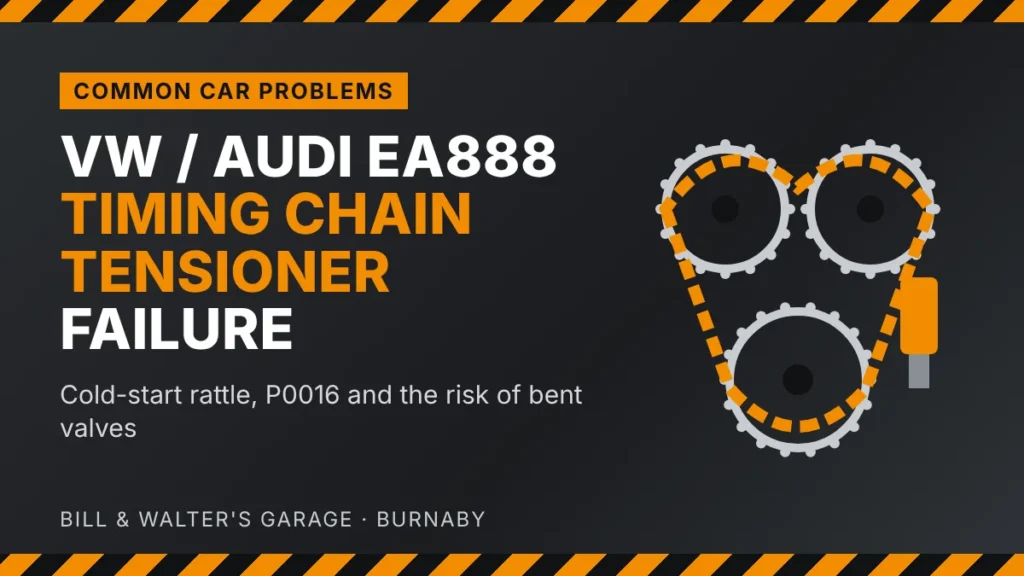
On many 2008–2014 Volkswagen and Audi 2.0T engines, the EA888 timing chain tensioner can lose its tension. The chain then slaps on cold starts and can eventually jump a tooth. These are interference engines, so a skipped chain can let the pistons hit the valves. A rattle for a few seconds after a cold start is the warning to act on, not one to live with.
Quick answer: key takeaways
- Affected: early (Gen 1 and some Gen 2) EA888 1.8T/2.0T TSI/TFSI engines in VW and Audi models from roughly the 2008–2014 model years.
- Main symptom: a rattle or grinding noise for a few seconds right after a cold start, sometimes with a check engine light and code P0016.
- Risk: if the chain jumps teeth, valves and pistons can collide. That turns a tensioner job into a cylinder head or engine job.
- Updated tensioners exist. Checking the tensioner is a shop job that needs the lower timing cover removed.
- The Canadian class-action settlement claim deadline passed on January 25, 2021, so plan on paying for the repair yourself.
What the EA888 timing chain tensioner does
The EA888 family is Volkswagen Group’s four-cylinder turbo engine, used in everything from the Golf GTI and Jetta to the Audi A4, A5, Q5 and TT. Its camshafts are driven by a chain rather than a rubber belt. A hydraulic tensioner keeps that chain snug. It is fed by engine oil pressure and has a mechanical ratchet so the chain stays tight before oil pressure builds.
In 2012 Volkswagen issued a bulletin titled “Engine Rattling Noises after Start, Engine Doesn’t Start, Timing Chain Slipped”. It blamed the problem on “incorrect timing chain tension due to the tensioner” on 2008–2013 cars with the 2.0L CCTA and CBFA engines (VW TSB via NHTSA). When the tensioner can’t hold the chain, the chain gets enough slack to skip over the sprocket teeth.
If you drive a chain-driven European engine, this is a different job from a rubber timing belt replacement. Our timing belt guide covers belt-driven engines.
Symptoms of a failing EA888 timing chain tensioner
Problems usually show up in this order:
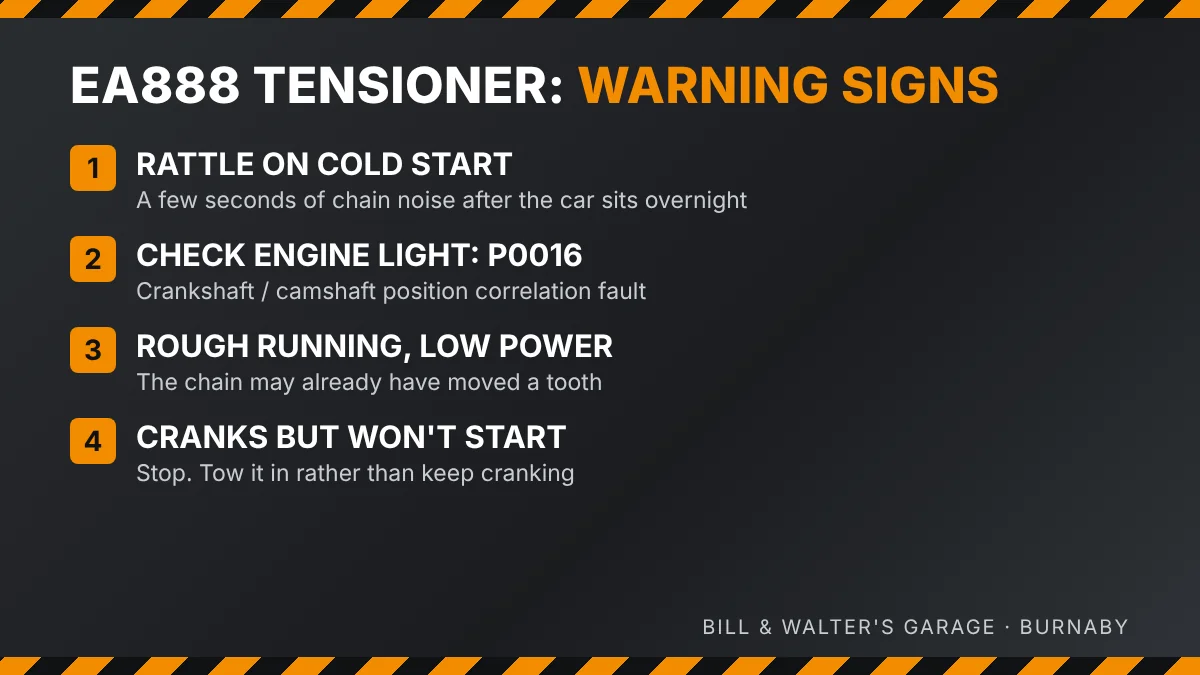
- Cold-start rattle. A loud chain rattle or grinding for a few seconds after the car has sat overnight, which fades as oil pressure builds. It is most noticeable on the first start of a cold morning.
- Check engine light with P0016. The VW bulletin lists fault P0016 (crankshaft/camshaft position correlation) and P0328 (knock sensor) with these failures (source). P0016 means the engine computer sees the cam out of step with the crank.
- Rough running or low power. If the chain has already moved a tooth, the engine can run poorly, hesitate or feel down on power.
- Cranks but won’t start. In the worst case the chain skips far enough that the engine won’t fire. Often this is after the valves have already been damaged.
One important caution: not every cold-start rattle on these engines is the tensioner. A 2018 VW tech tip on 2010–2018 models describes a short cold-start rattle caused by a camshaft adjuster that doesn’t lock (VW Tech Tip 10-18-01TT). Both problems sound similar from the driver’s seat, so you need an inspection to tell them apart.
Common causes, ranked
1. Early-design tensioner losing hydraulic tension
This is the defect behind the bulletins and lawsuits. Parts suppliers note that the early tensioner “may fail losing its hydraulic tension” and list superseded part numbers. They also advise that any 2.0T TSI engine up to 2013 should be checked, because some 2012 cars got the old part and some the new one (Shopdap). VW’s check is a direct one: with the lower timing cover off, the technician pushes the tensioning rail against the tensioner by hand. If the piston compresses, the tensioner has failed (VW TSB).
2. A stretched chain or worn guides
A tensioner that has been working hard for years usually comes with a stretched chain and worn guides. One A4 owner on AudiWorld reports that a previous shop replaced only the tensioner, and the old stretched chain soon wore out the new part (AudiWorld thread). That is why a proper repair looks at the whole timing set, not just one part.
3. Oil condition and service history
The tensioner runs on engine oil, and oil condition matters. When Audi extended coverage for timing chain and tensioner failures, it required owners to show oil-change records within a 10% variance of the specified intervals (Audi bulletin AWA-18-15). Use the correct VW/Audi-approved oil and change it on time. It won’t fix a bad tensioner, but it gives the timing system its best chance.
4. Something else that sounds similar
A cam adjuster that doesn’t lock (see above), a loose heat shield or a noisy accessory can all be mistaken for chain rattle. Listening alone isn’t enough. Scan data and a look inside are what settle it.
Which cars are affected?
The US class action In re Volkswagen Timing Chain Product Liability Litigation listed these EA888 vehicles: Audi A3 2008–12, A4 2009–12, A5 2010–13, A6 2012, Q5 2011–12, TT 2009–12; and VW Beetle 2012–14, CC 2009–12, Eos 2009–12, GTI 2008–12, Jetta 2008–10 and 2012–14 (Kessler Topaz). A second US case covered 2012–2015 Audi A4, A5 and Q5 with the Gen 2 engine (Timing Chain II).
In Canada, the Panacci v. Volkswagen Group Canada settlement, with companion cases in Saskatchewan and Québec, covered 2008–2014 EA888 vehicles sold or leased here. It extended timing chain coverage to 10 years or 160,000 km. The claim deadline for past repairs was January 25, 2021 (Top Class Actions Canada). By model year, that 10-year window has now closed for nearly all of these cars, so most owners today are paying for the repair themselves.
This is not a safety recall. We found no Transport Canada or NHTSA recall for the tensioner itself. The one related-sounding VW recall (15V705) concerns a camshaft lobe on some 2016 1.8T/2.0T engines and is fixed with software (NHTSA recall 15V705). Our advice is still to run your VIN through Transport Canada’s recall database every year.
What owners report
Owner forums show how these failures usually play out:
- A 2009 Jetta 2.0 TSI owner on Audizine had P0016 and half power. A new tensioner alone didn’t fix it, because both camshafts had already moved, and in the owner’s words “it looks like each is off one tooth” (Audizine).
- A 2013 Allroad owner at about 67,000 miles heard a start-up rattle and got P0016. Compression on three cylinders then read zero, which meant cylinder head work (Audizine).
- A 2010 A4 Avant went from hard starting to no start. Only the tensioner had been replaced earlier, and the stretched chain soon wore it out (AudiWorld).
- In a long Mk6 Golf GTI thread, owners describe tensioner and chain failures at around 90,000 km and expensive dealer repairs (VWWatercooled).
The common thread is that the drivers who caught the noise early fared far better than those who kept driving until the check engine light or a no-start.
What happens if you ignore it
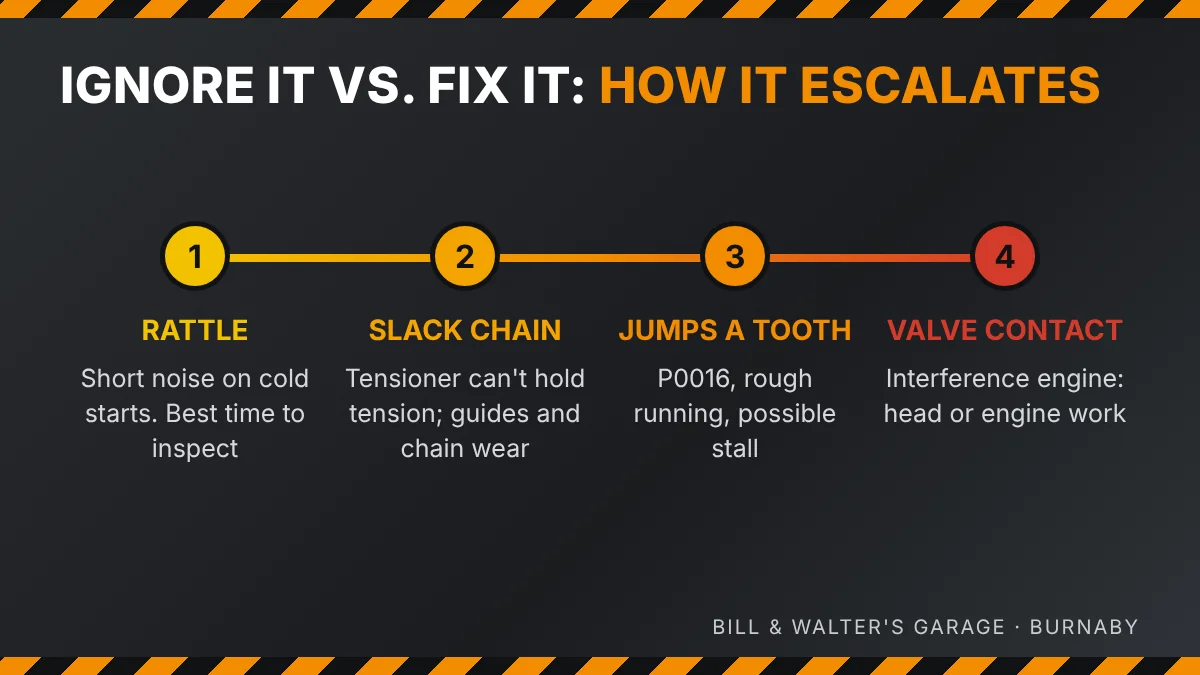
These are interference engines. If the chain jumps far enough, the pistons can hit the valves, and VW’s bulletin tells technicians to inspect pistons, valves, the intake camshaft and its bearing. The cylinder head or the complete engine may need replacing (VW TSB). So the repair can go from a timing-set job to bent valves or a replacement engine in one cold start.
There is a safety side too. An engine that loses timing can stall or lose power suddenly, which is dangerous merging onto Highway 1 or climbing a hill in traffic.
What you can check yourself vs. what needs a shop
Safe for owners
- Listen on a cold start. After the car has sat overnight, start it with the hood closed and the windows down. Note how long any rattle lasts. A phone video with sound is very useful to your technician.
- Note warning lights. If the check engine light comes on, have the code read soon, and don’t drive hard while it’s on.
- Check your service records. Look for proof of a tensioner update. Some invoices list the part number.
- Keep up with oil changes using the VW/Audi-approved specification for your engine.
Leave to a shop
Checking the tensioner means removing the lower timing cover. Replacing the chain, guides or tensioner needs engine-specific locking tools and exact timing alignment. Getting it wrong can cause the very valve damage you’re trying to prevent. This is not a DIY job on these engines.
Lower Mainland driving and cold-start noise
Our winters are mild, but damp mornings in the 0–5°C range are when a weak tensioner rattles most, because the oil is thick and pressure is slow to build. Short trips also mean lots of cold starts, which is when the chain is most likely to skip: think school runs in Burnaby, quick errands, or a car parked outside in North Vancouver for a week. If your VW or Audi rattles on cold starts, that’s worth booking in before winter. Our winter cold-start tips cover other seasonal engine checks.
How Bill & Walter’s diagnoses it
Bill & Walter’s Garage has been family-owned in Burnaby since 1956 and specialises in European vehicles, including Volkswagen and Audi. Every visit starts with a safety inspection. For a suspected tensioner problem we:
- Listen to a true cold start and review your video if you have one.
- Scan for stored and pending codes and look at cam/crank correlation data. We use this to tell a timing problem from a cam adjuster or sensor fault (see our check engine light guide).
- When the evidence points to the timing system, inspect the tensioner and chain under the lower timing cover.
- Explain the findings in plain language so you can decide on the repair. As an independent shop, we have no franchise or manufacturer sales pressure.
While your car is with us, you can use our free courtesy car. Regular customers in the Brentwood area also get free pickup and delivery.
Hearing a rattle on cold starts? Call (604) 298-3031 or book an inspection online. We’re at 4406 Dawson St, Burnaby, open Mon–Fri 7:00 AM–5:30 PM and Sat 7:30 AM–4:00 PM.
FAQ
How long can I drive with a rattling EA888 timing chain tensioner?
Nobody can predict it. Some engines rattle for months and others jump a tooth with little warning. Because these are interference engines, a skipped chain can bend valves, so get it inspected as soon as you notice a cold-start rattle.
Which VW and Audi engines have the tensioner problem?
Mainly early EA888 1.8T/2.0T TSI/TFSI engines (codes such as CCTA and CBFA) in roughly 2008–2014 models, including the GTI, Jetta, CC, Eos, Beetle, A3, A4, A5, Q5 and TT. Later 2012–2015 Audi Gen 2 engines were included in a second US case.
Does a cold-start rattle always mean the tensioner is bad?
No. VW has also documented a short cold-start rattle from a camshaft adjuster that doesn’t lock. Scan data and a physical inspection are needed to tell them apart.
Is the EA888 tensioner covered by a recall in Canada?
No safety recall covers the tensioner. A Canadian class-action settlement extended coverage to 10 years or 160,000 km for 2008–2014 vehicles, but its claim deadline was January 25, 2021, and most cars are now outside that window.
Should I replace just the tensioner or the whole timing set?
That depends on what the inspection finds. On high-kilometre engines, owners report that fitting a new tensioner to a stretched chain didn’t last. A technician should check chain stretch and guides before you decide.
What code does a failing EA888 timing chain tensioner set?
VW’s bulletin associates the failure with P0016 (crankshaft/camshaft correlation) and sometimes P0328. The engine can also rattle with no code stored at all.
Sources
- VW Technical Bulletin: Engine Rattling Noises after Start, Timing Chain Slipped (NHTSA file, 2012)
- VW Tech Tip 10-18-01TT: Cold-start rattle, camshaft adjuster (NHTSA file, 2018)
- Audi AWA-18-15: Timing Chain/Timing Chain Tensioner extended coverage (NHTSA file)
- Kessler Topaz: Volkswagen Timing Chain I settlement
- Kessler Topaz: Volkswagen Timing Chain II settlement
- CarComplaints: VW timing chain tensioner class action settlement (2018)
- Top Class Actions Canada: Volkswagen and Audi timing chain defect settlement
- Shopdap: 2.0T VW and Audi TSI timing chain tensioner problems
- NHTSA recall 15V705 (camshaft lobe, 2016 models)
- Audizine: Cams skipping teeth in opposite directions
- Audizine: 2013 Allroad timing chain failure
- AudiWorld: An unfortunate warning to 2.0T owners
- VWWatercooled: Timing chain and tensioner discussion and issues
Disclaimer: Engine noises and fault codes can have more than one cause. This article is general information. A hands-on inspection is the only way to confirm the diagnosis for your vehicle.