A sweet smell from your car, often described as maple syrup or hot butterscotch, almost always means engine coolant (antifreeze) is leaking and getting hot. If you smell it inside the cabin, the heater core is the usual suspect. If you smell it under the hood after a drive, look at the hoses, radiator and water pump. If it comes with thick white exhaust smoke, coolant may be burning inside the engine, and that needs attention quickly.
Quick answer: key takeaways
- Most coolant is ethylene glycol based. When it leaks onto hot engine parts, it gives off a sweet smell.
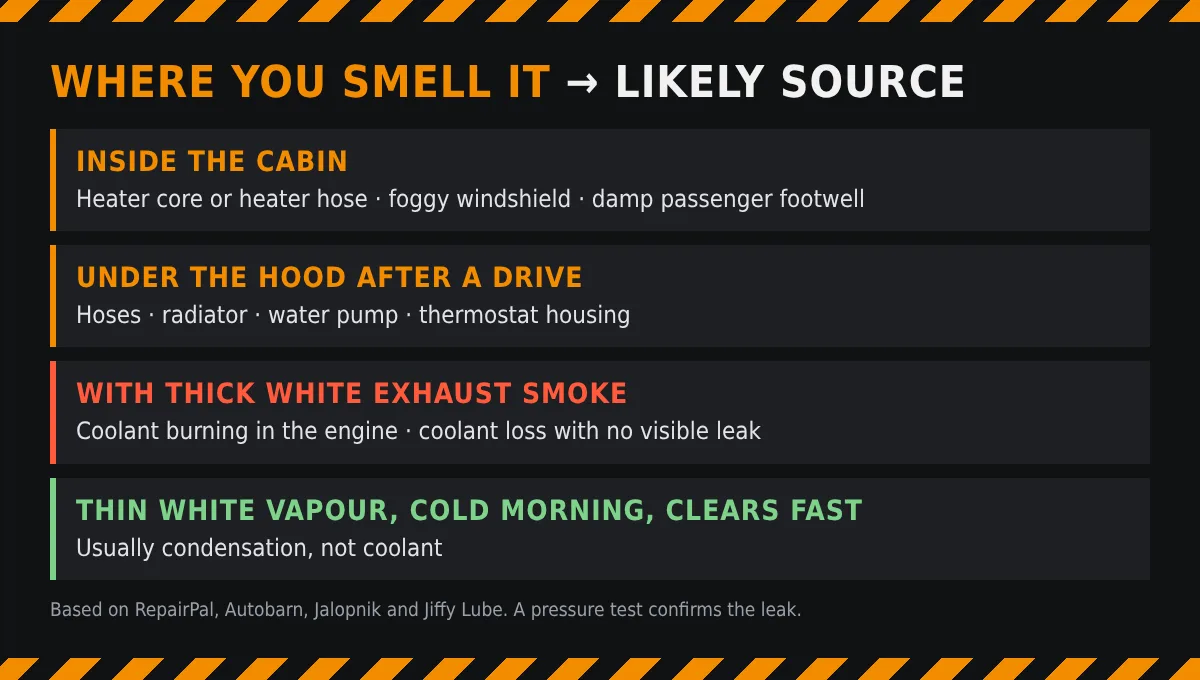
- Sweet smell inside + foggy windshield or damp passenger footwell = likely heater core leak.
- Sweet smell outside the car after driving = likely an external leak at a hose, the radiator, the water pump or the thermostat housing.
- Thin white vapour on a cold morning that soon clears is usually condensation. Thick white smoke that lingers and smells sweet points to coolant burning in the engine.
- Low coolant can lead to overheating and serious engine damage, and antifreeze is poisonous to pets and children. Don’t ignore it.
Why does coolant make a sweet smell from your car?
Most automotive antifreeze is based on ethylene glycol, which VCA describes as a sweet-tasting liquid (VCA Canada). In the jug, it doesn’t smell like much. When it leaks onto a hot engine, exhaust or heater core, it vaporises, and that is the syrupy smell drivers notice. Jalopnik compares hot leaking coolant to the smell of hot butterscotch (Jalopnik).
Where you notice the smell, and what comes with it, tells you a lot about where the coolant is going.
Symptoms: where you smell it matters
Sweet smell inside the car
The heater core is a small radiator behind the dashboard that heats the cabin. When it leaks, RepairPal says you may find coolant in the footwell, notice a sweet smell inside the car and see the windshield fog up with moisture (RepairPal). Autobarn adds that the passenger-side carpet may be wet (Autobarn). The smell is usually strongest with the heater or defroster on.
Sweet smell outside the car or under the hood
If you notice the smell when you get out after a drive, coolant is probably leaking onto hot engine parts. The usual sources are the radiator, the coolant hoses, the water pump and the thermostat housing (RepairPal). You might also see drips or a puddle under the front of the car, or dried, crusty residue around a hose connection.
Sweet smell with white exhaust smoke
This is the combination to take seriously. Jalopnik explains that white smoke from the exhaust usually means coolant is getting into the combustion chambers (Jalopnik). Signs that often come with it include:
- Coolant level dropping with no visible leak. RepairPal says this is a sign coolant may be burning inside the engine.
- Bubbles in the coolant reservoir or radiator, or coolant being pushed out, which suggests combustion gases are getting into the cooling system (AutoNation, SlashGear).
- Milky, frothy or “chocolate milk” coloured oil on the dipstick or under the oil cap.
- The engine running hot or overheating.
White smoke: condensation or coolant?
Not all white vapour is bad news. On a cool, damp morning, which is most mornings in Burnaby from October to April, a little white vapour from the tailpipe is often just condensation. Jiffy Lube says thin white smoke on cold mornings is most likely condensation (Jiffy Lube). Jalopnik notes that lots of short trips, or a car that sits a lot, makes condensation worse, because the exhaust never gets hot enough to dry out.
The differences are in how long it lasts, how thick it is and how it smells. Jiffy Lube describes the coolant kind as “thick, persistent, and carries a sweet aroma.” If the white smoke continues once the engine is warm, or you’re adding coolant regularly, have it checked.
Common causes of a coolant leak
RepairPal lists the radiator, hoses, water pump and thermostat housing as the usual external sources. Here is how they compare with the internal leaks:
- Coolant hoses and connections. Hoses and their connections are a common leak point. Look for wet spots, crusty residue or a hose that looks swollen or cracked.
- Radiator. A leaking radiator often leaves drips or a puddle under the front of the car.
- Water pump. A leaking pump drips coolant onto hot engine parts, which is where the under-hood smell comes from.
- Thermostat housing. Another external leak point that drips onto hot parts.
- Heater core or its hoses. This causes the sweet smell inside the cabin and windshield fogging.
- Head gasket or other internal leak. This causes coolant loss with white smoke, bubbles or milky oil. Autobarn notes that a head gasket leak more often shows up with white smoke than as a sweet smell alone.
What owners report
Owner forums are full of the same story. On the Lexus Owners Club, an LS 400 owner had a mild coolant smell and fogging inside the car with no visible leak. He traced it to a small leak at the heater valve hose at the firewall, then replaced the heater core. A Corvette Forum member described a windshield that fogged on the inside and smelled of antifreeze, with no leaks and a full reservoir. Most replies pointed to the heater core, and one warned “It WILL get bigger.”
On Bimmernut, a BMW E34 owner reported a sweet smell with the heat on, fogging, and coolant dropping slightly every 800 km or so. Suggestions ranged from the heater core to a hose under the coolant reservoir, which shows why it pays to test rather than guess. And on Ford-Trucks.com, an F-series owner with sweet-smelling fog from the defroster was planning a compression test to rule out a head gasket before replacing the heater core.
These are individual owner reports, not statistics, but the pattern is consistent: the smell usually shows up before the problem gets worse.
What happens if you ignore it
- Overheating. RepairPal warns that a car losing coolant can overheat, resulting in serious engine damage. AutoNation adds that driving an overheating engine can warp the cylinder head.
- A small leak becomes a big one. Hoses and seals tend to fail suddenly once they start to weep, often when the engine is hot and under load.
- Poor visibility. A leaking heater core can fog the windshield from the inside, which is a real safety problem on dark, wet Lower Mainland evenings.
- Poison risk. Ethylene glycol is dangerous to swallow even in small amounts (Poison Control). The ASPCA says only a small amount can be fatal to a pet, and VCA notes animals often drink it from drips and spills on driveways and garage floors (ASPCA).
What you can check yourself and what needs a shop
Safe checks
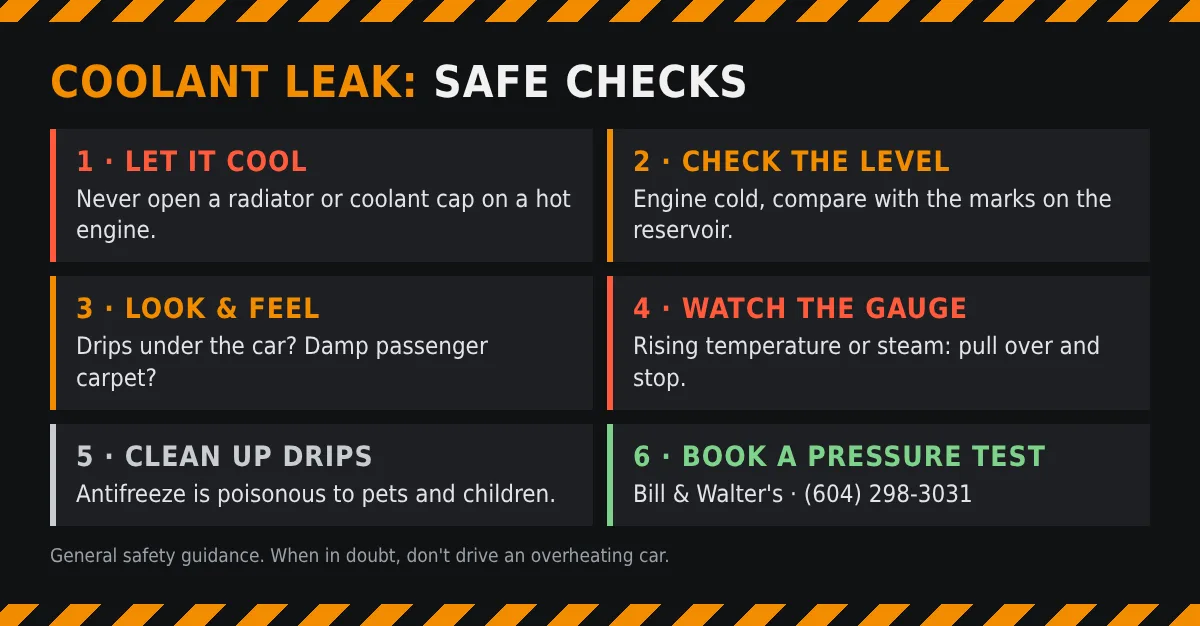
- Let the engine cool completely first. RepairPal warns not to open the hood until the car has cooled down. Never open a radiator or coolant cap on a hot engine. The system is under pressure and hot coolant can cause serious burns.
- With the engine cold, check the coolant level against the marks on the reservoir.
- Look under the car where it’s parked overnight. Coolant is often green, orange, pink or blue and feels slightly slippery.
- Check the passenger footwell carpet for dampness, and notice whether the smell gets stronger with the heater on.
- Watch the temperature gauge, and look at whether white smoke stops once the engine warms up.
- Clean up any drips right away and keep antifreeze containers sealed and out of reach of children and pets.
Leave these to a shop
- Pressure-testing the cooling system to find small or hidden leaks.
- Testing for combustion gases in the coolant, and compression or leak-down tests.
- Inspecting the water pump, thermostat housing and hoses that are hidden behind other parts.
- Diagnosing heater core leaks, which usually means working behind the dashboard.
Coolant leaks in the Lower Mainland
Our wet winters make the condensation-versus-coolant question come up constantly, and fogged windows are easy to blame on rain. If the fog smells sweet, or comes back quickly with the defroster on, it isn’t just humidity. Long climbs (Burnaby Mountain, Highway 1 up to Westwood Plateau or the Sea-to-Sky) and stop-and-go traffic on Highway 1 put the most load on the cooling system, and that is when a weak hose or pump is most likely to let go.
How Bill & Walter’s diagnoses a sweet smell
Every visit to Bill & Walter’s Garage starts with a safety inspection. For a coolant smell, we check the coolant level and condition, pressure-test the cooling system, and inspect the hoses, radiator, water pump and thermostat housing. If the smell is inside the car or there’s white smoke, we look for heater core and internal leaks before recommending any repair. We service all makes and specialise in European vehicles, and as an independent, family-owned shop since 1956, we’re not under any franchise pressure to sell you anything you don’t need.
Related services: belts & hoses, diagnose & test, safety check and factory-scheduled maintenance. If your heater or AC isn’t working properly either, see our article on car AC blowing warm air.
Noticed a sweet smell or white smoke? Call us at (604) 298-3031 or book online. We’re at 4406 Dawson St, Burnaby, open Monday to Friday 7:00 AM–5:30 PM and Saturday 7:30 AM–4:00 PM. A free courtesy car is available while we work on your car.
FAQ: sweet smell from car
Why does my car smell sweet?
A sweet, syrupy smell almost always means engine coolant (antifreeze) is leaking and getting hot. Inside the cabin, the heater core is the usual cause. Under the hood, look at the hoses, radiator, water pump and thermostat housing.
Is it safe to drive with a sweet smell from the car?
Short distances may be okay if the coolant level is full and the temperature gauge stays normal. But a leak can get worse suddenly, and low coolant can lead to overheating and serious engine damage. Have it checked soon, and stop driving if the gauge rises or there is steam.
Why does my car smell sweet when the heater is on?
That is a classic sign of a leaking heater core or heater hose. Other signs are a foggy windshield and a damp passenger-side footwell.
Is white smoke from the exhaust always a head gasket?
No. Thin white vapour on a cold morning that disappears as the engine warms up is usually condensation. Thick, lingering white smoke with a sweet smell, plus coolant loss, suggests coolant is burning in the engine, which can mean a head gasket or other internal leak.
Is antifreeze dangerous to pets and children?
Yes. Ethylene glycol is dangerous to swallow even in small amounts. Clean up drips, store antifreeze sealed and out of reach, and contact a veterinarian, a poison centre or 911 right away if you suspect anyone has swallowed some.
If you think a person has swallowed antifreeze, call 911 or contact the BC Drug and Poison Information Centre. For pets, call your veterinarian or an emergency animal hospital right away.
Sources
- RepairPal: Coolant leaks, what causes them and what to do
- Autobarn: Sweet smell from engine
- Jalopnik: White smoke from your exhaust, what it means
- Jiffy Lube: Does white smoke from the exhaust mean trouble?
- AutoNation Parts: Symptoms you blew a head gasket
- SlashGear: If your diesel exhaust smells sweet, this is probably why
- ASPCA: The dangers of antifreeze and your pets
- VCA Canada: Ethylene glycol poisoning
- Poison Control: Antifreeze, bad for your kids and pets
- Lexus Owners Club: Smell of coolant inside
- Corvette Forum: Smells like antifreeze
- Bimmernut: Heater smells sweet
- Ford-Trucks.com: Potential serious problem
Disclaimer: A sweet smell, white smoke and coolant loss can have more than one cause. This article is general information, not a diagnosis. A hands-on inspection is the only way to confirm what’s happening with your vehicle.