Car AC blowing warm air? The most common reason is low refrigerant from a leak. Close behind are a compressor or clutch that isn’t engaging, an electrical fault, a condenser or cooling fan problem, or a stuck blend door. When and how the air goes warm narrows down the cause. Topping up refrigerant without finding the leak is only a temporary fix.
Quick answer: key takeaways
- Low refrigerant is the most common cause, and in a sealed system low refrigerant means a leak.
- Warm only at idle, cool when moving? Suspect condenser airflow or the cooling fan.
- One side cold, the other warm? Suspect a blend door actuator.
- DIY recharge cans can overcharge the system, and sealers can clog parts and contaminate shop equipment.
- In BC, servicing vehicle AC is limited to approved, trained people, and releasing refrigerant is prohibited.
How your car’s AC works (in 60 seconds)
Your AC doesn’t make cold. It moves heat out of the cabin. O’Reilly’s explainer describes the loop. A belt-driven compressor squeezes low-pressure refrigerant gas into a hot, high-pressure gas. The condenser behind the grille sheds that heat and turns it into a liquid, with a fan helping airflow, especially at idle. An expansion valve or orifice tube drops the pressure. The evaporator in the dash then absorbs heat from cabin air that the blower pushes across it. A receiver-drier or accumulator removes moisture.
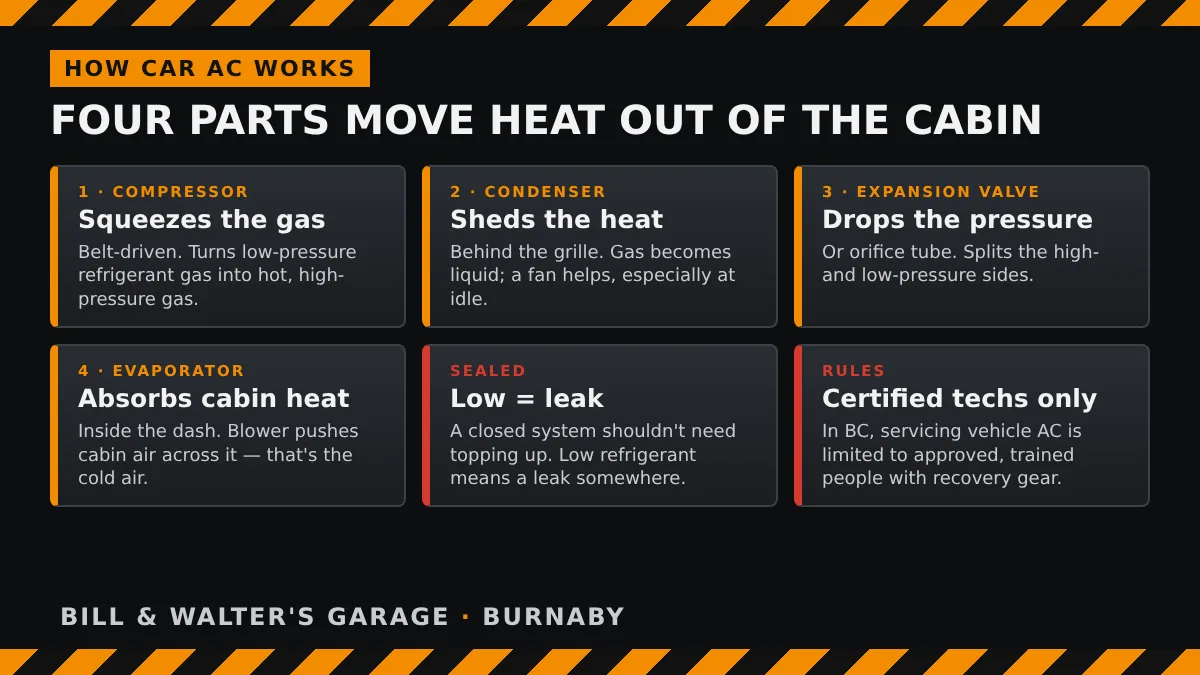
It’s a sealed system. If refrigerant is low, it has leaked out somewhere. It hasn’t been “used up.”
Symptoms: how car AC blowing warm air shows up
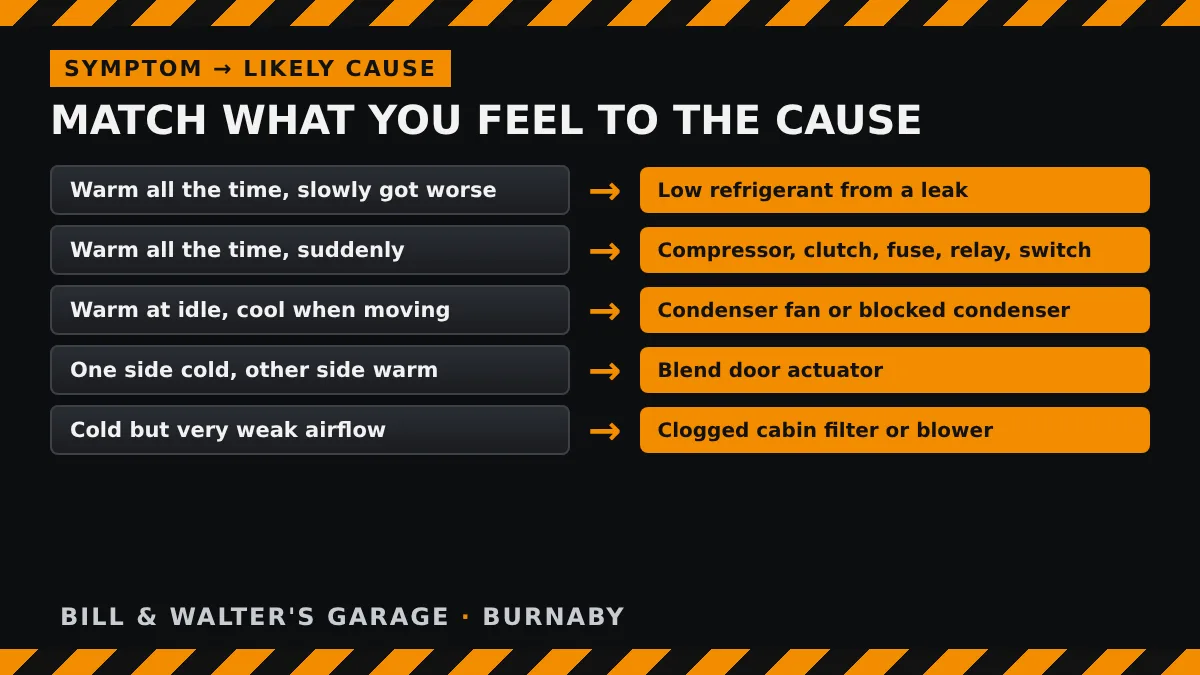
- Gradually less cold over weeks or months: typical of a slow leak.
- Suddenly warm: points to a part or electrical failure (compressor, clutch, fuse, relay, pressure switch).
- Cool on the highway, warm at a stoplight: points to condenser airflow.
- Cold on one side, warm on the other, or temperature that won’t change: a blend door issue.
- Cold air but very little of it: a clogged cabin filter or blower problem.
- Clicking on and off rapidly, or new noises from the compressor. (Our post on a noisy AC compressor covers sounds in detail.)
Common causes of a car AC blowing warm air
1. Low refrigerant from a leak
Kelley Blue Book calls low refrigerant the most common reason an AC blows hot air. It also says recharging without fixing the leak is a temporary fix that is environmentally irresponsible. Cars.com notes that leaks happen at seals and in components, and that a healthy system shouldn’t need topping off. One well-documented example is Honda. Its service bulletin 19-091 extended warranty coverage on certain factory-defective AC condensers that could develop tiny leaks.
2. Compressor clutch, fuse, relay or pressure switch
If the compressor never engages, nothing circulates. Mavis notes that if the compressor clutch fails, there’s no way to pump refrigerant through the system. The clutch may not engage because of a blown fuse, a bad relay, the clutch air gap or a failed coil. It can also be the low-pressure switch, which is designed to stop the compressor running when refrigerant is low. So a “dead compressor” is sometimes really a leak or a cheap electrical part.
3. A failed compressor
Kelley Blue Book calls the compressor the most expensive AC part to fix. It’s one reason a proper diagnosis matters before anyone replaces parts.
4. Condenser blockage or cooling fan failure
The condenser needs airflow to get rid of heat. Parts maker Four Seasons says poor condenser airflow is a common cause of AC that blows warm air at idle, often in stop-and-go traffic. YourMechanic notes that a failed condenser fan can cause warm air and overheating at idle that ease once the car is moving. A condenser blocked by debris, or damaged by road stones, has a similar effect.
5. Blend door actuator
A small motor in the dash moves a door that mixes hot and cold air. Kelley Blue Book notes that if the blend door sticks on heat, the AC can blow hot air. In dual-zone cars it often shows up as one side warm and the other cold.
6. Clogged cabin air filter
A packed cabin filter restricts airflow. The air may still be cold, but so little comes out that the car never cools down. It’s one of the easiest things to rule out.
What owners report about car AC blowing warm air
Reddit couldn’t be loaded for this article, so these examples come from owner forums. They’re paraphrased, with links.
- A Corvette owner on CorvetteForum had warm air from the driver’s side only. It was fixed by replacing the driver-side blend door actuator.
- A Land Rover LR4 thread on LandRoverWorld describes warm air while stopped because the cooling fan wasn’t spinning properly. One owner found the fan rubbing the shroud.
- In a CivicX DIY recharge thread, one 10th-gen Civic owner added a second can and the compressor began short-cycling. A dealer later found leaks in several components. That’s a cautionary tale about recharging without diagnosing.
- A 2003 Civic owner on Honda-Tech said the “AC is warm when idle at a stoplight” but cold while driving. Replies pointed to condenser airflow or the refrigerant charge.
- On Vancouver’s REVscene, a local owner whose AC stopped cooling was advised to check for leaks with UV dye before anything else.
What happens if you ignore it
- Comfort and safety. A hot cabin is tiring. In our climate the bigger issue is fogged windows, because defrost relies on the AC to dry the air.
- Bigger repairs. Running low on refrigerant means running low on the oil it carries. A leak left alone can turn into a compressor replacement.
- Overheating clues. If a cooling fan has failed, the engine can run hot in traffic too. Don’t ignore a rising temperature gauge.
- Environmental harm. Refrigerant that leaks out goes into the atmosphere. That’s why the rules on handling it are strict.
What you can check yourself and what needs a certified technician
Safe checks:
- Make sure the AC button is on, the temperature is set to cold, and recirculate is on during hot weather.
- Feel whether it’s warm all the time or only at idle, and on both sides or one.
- With the engine off, look through the grille for leaves or debris on the condenser.
- Check or replace the cabin air filter if it’s due.
- Check the owner’s manual fuse chart for the AC fuse.
Leave the refrigerant side to a professional. Refrigerant can cause frostbite and serious eye injury. Ford’s R-134a safety data sheet calls for insulated gloves and safety glasses. The gauges on DIY recharge cans read only the low side, and Underhood Service warns this often leads to an overcharged system. Sealers can clog the condenser and expansion valve, and can damage shop recovery machines. Refrigerant types also aren’t interchangeable. Many newer vehicles use R-1234yf, which the EPA says has its own unique fittings, and the industry describes it as mildly flammable.
The rules in BC and Canada
BC’s Ozone Depleting Substances and Other Halocarbons Regulation prohibits releasing refrigerants. It says only an approved person may service a motor vehicle air conditioner. That means someone with trade credentials or apprentice status plus an approved environmental awareness course, using proper recovery equipment. Federally, automobiles from model year 2021 onward can’t use an HFC refrigerant with a global warming potential above 150, according to the Canada Border Services Agency notice on the federal regulations. That effectively rules out R-134a (GWP 1,430) in new cars.
Lower Mainland angle: warm summers, wet winters
Stop-and-go traffic on Highway 1 and the Kingsway corridor is exactly where condenser and fan problems show up first, because there’s little airflow at idle. In our damp winters, a working AC matters just as much. Defrost mode engages the compressor to pull moisture out of the air, which clears fogged windows faster. Regular use also helps keep seals lubricated, though compressors typically won’t run when it’s near freezing. More on that in our post on why you should use your car AC in winter.
How Bill & Walter’s diagnoses AC problems
We’re a family-owned independent shop in Burnaby, servicing all makes and specialising in European vehicles. Every visit starts with a safety inspection. For a car AC blowing warm air, we check how and when the air goes warm and test the electrical side (fuses, relays, clutch and pressure switch). We check condenser airflow and the cooling fans, and look for leaks before any refrigerant is added. The work is done by trained technicians with proper recovery equipment, so the fix lasts and no refrigerant is vented. If the cooling fan is involved, we’ll check the engine cooling system too.
No franchise sales pressure, just a clear explanation of what we found and your options. A free courtesy car is available while we work, and regular Brentwood-area customers get free pickup and delivery. Call (604) 298-3031 or book online. We’re at 4406 Dawson St, Burnaby, open Mon–Fri 7:00 AM–5:30 PM and Sat 7:30 AM–4:00 PM.
FAQ
Why is my car AC blowing warm air all of a sudden?
A sudden change usually points to a failure rather than a slow leak. Common causes are a compressor clutch that won’t engage, a blown fuse or bad relay, a low-pressure switch stopping the compressor, or a failed compressor.
Why does my AC blow cold when driving but warm at idle?
That pattern usually means the condenser isn’t getting enough airflow when the car is stopped. A failed or weak cooling fan, or a condenser blocked with debris, are the usual suspects.
Can I just recharge my car AC with a can from the store?
It’s risky. Can gauges read only one side of the system, so overcharging is common. Sealers can clog parts, and the leak that caused the problem is still there. In BC, servicing vehicle AC is limited to approved, trained people.
Why is only one side of my car blowing warm air?
In dual-zone systems, a failed blend door actuator on one side is a common cause. The door gets stuck on heat while the other side works normally.
What refrigerant does my car use?
Older cars mostly use R-134a. Many newer cars use R-1234yf, which needs different equipment and fittings. Check the label under the hood or your owner’s manual. The two must not be mixed.
Should I use my AC in winter?
Yes. Defrost uses the AC to dry the air and clear fogged windows, and regular use helps keep the system’s seals lubricated.
Sources
- O’Reilly Auto Parts: How do vehicle AC systems work?
- Kelley Blue Book: Why your air conditioning blows hot air
- Mavis: Why is my AC blowing warm air?
- Rick’s Free Auto Repair Advice: Compressor clutch not engaging
- Four Seasons: Condenser airflow tech tip (PDF)
- YourMechanic: Symptoms of a bad AC condenser fan
- Cars.com: Why does your air conditioning need recharging?
- CarComplaints: Honda Civic AC condenser lawsuit and TSB 19-091
- Underhood Service: DIY AC recharge kits
- Ford: R-134a safety data sheet (PDF)
- US EPA: Unique fittings and label colours
- Vehicle Service Pros: Chemours FAQ on R-1234yf
- BC Ozone Depleting Substances and Other Halocarbons Regulation (B.C. Reg. 387/99)
- CBSA Customs Notice 18-25 (federal ODS and halocarbon alternatives rules)
- Jalopnik: Why defrost uses the air conditioner
- Pirelli: Air conditioning in winter
- CorvetteForum: AC warm on driver side only
- LandRoverWorld: AC warm at idle (cooling fan)
- CivicX: DIY refrigerant recharge experiences
- Honda-Tech: AC warm when idle, cold when driving
- REVscene: Good shop to get AC repaired
Disclaimer: Warm air from the vents can have more than one cause, and several can happen at once. This article is general information. A hands-on inspection is the only way to confirm the diagnosis.