Car electrical problems after rain are often caused by water getting inside the car and reaching a fuse box, control module or wiring connector. Clogged sunroof drains, blocked cowl drains below the windshield and failed seals are the usual entry points. Flickering warning lights, a dead battery or locks and windows acting up the morning after a downpour are classic signs.
Key takeaways
- If electrical faults show up only after heavy rain or a car wash, think water leak first.
- The most common culprits are clogged sunroof drains and blocked cowl (wiper-area) drains, both usually filled with leaves and dirt.
- Many cars mount fuse boxes and body control modules low in the footwells, under seats or behind kick panels, which is exactly where leak water collects.
- Damp carpet, foggy inside windows, a musty smell or a sloshing sound are early warnings, so act before a module fails.
- Some water-intrusion problems have been the subject of safety recalls, so check your vehicle’s recall status.
Symptoms: what drivers notice after rain
Water on electronics rarely causes one clean failure. It causes “gremlins” that come and go, often worse the morning after rain and better after a few dry days. Symptoms owners have reported include:
- Dashboard warning lights that stay on or flicker, and a radio that switches itself on and off
- Navigation or screens shutting off while driving
- Interior lights staying on and draining the battery overnight
- Car alarm going off by itself
- Remote, power locks, windows or sunroof not working
- No-crank or no-start after a heavy downpour
- Rapidly flashing turn signals or the instrument cluster going blank
Watch for the physical clues too. A local TV station that interviewed a repair-shop owner about hidden sunroof leaks listed fogged or wet inside windows after the car has been closed up, a sloshing sound while driving, a mould or mildew smell, and carpet that stays damp.
Common causes, ranked
1. Clogged sunroof drains
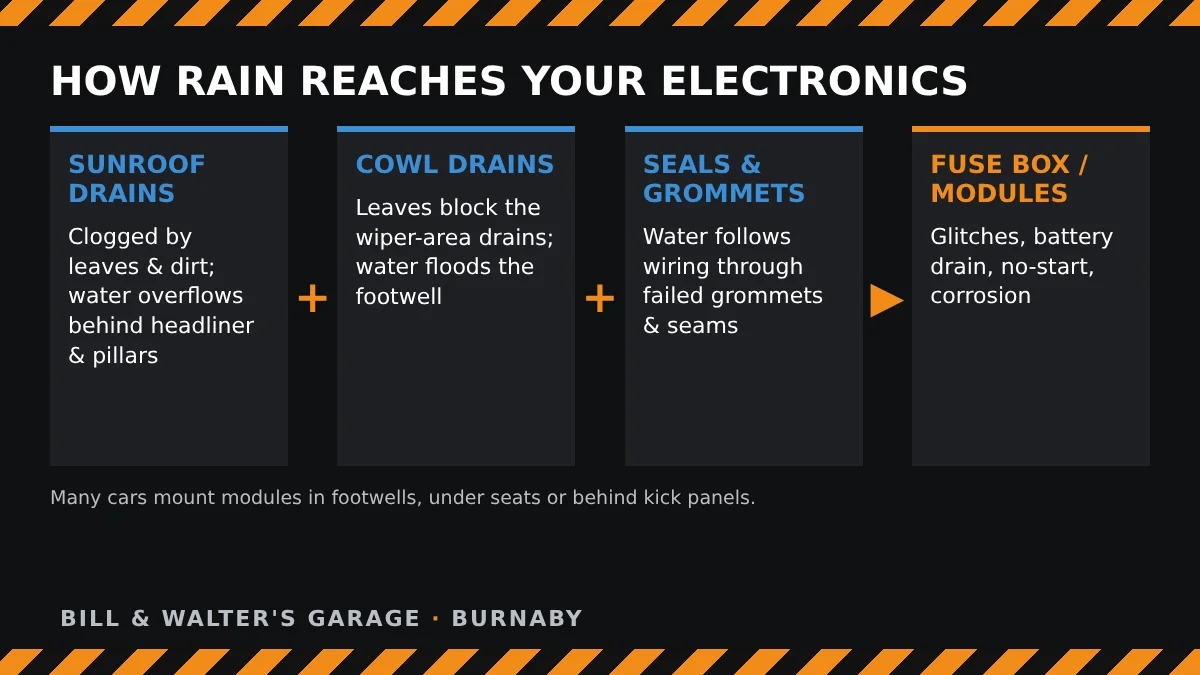
A sunroof isn’t watertight. It relies on rubber seals and a tray that catches water and sends it down drain tubes. Jalopnik explains that there are usually drains at each corner, with tubes running down the front (A) and rear (C) pillars to exit under the car. The front tubes are the ones that typically clog. AutoTrader.ca lists sand, dust, insects and foliage as the usual blockages. When a drain clogs, the water overflows behind the headliner and pillar trim, and it can run straight down onto whatever sits below.
2. Blocked cowl (plenum) drains
The cowl is the area under the wipers at the base of the windshield. It collects rain and drains it out through holes that clog with leaves and pine needles. On some cars, when those drains back up, water can overflow into the passenger footwell. Mercedes S-Class owners on MBWorld describe exactly this: leaves clogged the wiper-cowl drains, the passenger floor flooded, and the rear fuse/relay module under the back seat ended up sitting in water. A Porsche Cayenne owner on Rennlist reports that the dealer found water damage in the fuse/relay box and blamed vents clogged with leaves.
3. Failed seals, grommets and body seams
Not every leak comes from a drain. Owners have traced water to a bad wiring grommet under the steering column, unsealed body seams near the A-pillar, leaking roof clearance-light gaskets on trucks, and the HVAC blower housing. The water often follows a wiring harness down to the module it plugs into.
4. Design problems covered by recalls
Sometimes the leak is a known design issue. Two U.S. (NHTSA) recall examples:
- 2015–2016 Jeep Cherokee with power liftgate (recall 15V-826): water may leak into the power liftgate control module and cause a short circuit that increases the risk of fire. The remedy was a corrosion inspection and a water shield (recall details).
- 2015–2017 Ford Transit with a trailer tow module (recall 18V-275): water can enter the module and corrode the wiring. Possible results include rapidly flashing turn signals, loss of the instrument panel display and even seatbelt pretensioner deployment. The fix added a drain hole in the driver’s door stepwell and a fuse (recall details).
Canadian-market vehicles can be checked in Transport Canada’s motor vehicle safety recalls database or with your dealer using the VIN.
What owners report
Forum threads show how these leaks play out:
- A Mercedes C300 (W204) owner on MBWorld parked under a tree during heavy rain. Afterwards the dashboard lights stayed on and the radio cycled on and off. Leaves had clogged the sunroof drain, water got into the passenger side, and the dealer said the fuse-box damage wasn’t covered by warranty. The owner’s advice: check your drains, especially when trees start dropping leaves.
- An Infiniti Q60 owner on Grassroots Motorsports described flickering dash lights, navigation shutting off and a drained battery. The dealer found a clogged sunroof drain had leaked onto the body control module behind the passenger kick panel. The post title says it all: check the drain.
- A B6 Audi A4 owner on Audizine found the car wouldn’t start after a big rain, with a flooded driver’s footwell and dead interior lights and windows. The comfort module had been sitting in water and needed replacing. The leak turned out to be a bad grommet under the steering wheel.
- An Acura TL owner on Acurazine had the alarm going off after heavy rain and found water dripping from the under-dash fuse box, next to the sunroof drain hose.
- A Ford F-250 owner on Ford-Trucks.com had a no-crank and a drained battery after rain. Water from leaking roof clearance lights was running down the A-pillar and “getting on the GEM module under the dash”.
Audi Q5 owners on CarComplaints.com report that the rear sunroof drain tubes pass through compartments that hold the comfort control module, and that a clog there led to expensive module repairs.
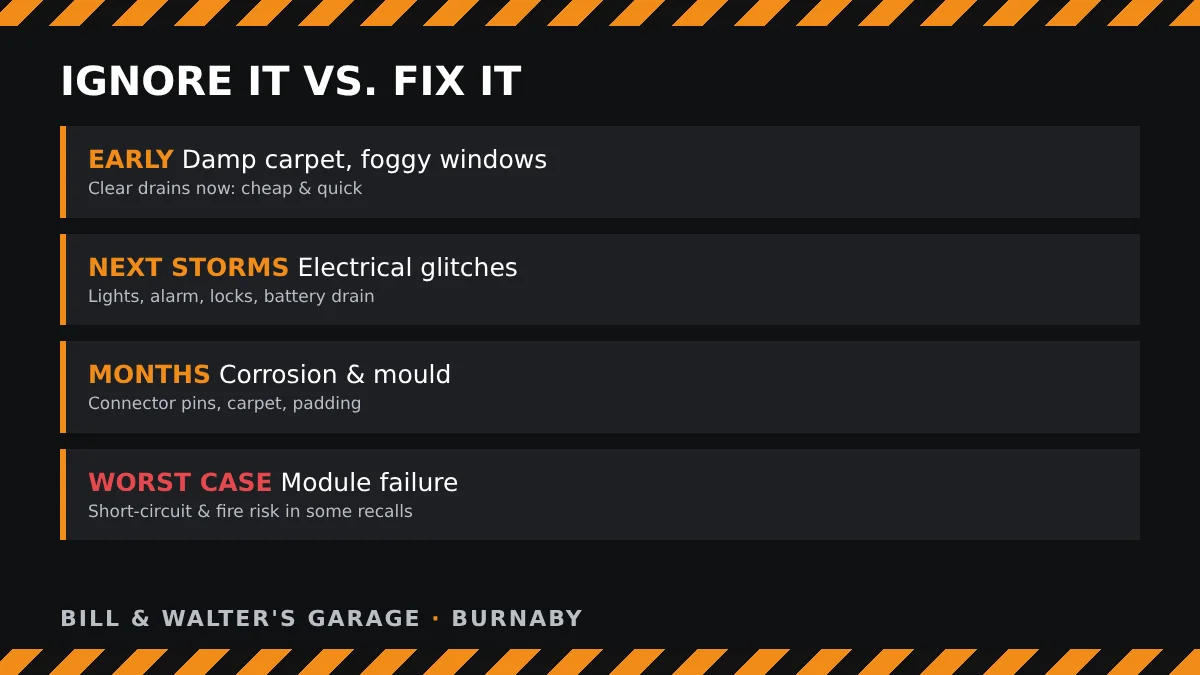
What happens if you ignore it
Water that sits in a car does damage slowly and then all at once. AutoTrader.ca lists wiring, electronics, upholstery, mould and mildew, corrosion and a hit to resale value. Corrosion on connector pins can keep causing faults long after everything has dried out. As the recalls above show, water in a module can also cause a short circuit and a fire risk, or affect safety systems such as turn signals and seatbelt pretensioners. The repair-shop owner interviewed by ABC News 4 warned that sunroof drain problems can cost hundreds to thousands of dollars to fix. Clearing a drain early costs very little by comparison.
What you can check yourself vs. what needs a shop
Easy owner checks:
- Feel the carpets in all four footwells and under the floor mats, and check the spare-tire well.
- Test the sunroof drains. With the car parked, open the sunroof and slowly pour a small amount of water into the channel near each corner. NAPA Know How says water should come out under the car. If it doesn’t, the drain is probably clogged. AutoTrader.ca suggests doing this once or twice a year.
- Clear leaves from the cowl at the base of the windshield, especially in fall.
- Note the pattern. Do the faults appear only after rain or a car wash? Which side of the car is wet? This helps a technician find the leak much faster.
Leave to a shop: forcing hard clogs, removing trim and carpet to reach modules, testing and cleaning corroded connectors, and diagnosing modules and wiring. If you find standing water around a fuse box or module, don’t keep cycling the electrics to “see if it works”. Get it looked at.
Why this is a big deal in Burnaby and the Lower Mainland
Our wet season lines up badly with leaf season. Autumn storms hit just as the trees on Burnaby’s streets drop their leaves, and a car parked under a maple for a few weeks can collect enough debris to plug a cowl or sunroof drain before the heavy rain arrives. Add months of steady winter rain and you get the conditions behind most of the owner stories above. A drain check in October or November is cheap insurance. If your battery keeps dying overnight in wet weather, see our article on why a car battery dies overnight. A leak-related short is one of the causes worth ruling out.
How Bill & Walter’s tracks down rain-related electrical problems
Every visit to Bill & Walter’s starts with a safety inspection. Electrical faults that come and go with the weather are a job for careful diagnosis and testing, not guesswork. We read the fault codes, check the battery and charging system, look for water and corrosion around fuse boxes and modules, and trace the leak back to its source, whether it’s a drain, a seal or a grommet. European cars are our specialty, and many of them mount modules in exactly the places leak water collects, but we service all makes. If the water has already damaged your battery, our battery replacement service can get you going again.
We’re a family-owned independent shop at 4406 Dawson St in Burnaby, here since 1956, and we have a BBB A rating. Call (604) 298-3031 or book online. We’re open Monday to Friday 7:00 AM–5:30 PM and Saturday 7:30 AM–4:00 PM, with a free courtesy car while your vehicle is with us.
FAQ
Why does my car have electrical problems after it rains?
Usually because water is getting inside and reaching a fuse box, control module or connector. Clogged sunroof drains, blocked cowl drains and failed seals or grommets are the most common entry points.
How do I know if my sunroof drains are clogged?
With the car parked, pour a small amount of water into the channel near each corner of the sunroof opening. It should come out under the car. If it doesn’t, or water pools in the channel, the drain is likely blocked.
Can a water leak drain my car battery?
Yes. Owners have reported interior lights staying on, modules staying awake and battery drain after water reached the body control module or fuse box.
Will the electrical problems go away once the car dries out?
Sometimes for a while, but corrosion on connector pins can keep causing faults, and the leak will return with the next rain. The leak source and any corrosion both need to be fixed.
How often should sunroof and cowl drains be checked?
Sources suggest at least once a year. In the Lower Mainland, checking in the fall, when leaves drop and the rainy season starts, makes the most sense.
Are water leaks into modules ever covered by recalls?
Some are. Examples include the 2015–2016 Jeep Cherokee power liftgate module and the 2015–2017 Ford Transit trailer tow module. Check your VIN in Transport Canada’s recall database or with your dealer.
Sources
- Jalopnik, Why You Should Clean Your Sunroof Drains
- AutoTrader.ca, Can your sunroof survive a summertime downpour?
- NAPA Know How, Is Your Sunroof Leaking? 3 Things to Check
- ABC News 4, Hidden problem with car sunroofs costing drivers
- Recall 15V-826, Jeep Cherokee liftgate module water leak
- Recall 18V-275, Ford Transit trailer tow module
- MBWorld, W204 water-damaged fuse box
- MBWorld, S-Class owners: keep your drains clean
- Rennlist, 2005 Cayenne water in fuse relay
- Grassroots Motorsports, Infiniti G35/G37/Q60 drain warning
- Audizine, Flooding and electrical problems after big rain
- Acurazine, Water in under-dash fuse box
- Ford-Trucks.com, Electrical issues when it rains
- CarComplaints.com, 2018 Audi Q5 sunroof leaks into comfort control module
Disclaimer: electrical faults can have more than one cause. This article is general information, and a hands-on inspection is the only way to confirm a diagnosis on your vehicle.