Most DSG transmission problems show up as jerky low-speed shifts, a shudder when pulling away, hesitation from a stop or a flashing gear display (PRNDS) on the dash. The usual causes are worn clutches, clutch adaptation values that have drifted, or a fault in the mechatronic unit that controls the gearbox. Some low-speed clunks are normal for a dual-clutch gearbox, so a proper scan and road test is the fastest way to tell a quirk from a fault.
Key takeaways
- A DSG is two gearboxes in one with two clutches, controlled by a computer-and-hydraulics module called the mechatronic unit.
- Jerking or judder from a stop usually points to clutch wear, adaptation values or the mechatronic unit. A fluid change only helps if the fluid is part of the problem.
- A flashing PRNDS display, limp mode, loss of drive or a burning smell means stop driving and have the codes read.
- Several 2007–2010 VW and Audi DSG models had a recall and extended warranty coverage; check your VIN with Transport Canada and your dealer.
- Cold mornings make many DSGs shift slower and clunk more until the fluid warms up.
How a DSG works (and why it feels different)
A direct-shift gearbox (DSG, called S tronic at Audi) is essentially two manual gearboxes in one housing, each with its own clutch. One clutch drives the odd gears and reverse; the other drives the even gears. The next gear is already selected, so a shift simply hands torque from one clutch to the other. A mechatronic unit, which combines the transmission computer and the hydraulic control unit, runs the whole process (Wikipedia, Direct-shift gearbox).
There are two families you’ll hear about:
- Wet-clutch DSGs such as the 6-speed DQ250 (02E), and the 7-speed DQ381 and DQ500. The clutches run in fluid, and these units are used with higher-torque engines. The DQ500 is rated to 600 N·m and appears in models such as the Tiguan 4Motion and Tiguan R.
- Dry-clutch DSGs, mainly the 7-speed DQ200 (0AM), used with smaller engines of about 1.0–1.6 L and rated to 250 N·m. Its clutches are dry plates, which makes it more prone to judder in slow traffic.
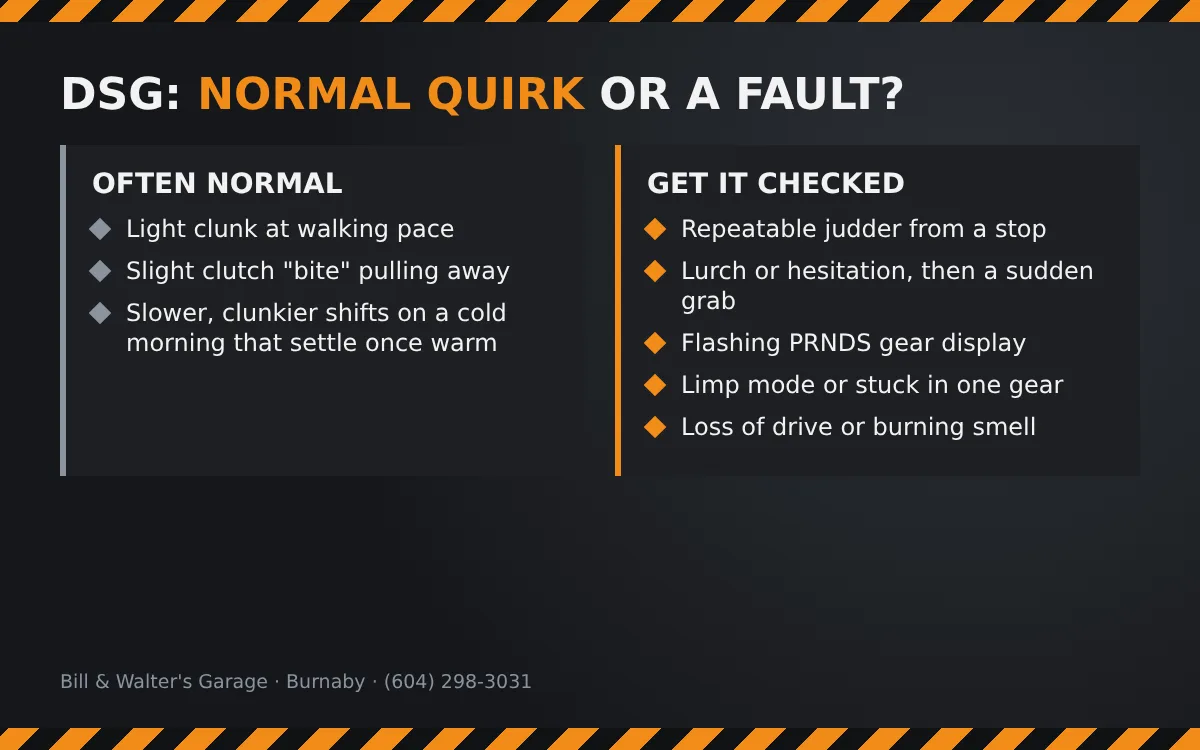
Because a DSG uses real clutches rather than a torque converter, it never feels quite like a conventional automatic. Light clunks at walking pace and a slight “bite” as the clutch engages are part of the design. What isn’t normal is a repeatable shudder, a lurch, a flashing gear display or a car that suddenly loses drive.
Symptoms of DSG transmission problems
Owners and technicians describe a fairly consistent set of warning signs:
- Judder or shudder when pulling away, especially from a stop or on a hill, that feels like the car is shaking through the floor.
- Jerky or harsh shifts at low speed, often on the 1–2 upshift or 3–2 and 2–1 downshifts as you slow down.
- Hesitation when you press the accelerator from a stop, followed by a sudden grab.
- A flashing gear indicator (PRNDS) on the instrument cluster. When the DSG logs a fault, the whole strip often flashes, sometimes with judder or limp mode (Service4Service, flashing gear indicator guide).
- Limp mode: the car is stuck in one gear, or only odd or only even gears work.
- Sudden loss of drive or the car dropping into neutral.
Common causes, ranked
1. Worn clutches
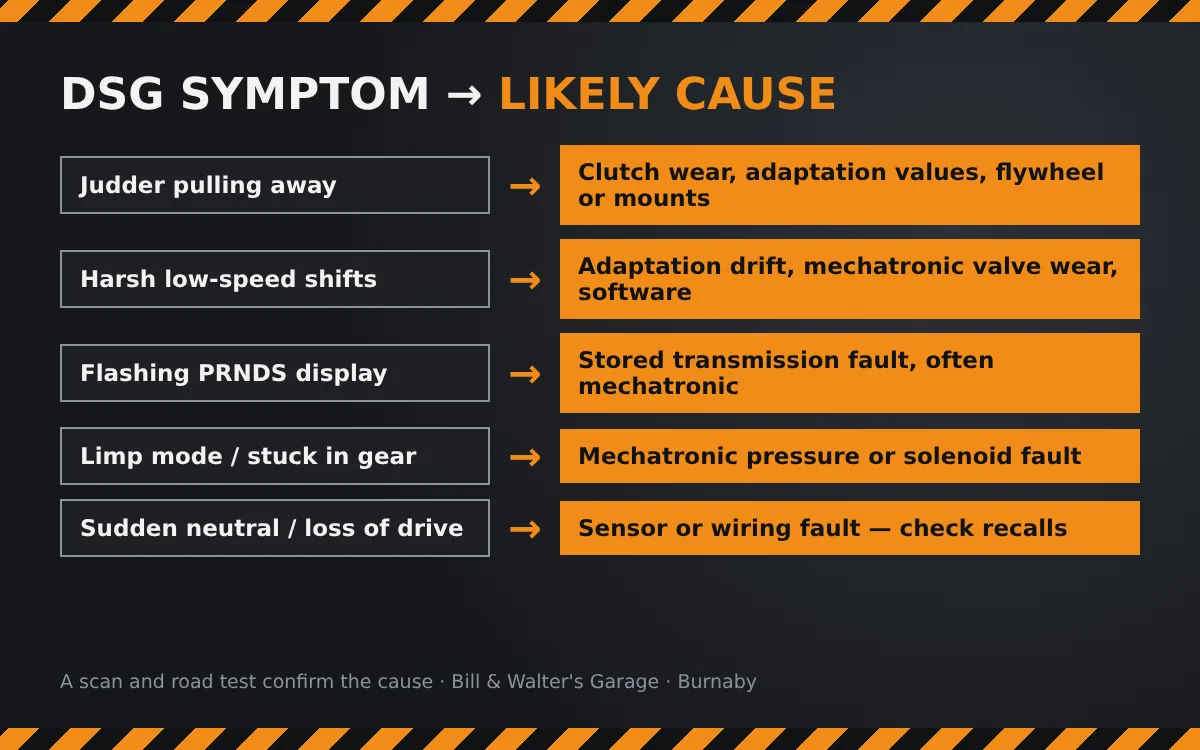
DSG clutches wear like any clutch, and Wikipedia’s summary notes that their life is limited by slippage in low-speed, stop-and-go driving. Worn clutch material is a common reason for judder when pulling away. A recalibration can’t restore worn friction material (Service4Service, DSG judder when pulling away).
2. Clutch adaptation values out of range
The gearbox “learns” exactly where each clutch engages. If those learned values drift, the car can judder or grab even with healthy clutches. A technician can check the adaptation data with a scan tool and, where appropriate, run the basic settings again.
3. Mechatronic unit faults
The mechatronic unit is behind many DSG warning lights. For the 7-speed DQ200, fault codes P17BF (hydraulic pump overload protection) and P189C (insufficient pressure build-up) are linked to jolting shifts, getting stuck in gear and limp mode (Actronics, DQ200 P17BF and P189C). On 6-speed units, shift solenoid and speed sensor codes, together with a flashing PRNDS that often clears after the car cools down, are typical (ECU Testing, DSG gearbox ECU). In 2009, NHTSA’s preliminary investigation PE09035 linked harsh, jerky low-speed shifting to worn bushings in the mechatronic solenoid valves (CarComplaints, PE09035).
4. Wiring and sensor faults
Wikipedia’s DSG summary also notes that DQ200 and DQ250 units could lose power because sulphur deposits in the oil caused wiring short circuits. A 2009 recall (below) involved a badly crimped temperature-sensor wire that made the gearbox think it was overheating.
5. Overdue fluid service on wet-clutch units
Wet-clutch DSGs need periodic fluid and filter service. One VW dealer’s maintenance page lists DSG service every 40,000 miles (about 64,000 km) (Carter VW, maintenance costs); check your own owner’s manual or maintenance booklet, because intervals vary by gearbox and model year. Fresh fluid helps only when fluid condition is part of the problem, and it won’t cure worn clutches.
6. Other causes that feel like a DSG problem
A worn dual-mass flywheel or tired engine and transmission mounts can produce a similar judder, and an engine misfire can feel like a jerky shift. That’s why diagnosis checks more than the gearbox.
Recalls and extended warranties to know about
- Transport Canada recall 2009249 (August 2009) covered 3,467 2009–2010 Audi A3, Audi TT, VW Eos and VW Jetta vehicles. Badly crimped wires on a temperature sensor harness could falsely signal high gearbox oil temperature and shift the transmission into neutral, causing a loss of drive. The fix was a transmission control module reprogram (Guide Auto Web, recall 2009249). The matching US recall was 09V333000 (NHTSA recall 09V333000 summary).
- In the US, Volkswagen Group of America announced a 10-year / 100,000-mile customer service program for DSG mechatronic units on 2007–2009 VW and Audi models, including the GTI, Jetta, Eos, A3 and TT (Automotive Fleet). Coverage in Canada may differ, so ask a VW or Audi dealer about your VIN.
- Transport Canada recall 2019610 covers the 2013 Jetta Hybrid, where the transmission accumulator housing can crack and the car may suddenly lose power (Transport Canada recall 2019610).
You can check any vehicle for open recalls on the Transport Canada Motor Vehicle Safety Recalls Database.
What owners report
Owner forums are full of DSG stories, and a few patterns stand out:
- On Audizine, a 2013 Audi S4 owner described hesitation and a clunk into gear on cold mornings. Other members replied that cold DSGs shift slower and clunk more, and one owner who drives at −27°C said things return to normal once the oil is warm (Audizine, DSG question cold weather).
- Another Audizine member with a 2010 S4 described the car lurching and nearly stalling after cold starts around −12°C. Replies pointed to a software update or a possible mechatronic fault (Audizine, odd DSG behaviour on cold start).
- A Mk7 GTI owner on VWWatercooled reported a brief shudder pulling away in first or reverse during the first minutes after a cold start, even with a recent DSG service, and felt the dealer had brushed it off (VWWatercooled, Mk7 GTI DSG shudder).
- A 2010 Jetta owner on CarComplaints said a gearbox adjustment and oil change reduced the juddering “for awhile,” but it came back within a couple of months (CarComplaints, 2010 Jetta gearbox juddering).
- On r/Volkswagen, an owner of a one-year-old Arteon R described jerky 1–2 and 3–2 shifts. Commenters suggested a software update and adaptation first, then checking the clutch and flywheel (r/Volkswagen, my DSG started failing).
The common thread: quick fixes like a fluid change sometimes help for a while, but lasting results come from finding the real cause first.
What happens if you ignore it
A DSG that judders or hesitates rarely gets better on its own. Clutch slippage creates heat and wear, and a mechatronic fault can progress from occasional harsh shifts to limp mode or a sudden loss of drive. Losing drive while merging onto Highway 1 or pulling away from a stop on a busy intersection is a real safety risk, which is why the 2009 recall was issued. Repairs also escalate: an adaptation reset or software update caught early is a far smaller job than replacing clutch packs or a mechatronic unit later.
What you can check yourself, and what needs a shop
Things you can safely do:
- Note when it happens: cold or warm, first gear or reverse, uphill, at what speed. This helps a technician reproduce it.
- Watch the cluster for a flashing PRNDS or a transmission message, and take a photo if it appears.
- Check for recalls with your VIN on the Transport Canada database.
- Look at your service records to see when, or whether, the DSG fluid was last serviced.
Leave the rest to a shop. Clutch adaptation, basic settings and fault codes require a proper scan tool and specific procedures, and DSG fluid service involves exact fill levels and temperatures. If the car slips, sticks in one gear, loses drive or smells burnt, stop driving and arrange a tow rather than limping it in.
The Lower Mainland angle
Our driving is hard on dual-clutch gearboxes. Stop-and-go traffic on Highway 1, the Kingsway corridor and around Metrotown means lots of slow creeping, which is exactly where DSG clutches slip the most. Burnaby’s hills add pull-away load, and while our winters are mild by Canadian standards, frosty mornings are still when many owners notice their DSG at its clunkiest. If your car only misbehaves for the first few minutes on a cold morning, mention it, because that detail matters for diagnosis.
How Bill & Walter’s diagnoses DSG problems
Every visit starts with a safety inspection. For a DSG complaint, we then do a full diagnostic scan and test: reading transmission and engine fault codes, checking clutch adaptation values and mechatronic data, looking at fluid condition and service history, and road testing to reproduce the symptom. We also rule out look-alikes such as engine misfires, mounts and flywheel wear. You get a clear explanation of what’s wrong and your options before any repair decision.
As an independent, family-owned shop since 1956 that specialises in European vehicles, we work on Volkswagen and Audi models every day, with no franchise or manufacturer sales pressure. We also handle factory-scheduled maintenance so your service history stays on track, and we offer a free courtesy car while your vehicle is with us.
Call (604) 298-3031 or book an appointment. We’re at 4406 Dawson St, Burnaby, open Monday to Friday 7:00 AM–5:30 PM and Saturday 7:30 AM–4:00 PM. If a warning light is also on, our guide to the check engine light explains what to watch for, and VW and Audi owners may also want to read about EA888 timing chain tensioner failure.
FAQ
Is it normal for a DSG to jerk at low speed?
Light clunks and a slight clutch bite at walking pace are normal for a dual-clutch gearbox, and many feel harsher when cold. A repeatable shudder, a lurch from a stop, a flashing PRNDS display or a loss of drive are not normal and should be checked.
What does a flashing PRNDS light mean?
On DSG cars, the gear display usually flashes when the transmission has logged a fault, often in the mechatronic unit. Have the codes read promptly, and stop driving if the car slips, sticks in gear or loses drive.
Will a DSG fluid change fix jerking?
Only if fluid condition is part of the problem. Fresh fluid can’t fix worn clutches or a failing mechatronic unit, which is why a scan and road test should come first.
How often does a DSG need fluid service?
It depends on the gearbox and model year. One VW dealer lists every 40,000 miles (about 64,000 km) for DSG models. Check your owner’s manual or maintenance booklet for your car’s interval.
Was there a DSG recall in Canada?
Yes. Transport Canada recall 2009249 covered 2009–2010 Audi A3, Audi TT, VW Eos and VW Jetta models whose transmission could shift into neutral because of a faulty temperature-sensor wire. Check your VIN on the Transport Canada recalls database.
Why does my DSG shift rough when cold?
Many owners report slower, clunkier shifts until the transmission fluid warms up. If it settles within a few minutes it is often normal behaviour, but judder or lurching that persists, or gets worse, deserves a diagnosis.
Sources
- Direct-shift gearbox (Wikipedia)
- Transport Canada recall 2009249 (Guide Auto Web)
- NHTSA recall 09V333000
- ABC News, Thousands of Cars Recalled Because of Transmission Problems
- Automotive Fleet, VW Group of America announces customer service program
- Transport Canada recall 2019610
- CarComplaints, NHTSA investigation PE09035
- Carter VW, Volkswagen maintenance costs
- Service4Service, Why does my DSG judder when pulling away?
- Service4Service, Flashing drive light or gear indicator
- Actronics, DQ200 DSG P17BF and P189C fault codes
- ECU Testing, VW and Audi DSG gearbox ECU
- Audizine, DSG question cold weather
- Audizine, Odd DSG behaviour on cold start
- VWWatercooled, Mk7 GTI DSG shudder
- CarComplaints, 2010 Jetta gearbox juddering
- r/Volkswagen, My DSG started failing badly
Disclaimer: DSG symptoms can have more than one cause, and some low-speed behaviour is normal for a dual-clutch gearbox. This article is general information; a hands-on inspection and scan are the only way to confirm a diagnosis on your vehicle.