Engine air filter replacement is usually due somewhere between about 24,000 and 48,000 km (15,000–30,000 miles) depending on your car, or sooner if you drive on dusty or gravel roads. Your owner’s manual or maintenance reminder gives the right interval for your vehicle. On a modern fuel-injected engine, a clogged filter mainly costs you power and acceleration, not fuel economy, so the best guide is a quick visual check rather than a fixed rule.
Key takeaways
- Follow your manufacturer’s schedule. Toyota’s Camry guide, for example, says replace at 30,000 miles (about 48,000 km) under normal conditions, while Honda’s maintenance minder flags it under sub-item 2.
- Dusty, gravel or unpaved roads mean more frequent checks and replacement.
- US Department of Energy and Oak Ridge National Laboratory testing found a clogged filter has no measurable effect on fuel economy in modern fuel-injected cars, but it does reduce acceleration.
- A filter that has been soaked by deep water should be replaced, and the intake checked.
- The engine air filter and the cabin air filter are different parts with different jobs.
What the engine air filter does
The engine air filter sits in the air box under the hood and traps dirt, dust and other debris before it can reach the engine’s internal parts, so the engine can make full power efficiently (Haynes). A thin coating of dust is not a problem; AAA notes a lightly dusty filter actually does a better job of trapping contaminants (AAA).
It’s easy to confuse it with the cabin air filter, which usually lives behind the glove box or under the dash and cleans the air you breathe inside the car. A clogged cabin filter doesn’t affect engine performance, but it can cause musty smells and weak airflow from the vents (NAPA Know How). Weak vent airflow is also one of the things we look at when an AC is blowing warm air.
How often is engine air filter replacement due?
There’s no single number for every car, and sources disagree. Here’s what the manufacturers and major parts brands actually say:
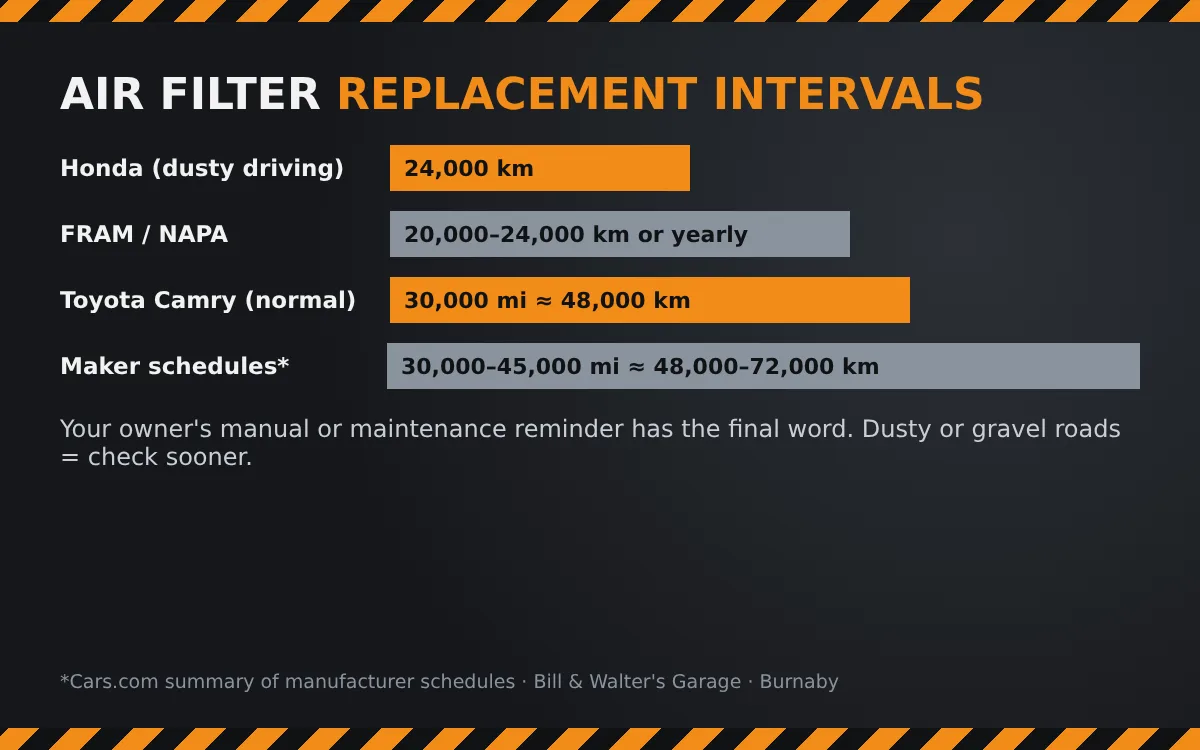
- Toyota (2017 Camry maintenance guide): replace the engine air filter at 30,000 miles / 36 months under normal conditions. On dirt or dusty roads, inspect it from 15,000 miles and then every 5,000 miles (Toyota Camry 2017 Warranty and Maintenance Guide).
- Honda maintenance minder: sub-item 2 means replace the air cleaner element and the dust and pollen filter, and inspect the drive belt. In dusty conditions Honda says to replace the air cleaner element every 24,000 km (15,000 miles) (Honda owner’s manual, maintenance minder).
- Hyundai and Genesis manuals call for more frequent replacement on dusty, sandy, muddy, unpaved or salt-spread roads (Hyundai owner’s manual; Genesis severe usage table).
- FRAM suggests every 20,000–24,000 km (12,000–15,000 miles) or once a year, whichever comes first (FRAM), and NAPA says typically every 15,000 miles and at least once a year (NAPA Know How).
- Cars.com says manufacturer schedules commonly fall between 30,000 and 45,000 miles (Cars.com), and AAA notes that in clean city or suburban driving a filter may last 20,000 miles or more.
Notice that filter brands lean toward shorter intervals than many automakers. The sensible approach is to follow your owner’s manual or maintenance reminder, use the “severe” or dusty schedule if that matches your driving, and have the filter inspected at each oil change.
Signs your engine air filter is clogged
- Sluggish acceleration or reduced power, especially when merging or climbing hills. AAA notes a badly restricted filter will reduce maximum power output.
- A filter that looks dark and packed with debris when held up to a light.
- Debris, leaves or nesting material in the air box.
- Less commonly, a check engine light or rough running, which FRAM lists as possible symptoms, more often on older vehicles (FRAM, dirty air filter symptoms).
Does a dirty air filter hurt fuel economy?
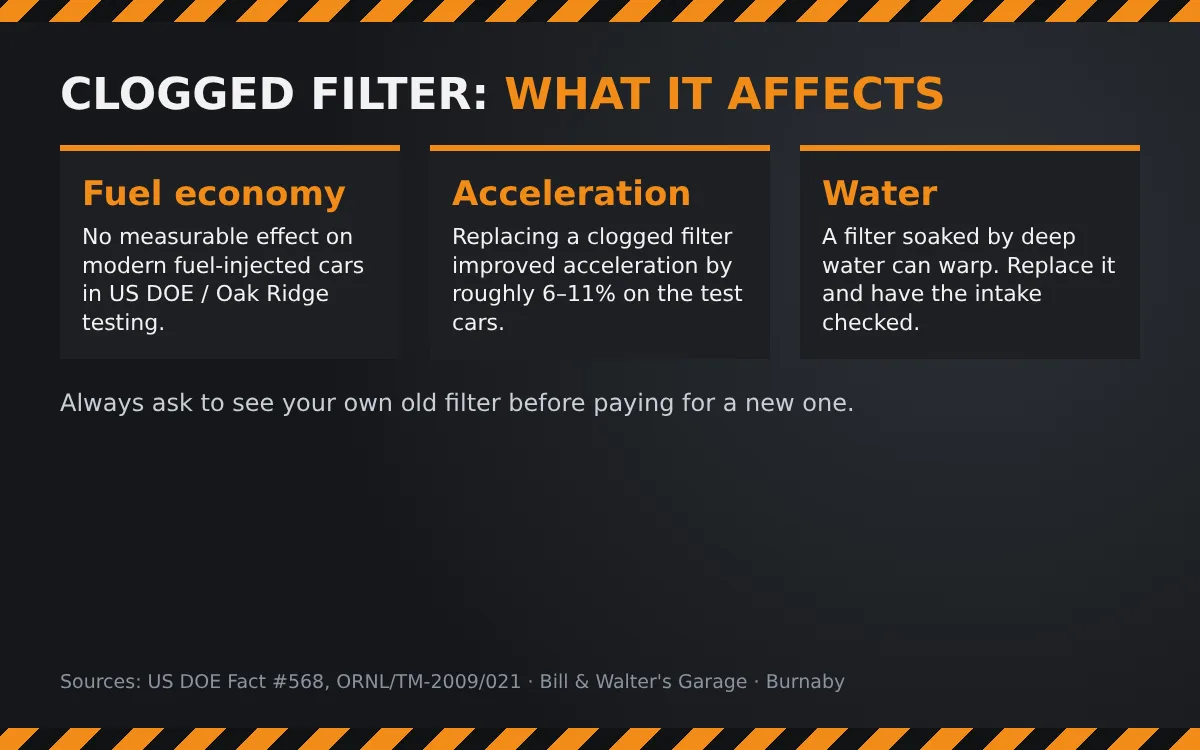
On a modern car, testing says not really. In 2009 the US Department of Energy summarised an Oak Ridge National Laboratory study that found a clogged air filter had no measurable effect on fuel economy in modern fuel-injected cars, because the engine computer keeps the air-fuel mixture on target. What did change was acceleration: replacing a clogged filter improved acceleration by roughly 6 to 11 percent on the test vehicles (US DOE, Fact #568; ORNL report on OSTI). A follow-up ORNL study that included a turbocharged direct-injection engine reached the same conclusion: fuel economy effects were insignificant, but every vehicle lost acceleration with a clogged filter (ORNL follow-up study). Older carbureted engines are different, and did lose some economy.
So if someone tells you a new air filter will noticeably cut your fuel bill, be sceptical. The real reasons to replace a dirty filter are performance, protecting the engine from dirt, and keeping to your maintenance schedule.
What owners report
- An r/AskMechanics poster was shown a photo of a “dirty” filter that didn’t match the aftermarket filter he had actually installed. Replies said filter upsells are common at quick-lube chains and suggested asking to see your own filter (r/AskMechanics, Do shops really upsell like this).
- A Mazda CX-5 owner, in a post reported by TorqueNews, said a dealer charged him for an air filter he had told them not to replace (TorqueNews).
- On Bob Is The Oil Guy, a member found a mouse nest of leaves and grass in a relative’s air box during a filter change, and others shared similar finds (BITOG, mouse nest in air box).
- Another BITOG member drove through roughly a foot of water in a downpour, the engine stalled, and the filter was soaked; once dried it was warped, and members advised replacing it (BITOG, air filter got wet).
- A PriusChat owner reported that after hours of driving in slush, water had saturated the air filter and shorted a sensor, and the dealer replaced the air flow meter and filter (PriusChat).
The lesson from these stories cuts both ways: filters do get dirty, wet or chewed, but you should always be able to see your own old filter before paying for a new one.
What happens if you ignore it
A neglected filter won’t usually leave you stranded, but it has real costs:
- Less power when you need it, such as merging onto the highway or climbing a steep grade.
- More dirt reaching the engine if the filter is damaged, poorly seated or chewed by rodents.
- Water damage risk: a filter soaked after driving through deep water can lose its shape and let water reach the intake. The Province warns that in water over about 15 cm (six inches) deep, most cars risk drawing water through the intake into the cylinders, which can bend or break connecting rods (The Province, deep water is deep trouble).
- Sensor problems: GM has warned that oil from over-oiled aftermarket filters can contaminate the mass airflow sensor, causing a check engine light and drivability issues (Vehicle Service Pros). K&N disputes that its filters cause sensor failure under normal conditions (K&N), so if you use an oiled filter, follow the maker’s oiling instructions carefully.
What you can check yourself, and what needs a shop
On many cars the air box opens with clips and the filter lifts out, so a visual check is a reasonable DIY job:
- Hold it up to a bright light. AAA says if light passes through more than half of a pleated paper filter, it can go back in. Some dense or foam-backed filters block light even when good.
- Look for damage, oil soaking or debris, and check the air box for leaves or nesting material.
- Don’t wash or rinse a paper filter. Hyundai warns that water can damage it, and FRAM advises not to disturb the filter unless you’re replacing it, since handling can push dirt to the clean side.
- Make sure it’s seated properly and the clips are fully closed when you’re done.
Have a shop take over if the filter is wet or oily, if there’s a check engine light or rough running, if you find rodent damage, or if the air box is hard to reach. A shop can also check the airflow sensor and look for intake leaks at the same time.
The Lower Mainland angle
Our rain is the bigger issue here than dust. Heavy downpours flood underpasses and low spots, and driving through standing water is the classic way to soak an air filter or worse. If water is deeper than halfway up your wheels, turn around. If you’ve driven through deep water and the car now runs rough or hesitates, have the filter and intake checked. Cars parked outside for long periods, or seasonal vehicles, are also more likely to attract rodents to the air box. And if you regularly drive gravel forest service roads or construction areas, use your manufacturer’s dusty or severe schedule.
How Bill & Walter’s handles air filter service
Every visit starts with a safety inspection, and checking the engine air filter is part of routine oil change and filter service and factory-scheduled maintenance. We follow your manufacturer’s schedule, not a one-size-fits-all rule, and if your filter still looks good we’ll tell you so and show you. If the car is down on power or has a warning light, a diagnostic test finds out whether the filter is really the cause, or whether it’s something like a sensor, intake leak or misfire. Our check engine light guide covers the warning-light side, and if water got in after heavy rain, see electrical problems after rain.
Bill & Walter’s Garage is a family-owned independent shop in Burnaby since 1956. We specialise in European vehicles and service all other makes, with no franchise or manufacturer sales pressure, plus a free courtesy car while your vehicle is with us. Call (604) 298-3031 or book an appointment. We’re at 4406 Dawson St, open Monday to Friday 7:00 AM–5:30 PM and Saturday 7:30 AM–4:00 PM.
FAQ
How often should I replace my engine air filter?
Follow your owner’s manual or maintenance reminder. Many schedules fall roughly between 24,000 and 48,000 km (15,000–30,000 miles), and Toyota’s Camry guide, for example, says 30,000 miles under normal conditions. Dusty or unpaved roads call for more frequent checks.
Does a dirty engine air filter reduce fuel economy?
Not measurably on modern fuel-injected cars, according to US Department of Energy and Oak Ridge National Laboratory testing. It does reduce acceleration and power, and older carbureted cars can lose some economy.
What’s the difference between an engine air filter and a cabin air filter?
The engine air filter cleans air going into the engine and sits in the air box under the hood. The cabin air filter cleans air coming through the vents into the passenger compartment, usually behind the glove box or under the dash.
Can I clean and reuse a paper engine air filter?
Paper filters are designed to be replaced. Hyundai warns not to wash or rinse them because water can damage the filter. Some aftermarket filters are designed to be cleaned and re-oiled, and those should be serviced exactly as their maker instructs.
Should I replace my air filter after driving through deep water?
Yes, if it got wet. A soaked paper filter can warp and stop sealing properly. If the engine stalled, runs rough or makes unusual noises after deep water, have the intake and engine checked before driving further.
How can I tell if a shop is upselling me an air filter?
Ask to see your own filter, not a sample. Hold it up to a light and compare its condition with your maintenance schedule. A good shop will happily show you and tell you when it doesn’t need replacing yet.
Sources
- Toyota, 2017 Camry Warranty and Maintenance Guide (PDF)
- Honda owner’s manual, Maintenance Minder
- Hyundai owner’s manual, filter replacement
- Genesis owner’s manual, maintenance under severe usage conditions
- FRAM, How often to change engine air filter
- FRAM, Dirty air filter symptoms
- NAPA Know How, How to replace an air filter
- NAPA Know How, Engine air filters vs cabin filters
- AAA, Changing your car’s engine air filter
- Cars.com, How often should you change the engine air filter?
- Haynes, What does the air filter do?
- US DOE, Fact #568: Replacing an air filter will improve performance but not fuel economy
- ORNL, Effect of intake air filter condition on vehicle fuel economy (OSTI)
- ORNL, Effect of intake air filter condition on light-duty gasoline vehicles (OSTI)
- The Province, Deep water is deep trouble for your car
- Vehicle Service Pros, GM warns about oily air filters
- K&N, Mass air flow sensor urban myths
- r/AskMechanics, Do shops really upsell like this
- TorqueNews, Mazda dealer air filter charge
- Bob Is The Oil Guy, Mouse nest in air box
- Bob Is The Oil Guy, Air filter got wet
- PriusChat, water-saturated air filter
Disclaimer: loss of power and other symptoms can have more than one cause, and a dirty air filter is only one of them. This article is general information; a hands-on inspection is the only way to confirm a diagnosis on your vehicle.